Transitioning from Single-Family to Flexible-Density
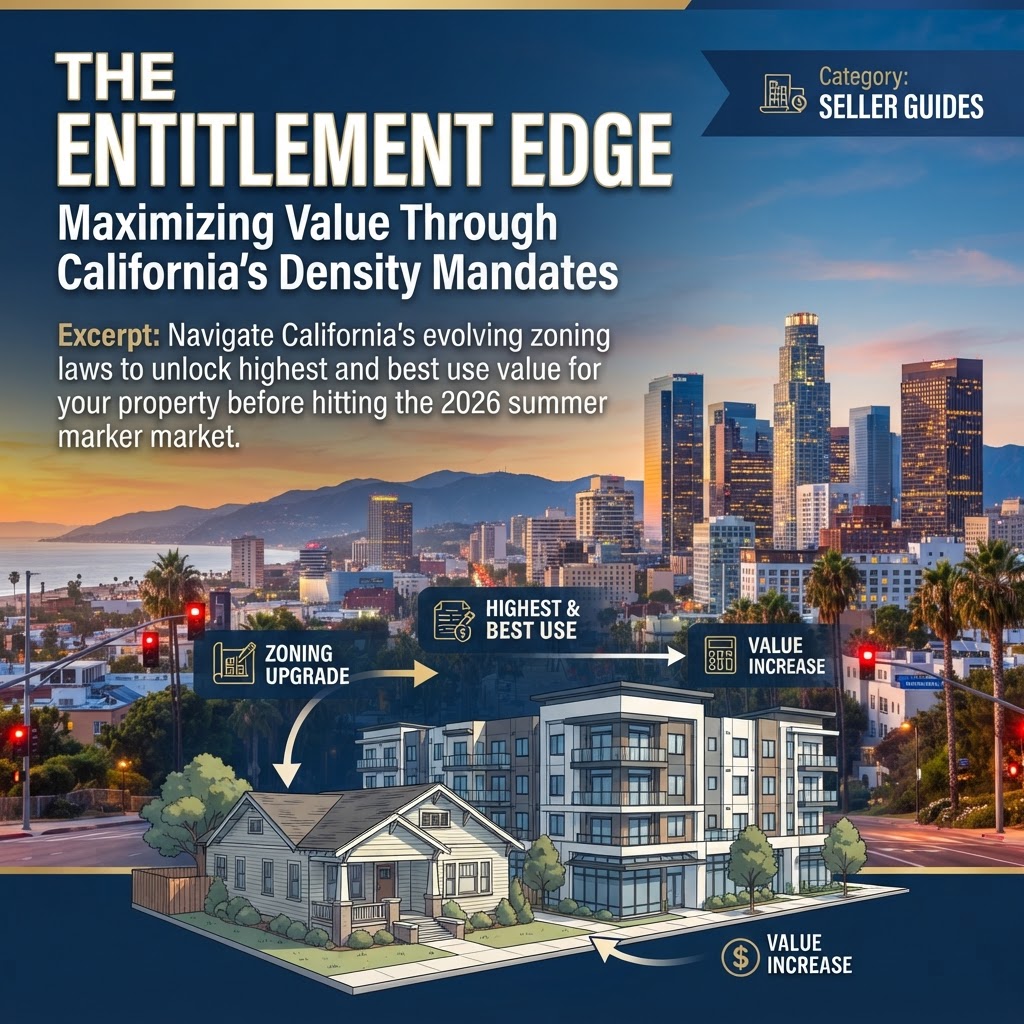
As of July 2026, the California real estate landscape has moved beyond the traditional single-family home (SFH) paradigm. Driven by legislative shifts like Senate Bill 9 and the recent 2025 updates to the Accessory Dwelling Unit (ADU) handbook from the California Department of Housing and Community Development (HCD), sellers are no longer just selling a house; they are selling a development-ready asset. To maximize value in this environment, sellers must shift their strategy from cosmetic upgrades to entitlement optimization.
The Power of 'Permit-Ready' Status
According to 2025 data from the California Association of Realtors (CAR), homes sold with pre-approved ADU plans or a completed 'Certificate of Occupancy' for secondary units commanded a 15-22% premium over comparable properties without such entitlements. In high-density coastal regions like Los Angeles and San Diego, this 'entitlement premium' is even more pronounced. Buyers in 2026 are increasingly sensitive to the 'missing middle' housing gap and are looking for properties that offer immediate rental income potential or the ability to split the lot under SB 9.
Data-Backed Valuation: The Rental Income Factor
A significant shift in 2026 is how lenders view these properties. Following the 2024 update to Fannie Mae and Freddie Mac guidelines, which allow lenders to count 75% of the projected rental income from an ADU toward a buyer's qualifying income, a seller who can prove the viability of a secondary unit significantly expands their buyer pool. Recent MLS data indicates that properties marketed with a 'pro-forma rental analysis' for their ADU potential sell 14 days faster than those marketed as standard residential lots.
Practical Preparation for 2026 Sellers
To capture this value, sellers should focus on three specific areas before listing:
- The Zoning Audit: Hire a land-use consultant to provide an official summary of the property’s development capacity. Under SB 9, many R1-zoned lots are now eligible for two primary units and two ADUs. Presenting this as a 'Highest and Best Use' report in the disclosure package can justify a higher asking price.
- Utility Transparency: One of the biggest hurdles in 2026 is utility capacity, particularly in fire-prone zones or areas with aging infrastructure. Sellers should proactively verify electrical panel capacity (at least 200 amps) and sewer lateral integrity, as these are prerequisites for adding density.
- Master-Planned ADUs: Many California municipalities, including San Jose and Sacramento, now offer 'pre-approved' ADU building plans. Identifying which pre-approved plan fits your lot can save a prospective buyer $10,000 to $20,000 in soft costs, making your property the most attractive option on the block.
Strategic Marketing: Selling the Lot, Not Just the Living Room
While staging the primary residence remains important, the 2026 seller must also 'stage' the exterior potential. This means clearing debris from the 'ADU footprint,' providing a plot map that demonstrates setback compliance (typically 4 feet in CA for ADUs), and highlighting separate access points. By shifting the narrative from a simple home sale to an investment opportunity, sellers can hedge against the volatility of the current interest rate environment and secure top-of-market offers.