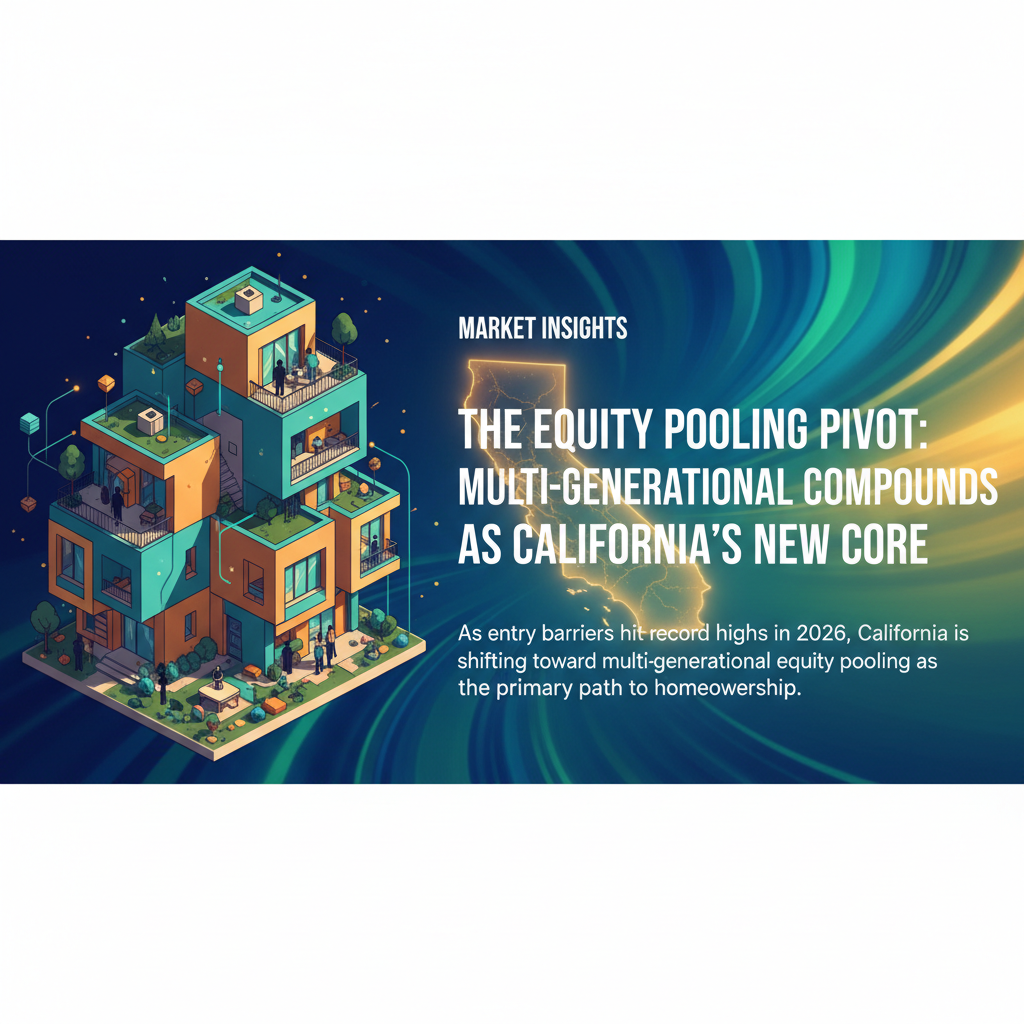
The Structural Shift Toward Intergenerational Equity
As of June 2026, the California real estate landscape has reached a definitive tipping point. With the California Association of Realtors (CAR) reporting a statewide median home price of $965,000—a 14% increase from 2024 levels—the traditional 'starter home' has largely vanished from the coastal and near-coastal markets. In its place, a new economic model has emerged: The Equity Pooling Pivot. This trend represents a fundamental shift from individual homeownership toward the acquisition and development of multi-generational family compounds.
Data from the U.S. Census Bureau and recent MLS filings indicate that nearly 32% of California residential transactions in H1 2026 involved co-borrowers from different generations, up from 18% in 2021. This isn't merely a social preference; it is a calculated response to the persistent 'higher-for-longer' interest rate environment and the erosion of purchasing power for the millennial and Gen Z workforce.
The ADU 2.0 Era: From 'Granny Flat' to Primary Asset
The legislative groundwork laid by SB 9 and subsequent ADU (Accessory Dwelling Unit) expansions has matured. In 2026, the market is no longer valuing ADUs as supplemental rental income, but as essential square footage for household stability. CBRE research suggests that properties featuring a primary residence plus both an ADU and a Junior ADU (JADU) are commanding a 22% premium over single-structure homes in markets like San Diego, Orange County, and the East Bay.
This 'compound' model allows families to pool three distinct income streams to service a single high-value mortgage. Investors are pivoting away from traditional fix-and-flips toward 'conversion-to-compound' strategies, where existing single-family lots are re-engineered into three-unit family hubs.
Economic Trends: The Wealth Transfer Acceleration
The 'Great Wealth Transfer' is no longer a future projection; it is the primary engine of the 2026 California market. As Baby Boomers downsize or enter assisted care, they are increasingly choosing to deploy equity into 'Asset Bridges.' Instead of selling the family home and moving to lower-cost states, many are using the proceeds to co-purchase larger properties with their adult children. This allows for the preservation of California-based equity while solving the housing needs of the younger generation.
According to a 2026 mid-year report by the UCLA Ziman Center for Real Estate, this internal equity migration has created a floor for prices in secondary markets like the Inland Empire and the Sacramento Valley, as families seek larger lot sizes capable of supporting multiple structures.
Practical Takeaways for 2026 Market Participants
- For Buyers: Prioritize 'Future-Proof' floor plans. Seek properties with R2 zoning or those already optimized for ADU/JADU integration. The ability to pool equity with extended family is currently the most effective hedge against 7% mortgage rates.
- For Sellers: Market the 'Compound Potential.' If your property has the setbacks and utility capacity for additional units, procure the architectural feasibility studies before listing. Buyers in 2026 are paying for the path of least resistance to multi-generational living.
- For Investors: Focus on 'Vertical Density Lite.' The highest yields are currently found in converting mid-century bungalows into three-key compounds. This strategy bypasses the volatility of the commercial sector while tapping into the desperate demand for high-quality, family-integrated residential space.
The Long-Term Perspective
The 2026 California market is defined by resilience through consolidation. While individual affordability remains a challenge, the collective purchasing power of the multi-generational household is keeping the market liquid. Real estate in the Golden State is evolving from a single-family dwelling model to a shared-equity infrastructure model—a trend that is likely to dominate the next decade of California’s economic evolution.


