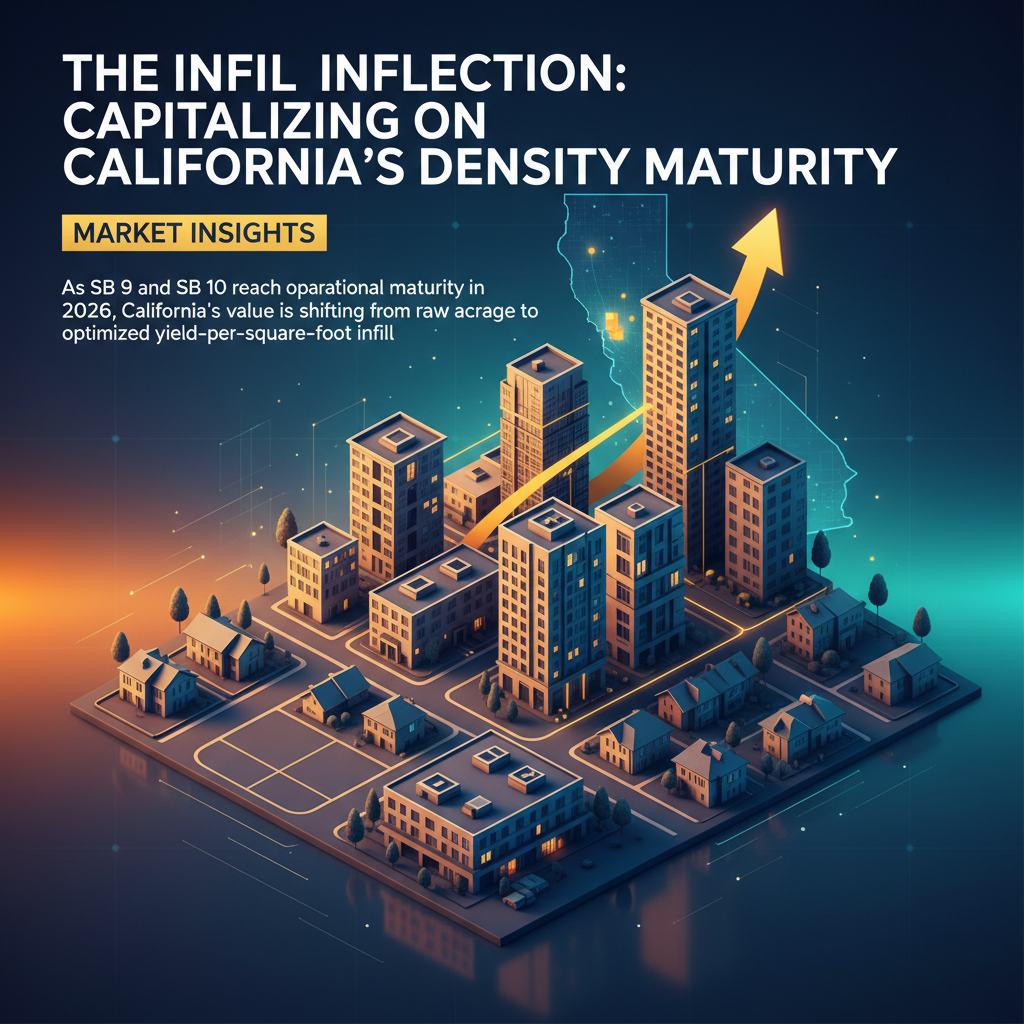
The Shift from Acreage to Optimized Density
As we pass the mid-point of 2026, the California real estate market has reached what economists are calling the "Infill Inflection." After years of legislative transition following the passage of Senate Bills 9 and 10, the friction of local permitting has finally given way to a streamlined development pipeline. According to recent data from the California Department of Housing and Community Development (HCD), 2025 saw a 22% year-over-year increase in urban lot splits, signaling a fundamental shift in how residential value is appraised. The traditional premium on the 'large backyard' is being replaced by a valuation model based on the maximum allowable yield-per-square-foot.
Data-Driven Density: The 2026 Landscape
Analysis from the California Association of Realtors (CAR) indicates that properties zoned for multi-unit transition are now trading at a 12-15% premium over traditional single-family residences in identical neighborhoods. This 'Density Delta' reflects a market that no longer views a property as a single dwelling, but as a multi-asset portfolio. For the first time since the post-WWII housing boom, the state's inventory is growing more rapidly through internal subdivision than through suburban sprawl. The 2025 Census Bureau update for California regions shows that 'Missing Middle' housing—duplexes, triplexes, and bungalow courts—now accounts for 38% of all new residential completions, up from just 14% in 2021.
Investment Perspectives: The Yield-Per-Square-Foot Pivot
For the modern California investor, the strategy has moved beyond simple appreciation. The 2026 market demands a focus on 'vertical liquidity.' High interest rates, which have stabilized at a 5.8% floor, make traditional fix-and-flip strategies less viable. Instead, institutional and savvy retail investors are targeting 'Under-Utilized Lots' (UULs). By utilizing the lot-split provisions of SB 9, an investor can effectively double their footprint without the acquisition costs of a second parcel. CBRE reports that 'subdivided equity'—the value created the moment a single lot is legally partitioned into two—is currently yielding a 24% internal rate of return (IRR) in coastal markets like San Diego and Santa Clara.
Practical Takeaways for 2026 Stakeholders
- For Sellers: Before listing a single-family home, commission a 'Density Audit.' Proving that a lot is eligible for an administrative lot split can increase the asking price by six figures, even if the work hasn't been started.
- For Buyers: Look for 'Pioneer Lots'—properties that are the largest in their immediate block. In a density-mature market, the square footage of the dirt is often more valuable than the condition of the structure.
- For Investors: Focus on 'Transit-Oriented Density.' Areas within a half-mile of major transit hubs allow for even higher density ratios under SB 10, often bypassing local parking requirements which significantly reduces construction costs.
Conclusion: The New California Norm
The California real estate market of June 2026 is defined by efficiency. The era of the 'sprawl' is being replaced by the 'infill,' as economic and legislative forces align to prioritize housing volume over lot size. As the state continues to grapple with inventory shortages, the investors and homeowners who view their property through the lens of potential density—rather than static occupancy—will be the ones to capture the next wave of California’s wealth creation.