The Evolution of Oakland’s Urban Core
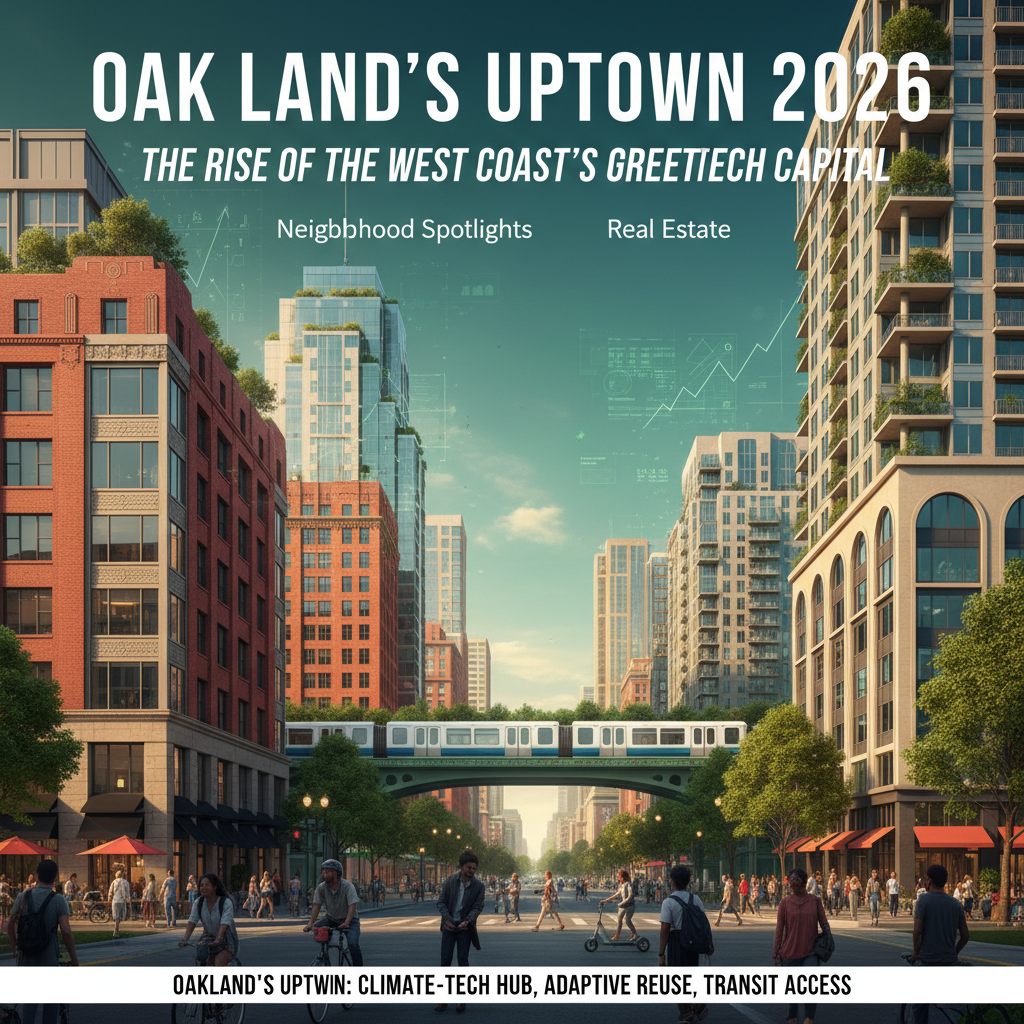
As of mid-2026, Oakland’s Uptown district has successfully pivoted from its 2010s identity as a nightlife destination into the West Coast’s primary engine for Greentech and Climate-Fintech. While San Francisco’s Mission District has consolidated the AI sector, Uptown has leveraged its industrial bones and transit connectivity to house the physical R&D required for the energy transition.
The Greentech Economic Engine
Data from the Bay Area Council Economic Institute indicates that since 2024, venture capital investment in East Bay climate-tech startups has surpassed $2.4 billion. This capital influx has transformed the Telegraph Avenue corridor. According to CBRE’s Q1 2026 report, vacancy rates for "flexible laboratory" spaces in Uptown sit at a record low of 4.2%, starkly contrasting with traditional Class A office space. This demand is driven by firms specializing in battery storage, carbon capture, and smart-grid software.
Connectivity and Transit-Oriented Development
The 19th Street BART station remains the neighborhood's pulse, connecting residents to downtown San Francisco in 12 minutes. The completion of the Broadway "Complete Streets" project in 2025 has added protected bike lanes and expanded pedestrian plazas, facilitating a car-free lifestyle. This infrastructure has supported a 15% increase in foot traffic for local retailers compared to 2023 levels.
Residential Market Trends
The residential landscape is dominated by high-density, mixed-use developments. MLS data for June 2026 shows a median sales price for condos and lofts at $915,000, reflecting a 5.8% year-over-year increase. Rental markets have stabilized due to the delivery of over 2,000 new units in the "Northgate" edge of the district. For investors, the "missing middle" housing—renovated 4-to-10 unit Edwardian buildings—offers the highest yield potential as young professionals seek character over glass-box high-rises.
Educational Anchors and Amenities
The Oakland School for the Arts (OSA) continues to serve as a cultural anchor, while the district’s proximity to UC Berkeley (just 4 miles north) ensures a steady pipeline of engineering talent. Amenities like the Hive—a social hub featuring local roasters and coworking spaces—provide the "third place" essential for the district’s collaborative ecosystem.
Practical Takeaways
- For Buyers: Focus on the "West Uptown" pocket near 27th Street, where historical lofts offer long-term value retention as the Greentech corridor expands northward.
- For Investors: Adaptive reuse projects that convert legacy retail into "wet lab" or creative R&D space are currently yielding a 200-basis-point premium over traditional residential rentals.
- For Sellers: Highlight energy-efficient upgrades; in this Greentech-centric market, LEED-certified features or EV-ready parking add a 4-7% premium to sale prices.