The Rise of the 'Super-Commute' Corridor
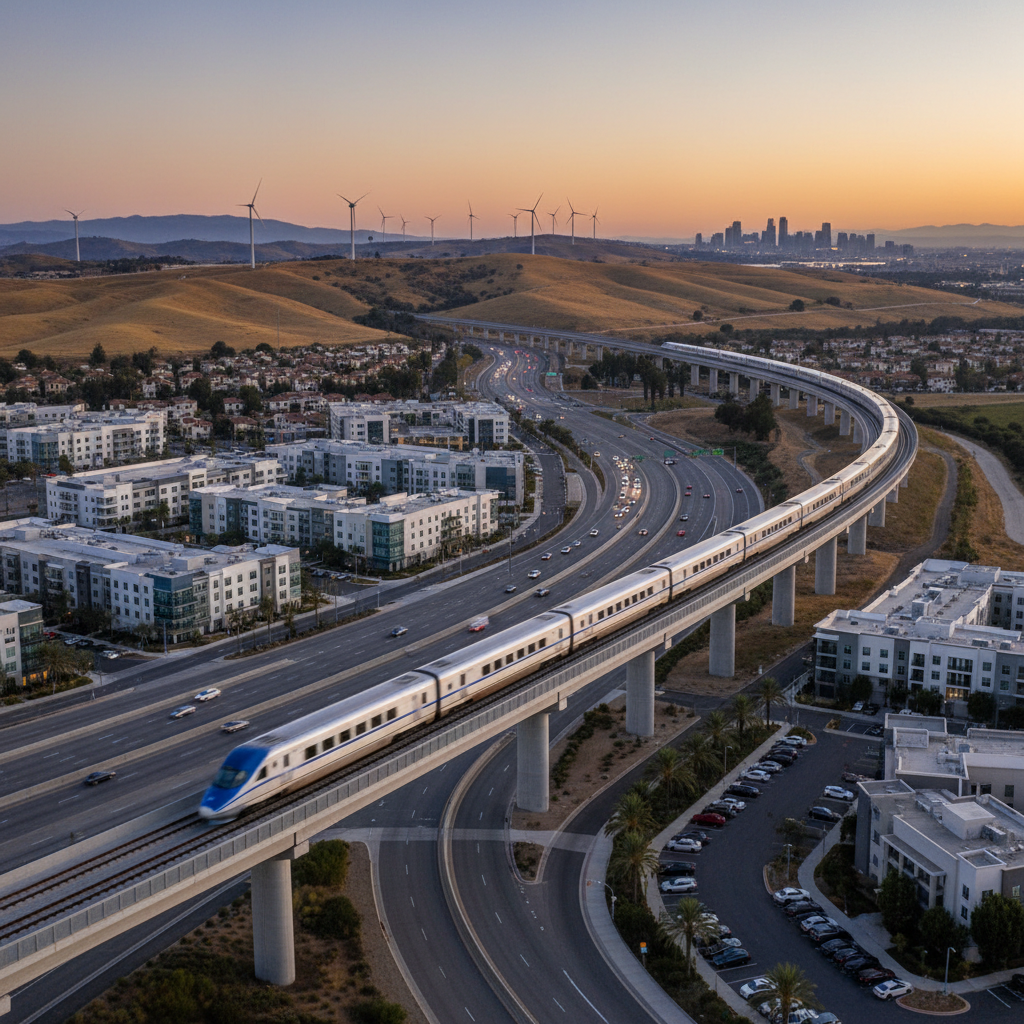
As of June 2026, a new map of California real estate value is being drawn, not by proximity to the beach, but by proximity to the rail. With the Brightline West high-speed connection between Las Vegas and Rancho Cucamonga now entering its final testing phase and the Central Valley segment of the California High-Speed Rail (HSR) showing tangible station progress, 'transit-adjacent' has become the most lucrative keyword in the California Regional MLS.
Data-Driven Speculation: The 14% Premium
According to May 2026 data from the California Association of Realtors (CAR) and supplementary CBRE transit-impact reports, residential property values within a five-mile radius of the Rancho Cucamonga, Palmdale, and Fresno station sites have appreciated by an average of 14.2% year-over-year. By comparison, the coastal markets of Santa Monica and Palo Alto have leveled off at a modest 3.1% growth rate during the same period.
This shift represents a fundamental change in how the California workforce views geography. 'We are seeing the birth of the 100-mile commute that actually feels like twenty minutes,' says Elena Rodriguez, a senior analyst at the Inland Empire Economic Partnership. 'Investors are no longer betting on tech-hub proximity; they are betting on the infrastructure that connects affordable land to those hubs.'
The 'Brightline Effect' in the Inland Empire
The Inland Empire, long considered a secondary market for Los Angeles spillover, is now a primary destination for institutional capital. In San Bernardino County, the volume of multi-family permits within transit-oriented districts (TODs) has spiked by 22% since January. The draw is clear: the ability to live in a more affordable Inland Empire home while maintaining a 'rail-linked' lifestyle to Southern California’s job centers and Nevada’s tax-friendly entertainment corridor.
Practical Takeaways for Market Participants
- For Investors: Focus on 'Last-Mile' connectivity. Properties that are not just near the station, but connected to it via micro-mobility lanes or secondary transit loops, are seeing the highest rental yield increases.
- For Sellers: If your property is within a designated Transit Priority Area (TPA), highlight the specific CEQA exemptions and density bonuses available to potential developers in your marketing materials to attract premium builder offers.
- For Buyers: The 'speculation window' is narrowing. As the first passenger runs for Brightline West are slated for late 2027, the current 2026 pricing still reflects a 'pre-operational' discount. Looking toward Palmdale and Victorville offers the highest upside before the lines go live.
Regulatory Tailwinds: The TOD Acceleration Act
Fueling this surge is the 2025 Transit-Oriented Development Acceleration Act, which streamlined the rezoning of former industrial lots near rail hubs. This has allowed for a 'podium-style' development boom in Fresno and Bakersfield, turning these Central Valley nodes into surprisingly urban, walkable environments that appeal to Gen Z buyers priced out of the coastal 'Big Four' cities.
As we move into the second half of 2026, the 'Golden State' is increasingly defined by its steel tracks. For the first time in a generation, the fastest way to build equity in California is to follow the sound of the whistle.