Navigating the Conversion Gold Rush in California’s 2026 Market
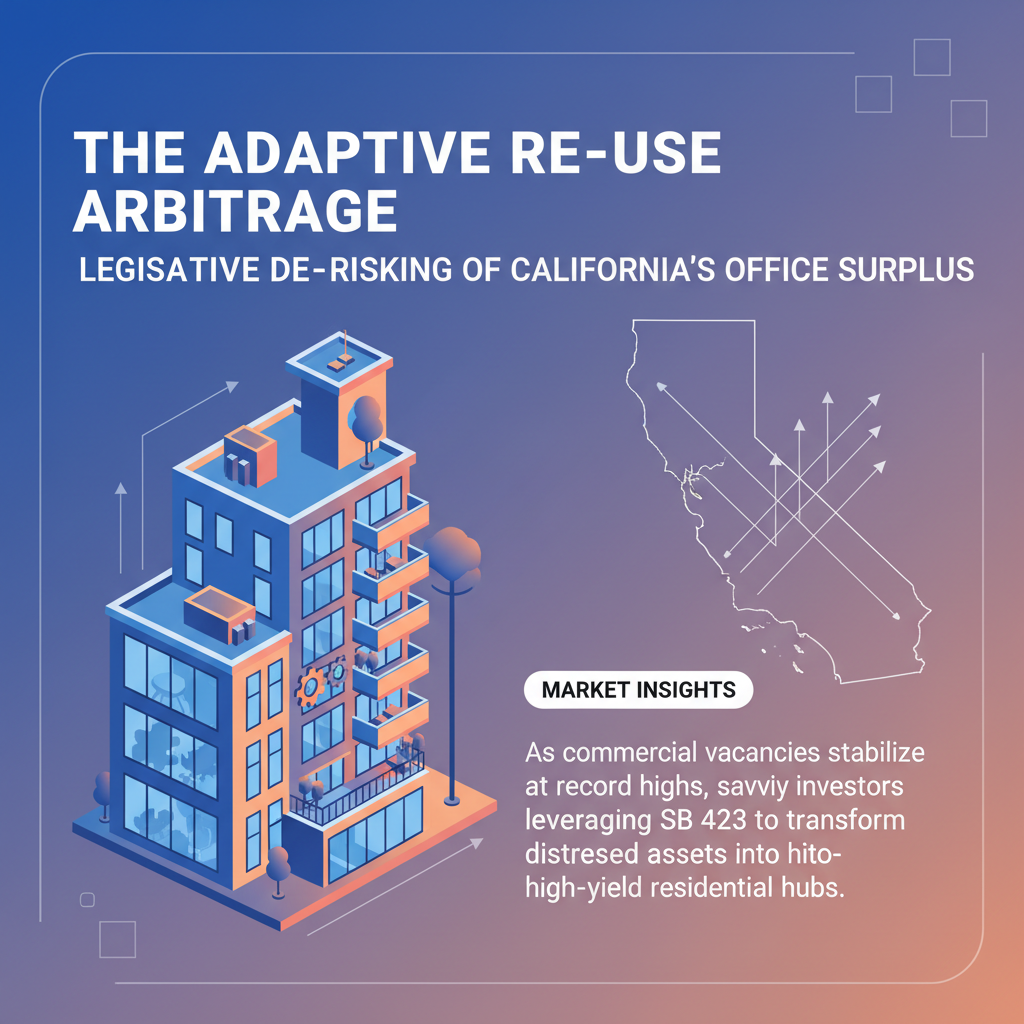
In mid-2026, the California real estate landscape is defined by a stark divergence: a persistent shortage of housing and a surplus of aging commercial real estate. While the 'Equity-Locked Squeeze' has stalled the single-family market, a new frontier of value creation has emerged. The 'Adaptive Re-Use Arbitrage' is no longer a niche architectural experiment; it is a primary investment strategy fueled by legislative tailwinds and institutional capital seeking yield in a post-office economy.
The Legislative Catalyst: SB 423 and CEQA Streamlining
The primary driver of this shift is the full implementation of Senate Bill 423, which extended and expanded the streamlined approvals originally established by SB 35. According to data from the California Department of Housing and Community Development (HCD), projects utilizing these streamlined ministerial approvals have seen a 40% reduction in pre-construction timelines compared to 2023 levels. By exempting qualifying adaptive reuse projects from certain CEQA (California Environmental Quality Act) hurdles, the state has effectively de-risked the entry point for large-scale conversions.
The Economic Shift: Conversion vs. Greenfield Development
Current 2026 construction indices suggest that the cost of converting Class B or C office space in urban cores like San Jose or Los Angeles is now 15-20% lower than greenfield development. This is largely due to the stabilization of material costs and a labor force that has specialized in the seismic and plumbing retrofits required for residential conversion. CBRE’s Q2 2026 report indicates that while San Francisco’s office vacancy remains elevated at 34%, the 'absorption delta'—the rate at which these spaces are being rezoned for residential use—has increased by 200 basis points year-over-year.
Investment Perspective: The 'Resi-Commercial' Yield
For institutional investors and REITs, the appeal lies in the stabilized yield. In the current interest rate environment, the spread between the acquisition cost of distressed commercial assets and the terminal value of luxury rental lofts is widening. Investors are focusing on 'Core-Adjacent' districts—areas directly bordering traditional business centers—where the infrastructure for 'walkable urbanism' already exists but the demand for housing remains unsatisfied.
Actionable Insights for Market Participants
- For Investors: Focus on assets with floor plate depths under 45 feet. These 'slim' commercial buildings are the most cost-effective for residential daylighting requirements and offer the highest density of units per square foot.
- For Developers: Leverage the 'Transit-Rich' density bonuses associated with SB 423. Properties within a half-mile of major rail or bus hubs now qualify for significant height and density increases that can turn a marginal conversion project into a high-alpha asset.
- For Municipalities: Cities that have proactively updated their local zoning codes to mirror state-level streamlining are seeing faster tax-base recovery as vacant office blocks are converted into vibrant, 24/7 residential enclaves.
Conclusion: A Structural Reimagining
The 2026 market proves that California’s housing crisis is being solved not just through expansion, but through reinvention. As the 'Office-to-Resi' pivot gains momentum, the successful participants will be those who view vacant commercial square footage not as a liability, but as the raw material for the state's next generation of urban housing.