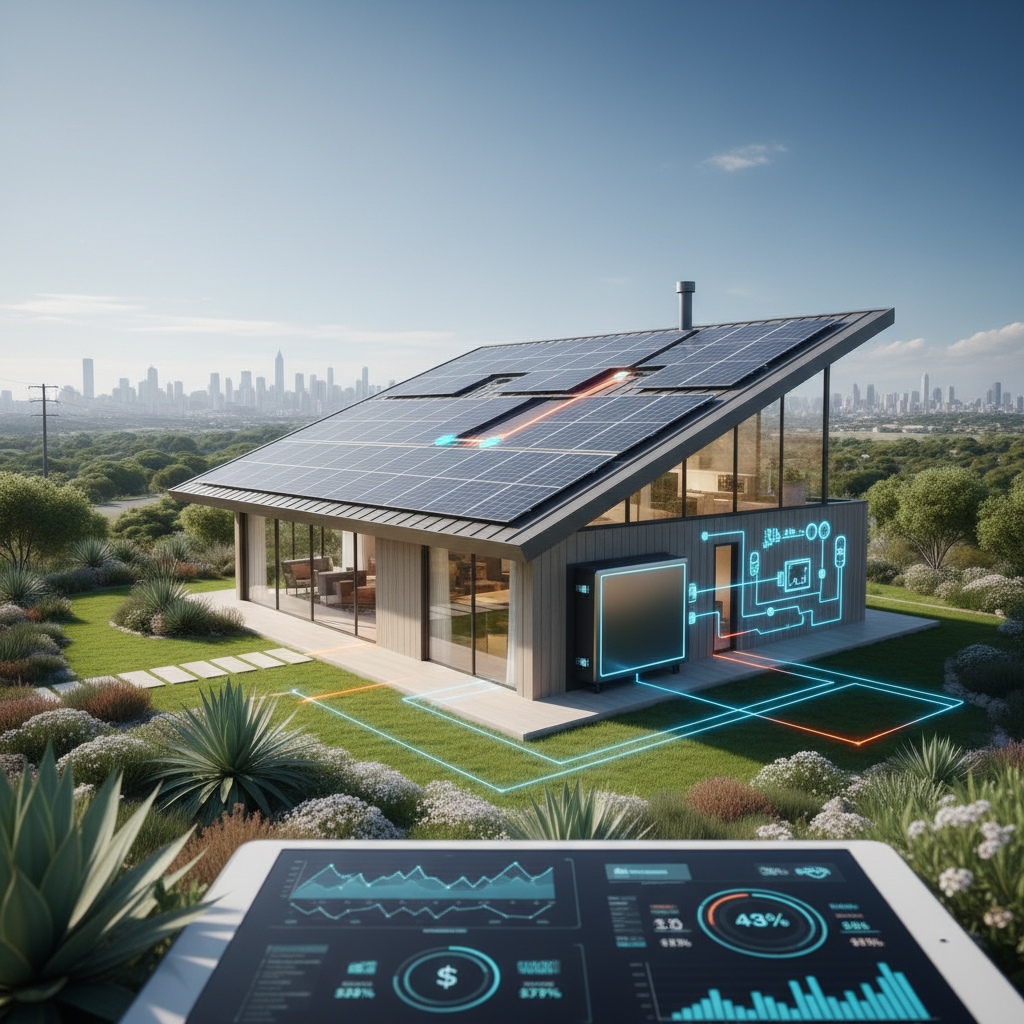
Beyond Solar: The Rise of the California Microgrid
By mid-2026, the California real estate narrative has shifted from simple square footage to kilowatt-hour security. While the previous decade focused on solar adoption as a 'green' amenity, the current market is defined by Energy Autonomy. Data from the California Public Utilities Commission (CPUC) indicates that residential electricity rates have surged by an average of 22% since 2024, driven by grid hardening costs and wildfire mitigation efforts. Consequently, a new valuation tier has emerged in the MLS: the Microgrid-Ready home.
The 7% Valuation Premium
Recent MLS data across the Inland Empire and Central Valley—regions most impacted by extreme heat and rising cooling costs—shows that homes equipped with integrated battery storage and 'islandable' solar systems (those capable of operating independently during grid outages) are selling for a 6.8% premium over non-storage-equipped peers. This significantly exceeds the historical 3-4% solar premium reported by the Lawrence Berkeley National Laboratory earlier in the decade. Buyers are no longer viewing energy systems as an environmental choice, but as a hedge against utility inflation and grid instability.
The Virtual Power Plant (VPP) Yield
For the sophisticated investor, the strategy has evolved beyond reducing monthly operating expenses. Under the 2026 regulatory framework, residential clusters participating in Virtual Power Plants (VPPs) are generating consistent passive income by discharging stored power back to the grid during peak demand windows. Institutional buyers are now underwriting multi-family acquisitions based on 'Energy Yield Potential.' In markets like San Diego and Fresno, the projected revenue from VPP participation is being factored into the capitalization rate, effectively treating the rooftop and battery array as a secondary revenue stream comparable to laundry or parking fees.
The Retrofit Hurdle and Market Bifurcation
A significant gap is widening between new builds, which have been subject to stringent solar-and-storage mandates since the 2025 code updates, and legacy inventory. CBRE analysis suggests that 'energy-obsolete' homes—those with aging, non-expandable solar systems or no storage capacity—are seeing longer days-on-market. The cost to retrofit a 2010s-era solar system to modern grid-independent standards currently averages $15,000 to $25,000, a cost that is increasingly being negotiated off the sales price of older homes.
Strategic Takeaways for Stakeholders
- For Sellers: Highlight 'Grid-Independent Duration' in listing remarks. Quantifying how many days a home can operate autonomously during a standard outage is now a more powerful marketing tool than traditional energy-efficiency ratings.
- For Buyers: Audit the inverter and battery chemistry. Older lithium-ion installations may have significant degradation; buyers should request a 'State of Health' (SOH) report for energy storage systems as part of the standard inspection contingency.
- For Investors: Focus on the 'Utility-Cost-to-Income' ratio of specific submarkets. Areas served by the most expensive investor-owned utilities are the prime targets for energy-autonomy retrofits, as the ROI on these upgrades is accelerated by the higher avoided costs of grid power.