The Rise of the 'Silicon Backbone'
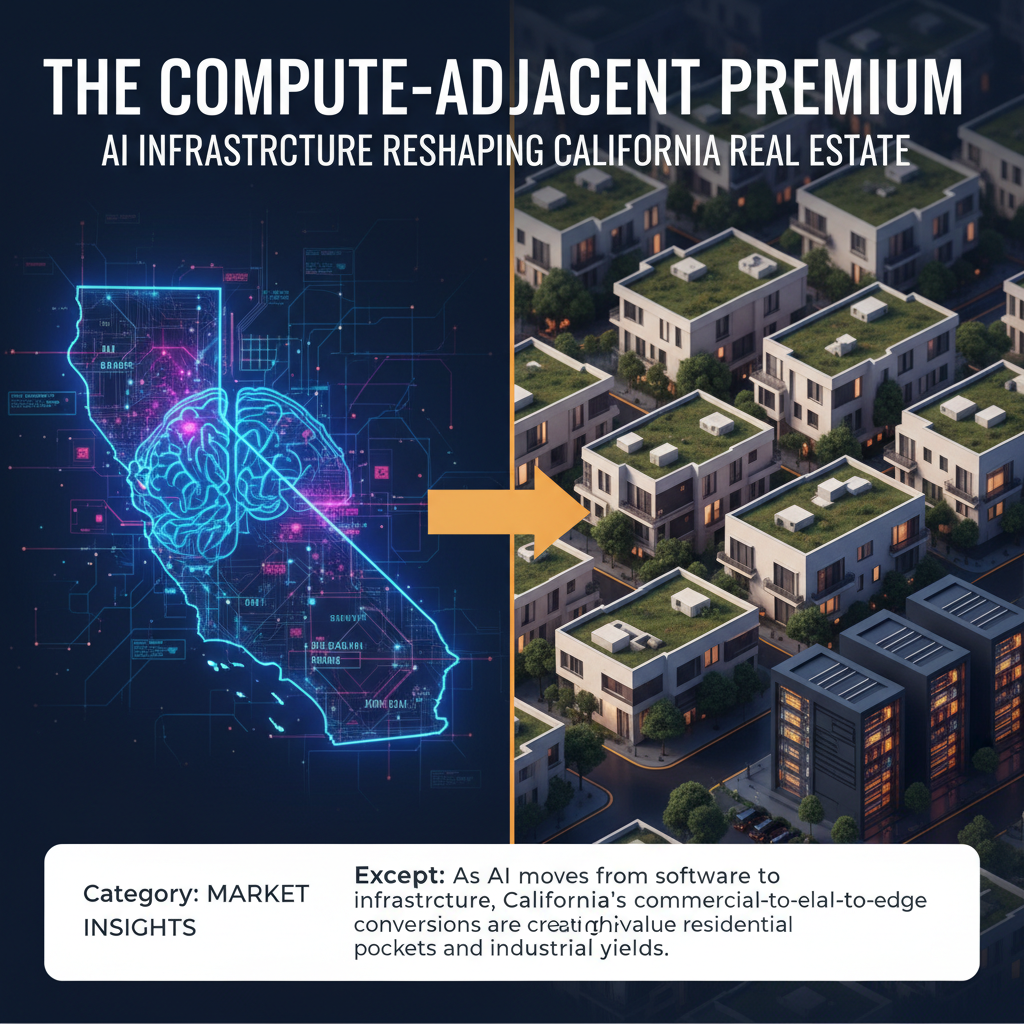
As we reach the midpoint of 2026, the California real estate narrative has shifted from the post-pandemic recovery to a specialized infrastructure boom. While the 'Remote Work' era decentralized the workforce, the 'AI Industrialization' era is re-anchoring high-value assets to physical proximity. The emergence of the 'Compute-Adjacent Premium' is now a primary driver for both commercial and residential valuations along the San Francisco-to-San Jose corridor and increasingly in the Inland Empire.
The Commercial Pivot: From Office Desks to Server Racks
According to Q1 2026 data from CBRE, vacancy rates in traditional Class B office spaces in Santa Clara and San Mateo have decoupled from the broader market. The reason? A massive wave of 'Edge-Computing' conversions. As low-latency AI applications become integral to California's logistics and autonomous sectors, the demand for localized data processing has turned underperforming office assets into high-yield industrial compute hubs.
Investment in specialized industrial real estate in California has seen a 14% year-over-year increase. Unlike the massive hyperscale data centers of the past, these 2026-era 'Micro-Hubs' are smaller, urban-integrated, and command a premium for their proximity to end-users. For investors, this represents a structural shift: the value is no longer in the floor-to-ceiling windows, but in the power-grid capacity and fiber-optic density of the building shell.
Residential Resilience in the AI Corridor
Despite high interest rates throughout 2025, residential markets in tech-adjacent zip codes have shown remarkable stability. NAR reports that in June 2026, median home prices in the 'AI Corridor'—specifically areas like Mountain View, Palo Alto, and Sunnyvale—have outperformed the state average by 9.2%. This is driven by a 'sticky' workforce of specialized engineers who require proximity to hardware labs and high-security compute sites that cannot be accessed remotely.
We are observing a concentration of wealth that is more geographically fixed than the software-only era. This has led to a 'scarcity floor' under residential pricing, where the supply of housing within a 20-minute commute of major AI infrastructure hubs remains critically low, insulating these areas from broader economic volatility.
Economic Trends: The Energy Constraints
The 2026 California market is defined by the intersection of real estate and energy. With the state’s aggressive decarbonization mandates, properties that boast independent power reliability—such as those with commercial-grade microgrids or advanced solar storage—are seeing a 'Resilience Alpha.' Data suggests that industrial properties equipped with independent power solutions are trading at a 15-18% cap-rate premium compared to those dependent solely on the aging public grid.
Practical Takeaways for Investors and Owners
- For Commercial Investors: Look for 'Power-Ready' assets. The most valuable attribute of a commercial building in 2026 is its electrical kVA capacity. Converting underutilized retail or office shells into edge-computing sites or specialized AI labs currently offers the highest ROI in the urban core.
- For Residential Sellers: Highlight infrastructure proximity. For homes in the Bay Area or Southern California tech hubs, marketing should emphasize 'Infrastructure Accessibility' rather than just 'Commute Distance.' Proximity to the growing network of specialized AI firm campuses is the new 'Walk Score.'
- For Developers: Focus on 'Energy-First' construction. To bypass the grid-connection delays currently plaguing new California builds, implementing on-site energy generation and storage is no longer an amenity—it is a requirement for liquidity in a 2026 exit.
As the AI revolution matures from code to hardware, the California real estate market is reacting with a renewed focus on the physical requirements of the digital age. Investors who prioritize power, proximity to infrastructure, and technical specifications over traditional aesthetic metrics are finding the highest growth potential in this new cycle.