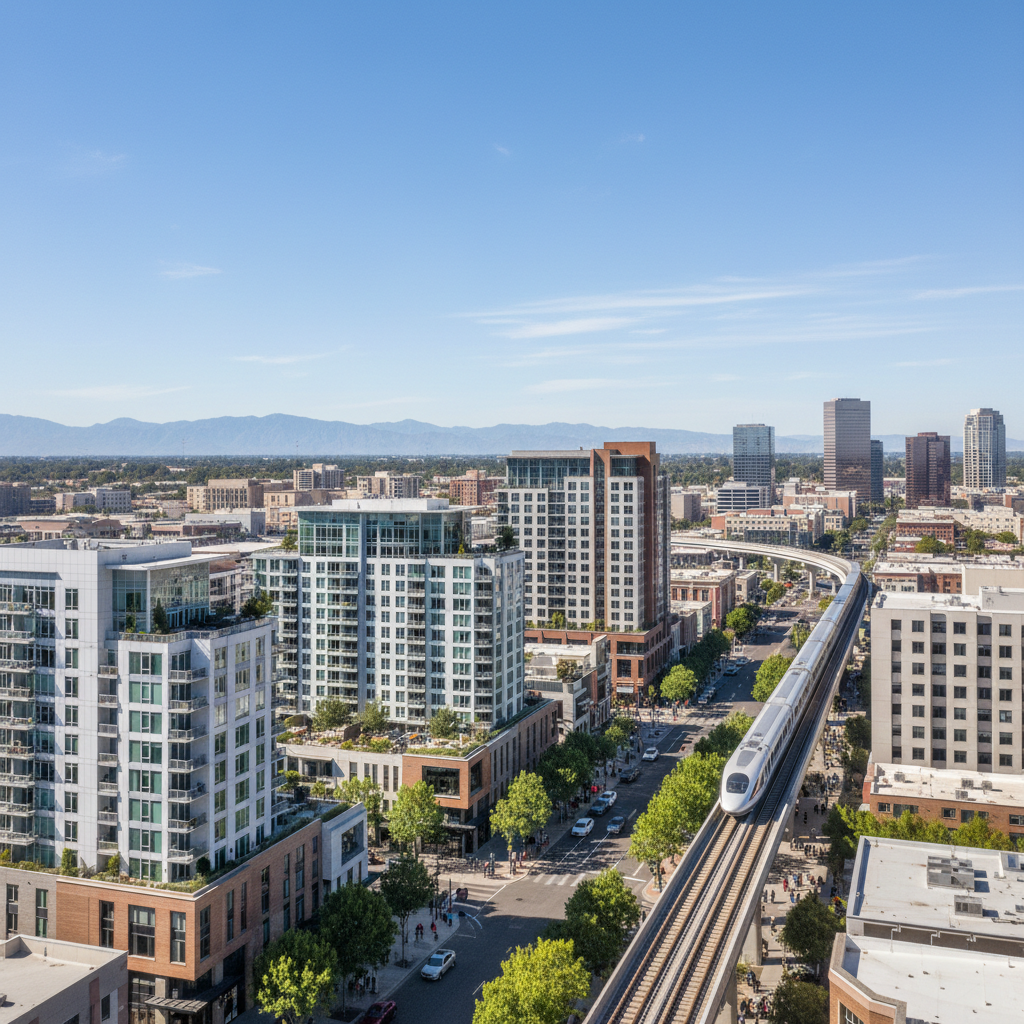
The Connectivity Premium: Infrastructure as a Growth Engine
In mid-2026, the narrative of California real estate has shifted from coastal saturation to the strategic depth of the Central Valley. At the heart of this pivot is Downtown Fresno’s Fulton District. Long considered a sleeper market, the district has been revitalized by the tangible progress of the California High-Speed Rail (CHSR). With the Fresno Station now serving as a primary node for testing and localized regional transit, the 'Connectivity Premium' is finally reflecting in property values. According to MLS data from Q2 2026, residential property values in the 93721 zip code have seen a 14.2% year-over-year increase, significantly outpacing the state average.
The 'Valley Loft' Aesthetic: Adaptive Reuse and Urban Density
The architectural landscape of the Fulton District has undergone a radical transformation. Developers have moved beyond the initial 'Fulton Mall' restoration of the late 2010s to focus on high-density adaptive reuse. Historic structures like the Helm Building and the Pacific Southwest Building are now at 98% occupancy, housing a mix of 'super-commuters' and local tech entrepreneurs. CBRE’s 2026 Regional Outlook notes that the conversion of former office and retail space into live-work lofts has increased the district's residential population by 22% since 2024. These units offer high ceilings, industrial finishes, and fiber-optic connectivity at a price-per-square-foot that is roughly 45% lower than comparable units in the San Jose or Sacramento markets.
Community Amenities and the 15-Minute Valley City
The Fulton District isn't just a bedroom community for commuters; it has developed a self-sustaining ecosystem. The Brewery District extension has integrated with the Fulton corridor, providing a walkable nightlife and dining scene that rivals San Diego’s North Park. For families, the proximity to the University High School (consistently ranked among the top in the state) and the expansion of the Fresno Unified School District’s magnet programs for arts and technology have made the area viable for more than just single professionals. Public transit has also seen a 'green' overhaul; the Fresno Area Express (FAX) now operates a dedicated electric shuttle loop connecting the Fulton District to the Community Regional Medical Center and the Tower District, achieving a true 15-minute urban core.
Market Data: Analyzing the Value Gap
Recent figures from the National Association of Realtors (NAR) highlight a significant migration trend: millennials and Gen Z buyers are moving to Fresno not just for the lower cost of living, but for the equity growth potential. In June 2026, the median home price in the Fulton District stands at $515,000—a stark contrast to the $1.4 million median in the Bay Area. However, with the rental market tightening (vacancy rates at a historic low of 2.1%), investors are seeing cap rates of 6.5%, a figure rarely seen in California’s primary coastal markets. This 'Value Gap' is narrowing as institutional capital begins to follow the public infrastructure investment.
Practical Takeaways for Buyers and Investors
- For Investors: Look for multi-family zoning opportunities within a half-mile radius of the High-Speed Rail station site. The 'HSR impact zone' is expected to see the highest appreciation as the system moves toward full operational status.
- For Homebuyers: Focus on the 'North Fulton' sector, where historical preservation grants are still available for residential restoration, providing a unique path to equity.
- For Sellers: The market is currently favoring sellers who can highlight 'work-from-home' readiness and energy-efficient upgrades, as the Central Valley’s climate-adaptive housing market gains momentum.
The Fulton District represents a new chapter for California: an era where the Central Valley is no longer a pass-through, but a destination defined by high-speed connectivity and a modern, attainable urban lifestyle.


