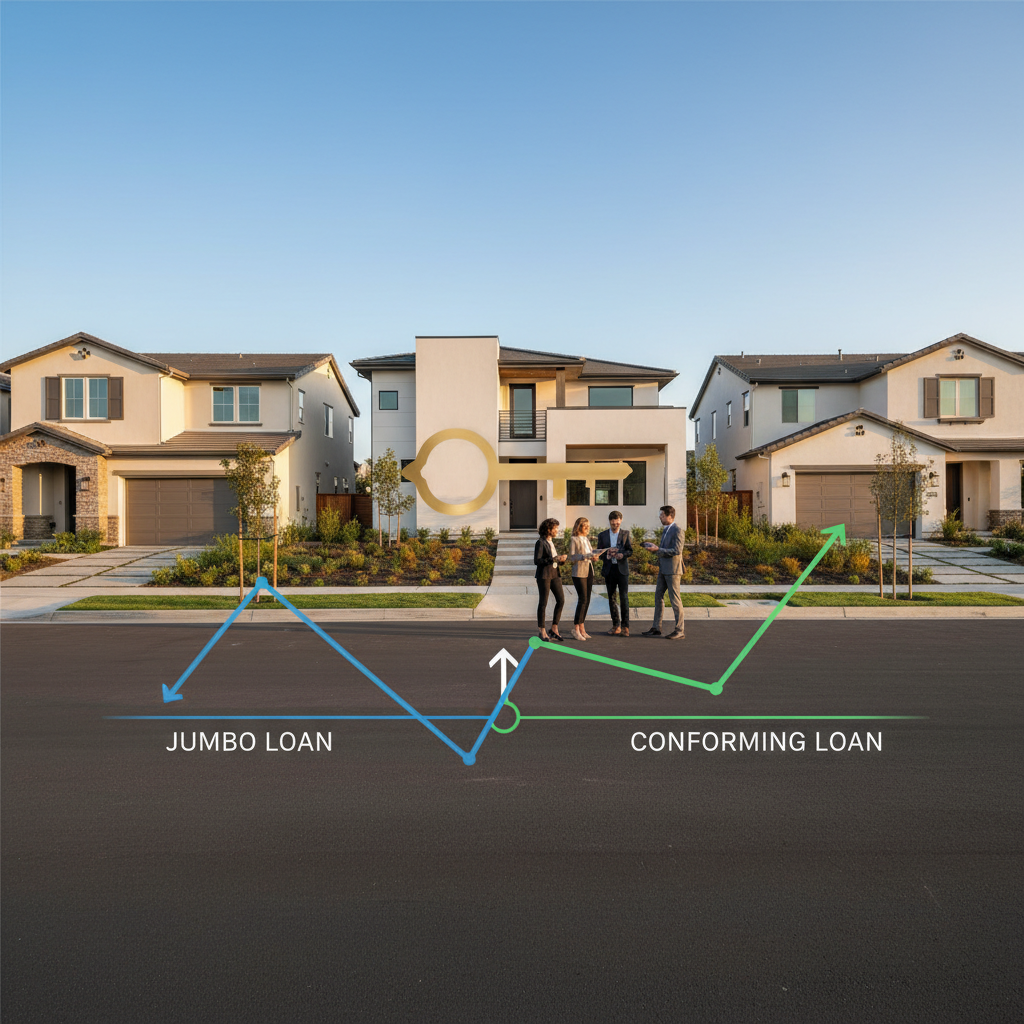
The Shift in California’s Mid-Market Financing
As of June 16, 2026, the California real estate market is witnessing a rare technical alignment in the lending space. For the first time in three quarters, the yield spread between ‘High-Balance’ conforming loans and traditional Jumbo products has compressed to within 15 basis points. This convergence is fundamentally altering the math for buyers in California’s coastal and suburban hubs, where the median home price now hovers near $915,000 according to the California Association of Realtors (C.A.R.).
Understanding the Rate Compression
Nationally, the Freddie Mac Primary Mortgage Market Survey (PMMS) shows the 30-year fixed-rate mortgage averaging 6.35%. However, in California’s high-cost counties—including Los Angeles, Orange, and Santa Clara—the 'Conforming High-Balance' limit has reached a threshold where it overlaps significantly with what was previously considered Jumbo territory. This has led to a 'Jumbo-Conforming Convergence' where the pricing advantage of conforming loans is being matched by aggressive portfolio lending from regional banks seeking to retain California's high-net-worth borrowers.
The $1.15M Sweet Spot
Data from the latest MLS reports suggests that the most competitive segment of the market is currently the $1.1M to $1.5M range. In this tier, buyers are no longer penalized for exceeding the conforming limit. Historically, Jumbo loans carried a premium of 0.5% to 1.0% over conforming rates. Today, that premium has evaporated due to increased liquidity in the secondary private label securities (PLS) market. For a buyer in San Diego or the East Bay, this means a $1.2M purchase with 20% down ($960,000 loan) now carries nearly the same interest rate as a $700,000 loan in a lower-cost state.
Key Data Points for June 2026
- California Median Price: $918,400 (Up 4.2% Year-over-Year).
- Inventory Levels: 2.8 months of supply, the highest since 2023, offering buyers slightly more leverage in negotiations.
- High-Balance Cap: The 2026 conforming limit of $1,149,825 in high-cost areas has effectively turned the 'entry-level' luxury market into a conforming-rate environment.
Strategic Takeaways for California Buyers
With the convergence of these loan types, the strategy for 2026 has shifted from avoiding Jumbo loans to optimizing them for long-term flexibility. Buyers should consider the following:
- Reserve Optimization: While rates have converged, Jumbo lenders still require higher liquid reserves (often 12-18 months of PITI). Buyers should prioritize liquidity over a larger down payment if it means securing a lower Jumbo tier rate.
- The 80/10/10 Alternative: In cases where Jumbo rates still slightly lag, the 'Piggyback' loan—a 10% second mortgage—remains a viable tool to keep the primary loan within conforming high-balance limits while avoiding Private Mortgage Insurance (PMI).
- Appraisal Buffer: With inventory rising, the 'appraisal gap' is narrowing. Buyers in the $1.5M+ range are finding more success with appraisal contingencies than they did during the 2024-2025 surge.
As we move toward the second half of 2026, the stability of this rate convergence will depend on the Federal Reserve’s stance on quantitative tightening. For now, California buyers are in a unique position where the size of the loan is no longer the primary determinant of the interest rate, providing a strategic window for those looking to upgrade within the state’s most desirable zips.


