Navigating the June 2026 Yield Curve Normalization
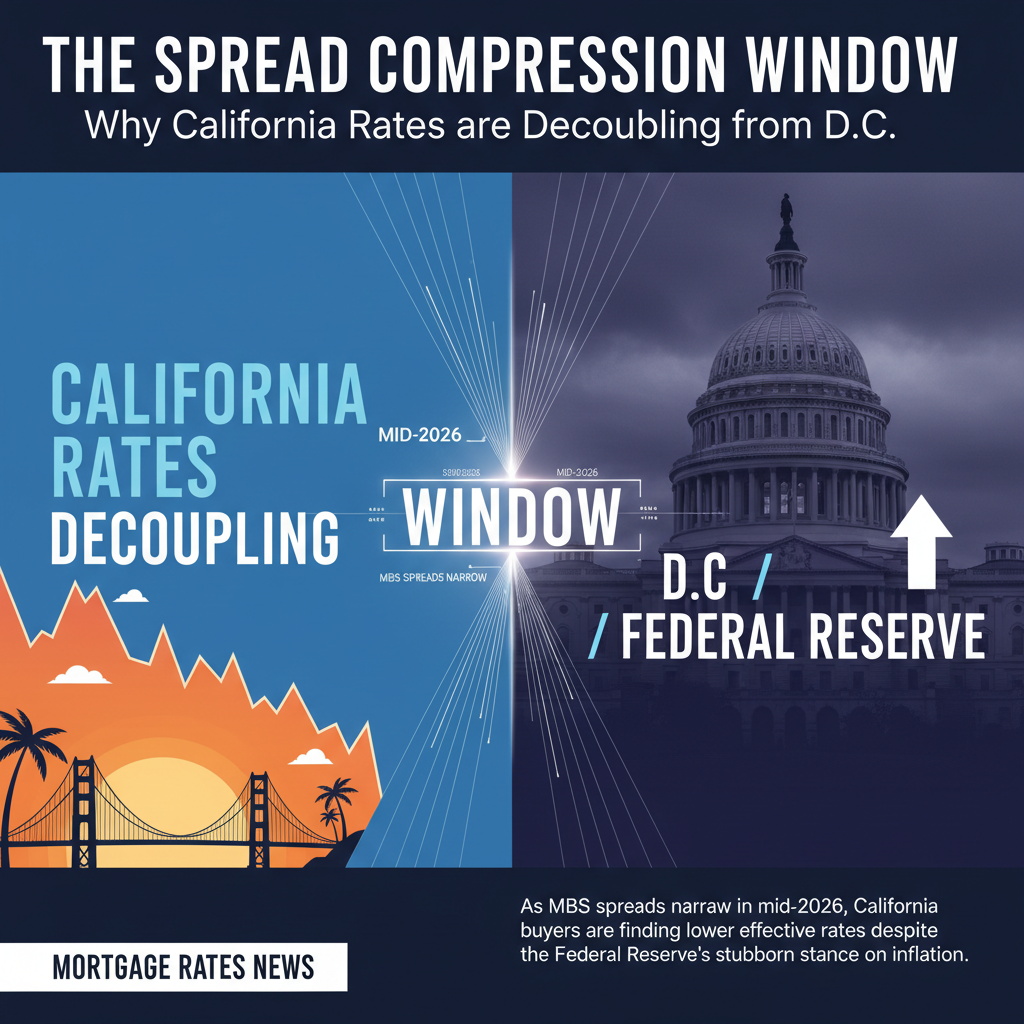
As of June 13, 2026, the California mortgage landscape is witnessing a phenomenon not seen in nearly three years: the narrowing of the 'MBS Spread.' While the Federal Reserve has maintained its benchmark rate to combat lingering services-sector inflation, the gap between the 10-Year Treasury yield and the 30-year fixed mortgage rate has compressed from 300 basis points down to approximately 210 basis points. For California buyers in high-velocity markets like San Jose and San Diego, this decoupling offers a strategic entry point.
The Data: Why Rates are Softening in the Golden State
According to recent data from the Freddie Mac Primary Mortgage Market Survey (PMMS), the national average for a 30-year fixed-rate mortgage has settled at 6.35%. However, in California’s high-balance conforming zones, lenders are aggressively pricing to maintain volume. Data from the California Association of Realtors (CAR) suggests that while inventory remains 15% below pre-pandemic norms, the stabilization of the 10-year Treasury near 4.1% has allowed secondary market investors to accept lower premiums on mortgage-backed securities.
This 'spread compression' effectively acts as a stealth rate cut. For a buyer in Orange County taking out a $1,050,000 high-balance loan, a 40-basis-point reduction in the spread translates to nearly $300 in monthly savings, significantly improving debt-to-income (DTI) ratios in a state where affordability remains a primary hurdle.
The Impact on High-Cost Counties
Lending news this week highlights a shift in how 'Coastal Premiums' are applied. Previously, California’s high-balance loans carried a significant surcharge compared to standard conforming limits. Today, due to the liquidity provided by the 2026 FHFA baseline adjustments, the 'California Discount' is returning. Private investors are favoring the equity-rich profiles of California borrowers, often pricing high-balance loans at parity with, or even slightly below, standard conforming rates.
Strategic Takeaways for June Buyers
- Monitor the 10-Year Treasury, Not the Fed: While the Federal Open Market Committee (FOMC) meetings garner headlines, the mortgage market is currently responding more to the normalization of the yield curve. Watch for the 10-year to stay below 4.25% as a signal to lock.
- Leverage Float-Down Provisions: Given the current volatility in the MBS market, buyers should prioritize lenders offering 'float-down' options. This allows a buyer to lock today’s narrower spread while retaining the ability to capture further drops before closing in July or August.
- Target 'Stagnant' June Inventory: MLS data for the first two weeks of June shows a 4% increase in price reductions across the Inland Empire and Central Valley. Combining these price cuts with the current spread compression creates a unique 'buy-box' for value-conscious investors.
Looking Ahead: The Mid-Summer Outlook
Market analysts at CBRE suggest that as the yield curve continues its path toward a traditional upward slope, the volatility that defined the early 2020s is beginning to fade. For California residents, this means the 'waiting game' for 4% rates is being replaced by a pragmatic realization: the current 6% range, when paired with narrowing spreads and rising inventory, represents the new equilibrium. The window to capture this specific compression may be short-lived as the market recalibrates for the Q3 election cycle volatility.


