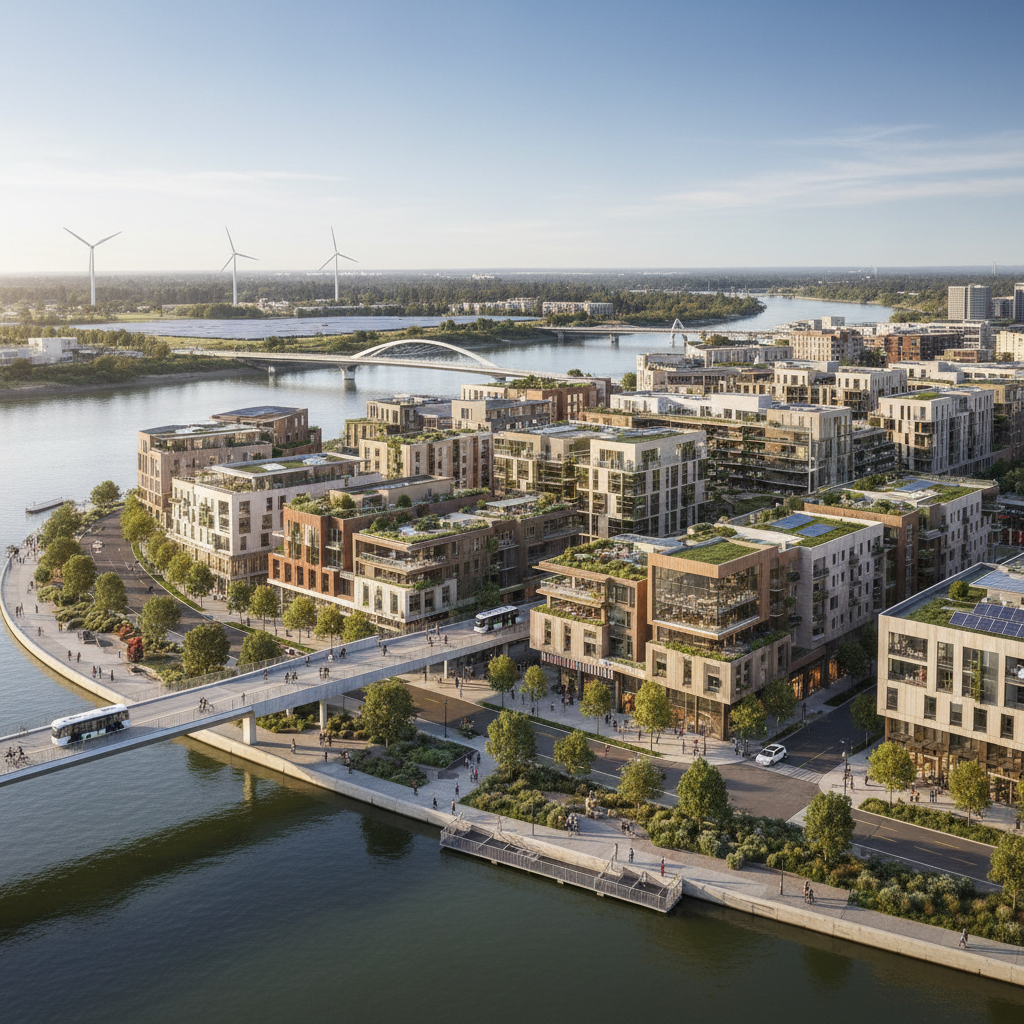
The Evolution of the Sacramento Riverfront
In mid-2026, the West Sacramento Bridge District has transitioned from a promising infill project into California’s most significant experiment in decarbonized urban living. Once a dormant industrial zone of warehouses and rice silos, this 188-acre district now serves as a high-density counterpoint to the sprawling suburbs of the Central Valley. Its success is rooted not just in aesthetics, but in a rigorous commitment to carbon-neutral infrastructure and multimodal connectivity that links it directly to the Northern California megaregion.
Infrastructure as a Catalyst: The New I Street Bridge
The 2025 completion of the new I Street Bridge has been the primary driver of property value appreciation in the district. Unlike the historic 1911 structure it replaced, the new bridge prioritizes wide bicycle lanes and pedestrian plazas, effectively merging the Bridge District with Sacramento’s downtown core. According to 2026 data from the Sacramento Area Council of Governments (SACOG), pedestrian and cyclist traffic between West Sacramento and the state capital has increased by 140% year-over-year, reducing local dependence on the I-80 corridor.
Market Resilience and Data Points
While much of the California market has faced inventory constraints, the Bridge District has maintained a steady pipeline of LEED-Platinum multi-family units. MLS data from Q1 2026 indicates a median sales price of $745,000 for luxury condos—a 12% increase since 2024, yet still offering a 45% discount compared to similar high-density products in the San Francisco Bay Area. CBRE’s latest regional report highlights a 96% occupancy rate in the district’s mixed-use developments, driven largely by 'remote-hybrid' professionals who utilize the nearby Amtrak Capitol Corridor for bi-weekly commutes to the Bay Area.
Sustainability and Community Amenities
The neighborhood’s appeal is anchored by its 'Green-Hydrogen' shuttle network, a zero-emission transit loop that connects residential hubs to the Sutter Health Park (currently seeing high demand due to its role as a temporary Major League Baseball venue) and the iconic Barn, an architectural landmark and social hub. For families, the district is served by the Washington Unified School District, which has recently integrated specialized STEM academies focusing on environmental science, leveraging the proximity of the river and the state’s ecological agencies.
Practical Takeaways for Real Estate Stakeholders
- For Buyers: Focus on units with 'Verified Green' certifications. As California’s energy mandates tighten, these properties are seeing lower utility overhead and higher resale premiums.
- For Investors: The 'Sacramento-Bay Area Blur' is accelerating. High-density rentals near the I Street Bridge entrance are yielding 5.2% cap rates, significantly outperforming the broader Sacramento metro average.
- For Sellers: Highlight the '15-minute city' aspect. In 2026, the proximity to the new Raley’s flagship grocery and the walkable access to Downtown Sacramento are the primary selling points for incoming coastal transplants.
As we navigate the mid-2020s, the Bridge District stands as a testament to how mid-sized California cities can successfully implement high-density, climate-resilient urbanism without losing the riverfront charm that defines the region.


