The Great Inland Pivot: Real Estate in the Path of Progress
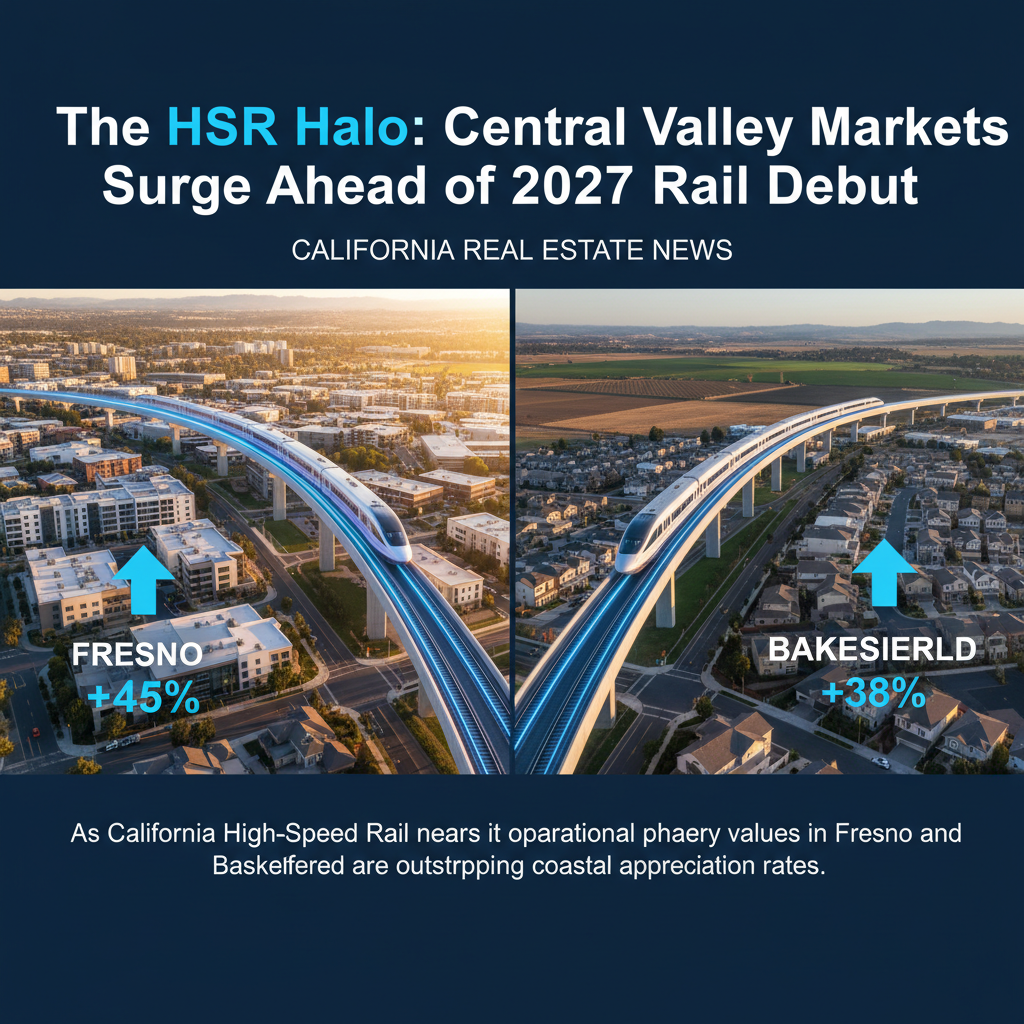
For decades, the California High-Speed Rail (HSR) was viewed as a distant, theoretical concept. However, as of June 2026, the infrastructure is no longer a localized construction project; it is a primary driver of real estate speculation. With the Merced-to-Bakersfield segment slated for its first passenger runs in 18 months, the 'HSR Halo Effect' is fundamentally altering the valuation of Central Valley residential and commercial assets.
Data-Driven Divergence: Inland vs. Coastal Growth
Data from the California Association of Realtors (CAR) for Q1 2026 reveals a striking trend. While San Francisco and Los Angeles have maintained a modest year-over-year appreciation of 2.4%, Fresno and Bakersfield have seen price surges of 11.2% and 9.8% respectively. This is not merely a search for affordability; it is a strategic move by investors and prospective 'super-commuters' betting on the connectivity of the 220-mph system.
According to the latest MLS reports, inventory in 'Station-Adjacent Zones' (within a 3-mile radius of planned HSR hubs) has dropped to a record low of 1.4 months' supply. Institutional capital, having retreated from coastal entry-level homes due to recent legislative caps, is redirected toward Central Valley multi-family developments. CBRE reports a 15% increase in transit-oriented development permits in the Merced-Kings County corridor over the last 12 months.
The 'Station-Adjacent' Premium and Zoning Shifts
Local municipalities are responding with aggressive rezoning. Fresno’s 'Core-to-Rail' initiative has already incentivized the conversion of aging industrial warehouses into mixed-use lofts. These units are being marketed at a 20% premium over traditional garden-style apartments in the suburbs. Buyers are increasingly valuing 'walkability-to-platform' as a top-tier amenity, anticipating a future where a commute from Fresno to a tech hub in San Jose takes under an hour.
Strategic Takeaways for Stakeholders
- For Investors: Focus on 'Secondary Hub' markets like Hanford and Madera. While Fresno is seeing the most volume, these smaller stops offer lower entry points with high potential for rental yield as the workforce decentralizes.
- For Homeowners: Those in the Central Valley should consider 'ADU-plus' strategies. With the anticipated influx of weekly commuters, short-term and mid-term rental demand for station-proximate housing is expected to peak in 2027.
- For Buyers: Look for 'Infrastructure Lag' opportunities. Areas where rail-adjacent road improvements are still in progress often trade at a discount compared to fully beautified station districts.
As the first train sets arrive for testing this fall, the window for 'early-adopter' pricing in the Central Valley is closing. The narrative of California real estate is shifting from coastal density to inland connectivity, proving that in 2026, speed is the ultimate amenity.