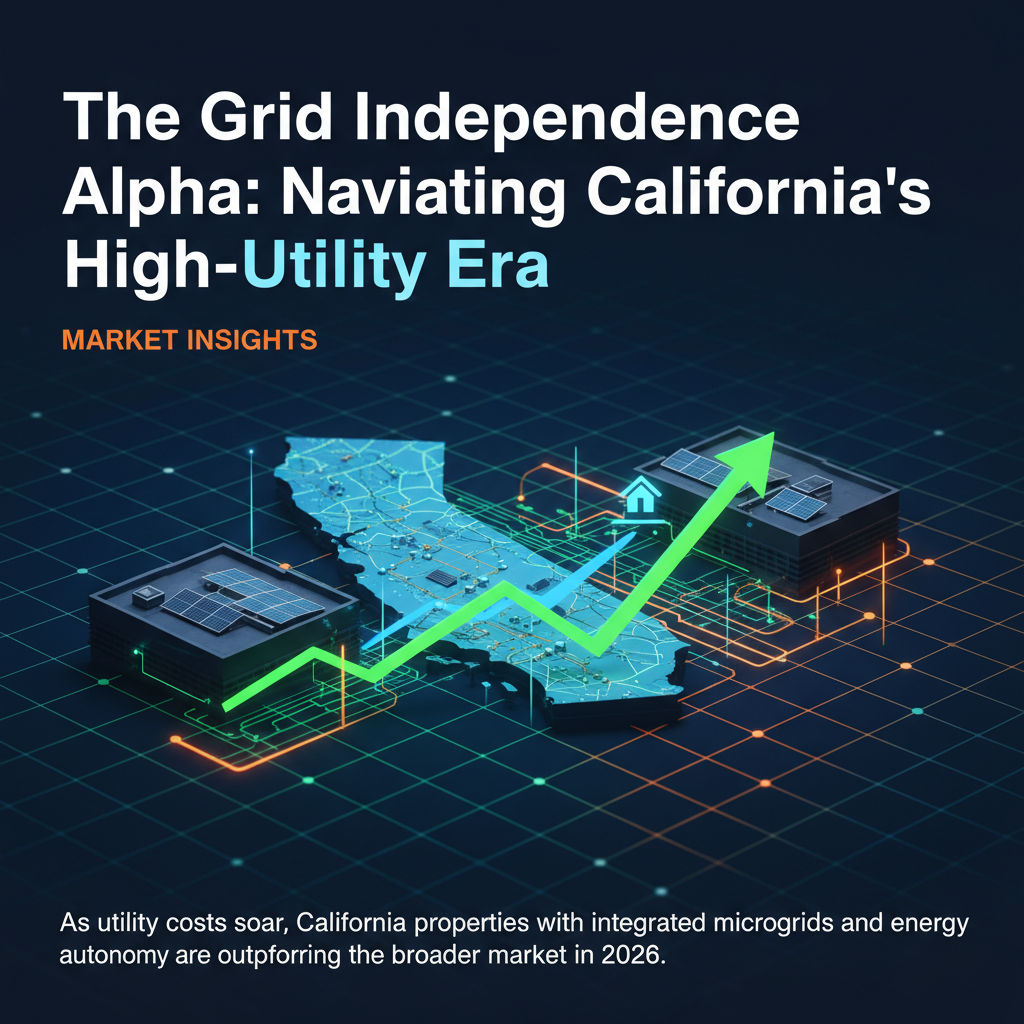
The Convergence of Costs and Climate
As of June 2026, California’s real estate landscape is being reshaped by a factor once considered a secondary utility concern: the cost and reliability of the electrical grid. While inventory levels have begun to normalize after the 'Great Recirculation' of early 2026, a new valuation divide has emerged. Properties equipped with sophisticated energy autonomy—specifically integrated microgrids and high-capacity battery storage—are commanding a distinct 'Grid Independence Alpha.'
According to recent data from the California Public Utilities Commission (CPUC), residential electricity rates have climbed an average of 22% over the last 24 months. For the high-end coastal markets and the heat-sensitive Inland Empire, this has shifted the buyer’s focus from mere aesthetics to the Total Cost of Ownership (TCO). Properties that can insulate owners from escalating Tier 2 and Tier 3 pricing structures are no longer just 'green'—they are essential hedges against inflation.
The Valuation Spread: Data-Backed Resilience
Market analysis from the first half of 2026 indicates a widening gap in 'Days on Market' (DOM) for energy-independent homes. NAR-affiliated MLS data for the California region shows that homes featuring 'Net Zero' certifications or private microgrid capabilities sell 14 days faster than comparable grid-dependent properties. Furthermore, these assets are securing a 7% to 9% premium in price-per-square-foot.
This isn't merely a residential phenomenon. In the commercial sector, particularly for industrial and cold-storage assets, the premium is even more pronounced. CBRE’s Q2 2026 report highlights that logistics hubs with onsite solar-plus-storage arrays are achieving 12% higher lease renewals. Tenants are increasingly willing to pay higher base rents in exchange for the long-term predictability of 'behind-the-meter' energy costs, effectively treating energy security as a core business insurance policy.
The Microgrid Mandate for Investors
For the 2026 investor, the play has shifted from basic solar installation to integrated energy management systems (EMS). The current 'Alpha' is found in properties that utilize AI-driven storage to arbitrage peak-load pricing. In regions like the Santa Clara Valley and Orange County, the ability to sell power back to the grid during peak demand windows is now being factored into the capitalization (Cap) rate of multi-family developments.
We are also seeing the rise of 'Energy-as-a-Service' (EaaS) in the California market. Institutional buyers are retrofitting older 1980s-era apartment complexes with decentralized energy systems, not just to reduce common area expenses, but to create a new revenue stream by billing tenants for locally generated, lower-cost power. This strategy is proving to be a significant yield driver in a market where traditional rent growth has slowed to 3.5% annually.
Practical Takeaways for 2026
- For Sellers: Prioritize 'Energy Audits' in your marketing materials. Highlighting a property’s annual energy savings compared to the local utility average is now as critical as a kitchen renovation in justifying a premium asking price.
- For Buyers: Calculate the 10-year TCO. A property that is $50,000 more expensive but features a robust microgrid may have a lower monthly carry than a cheaper, grid-tethered alternative, especially given the CPUC’s projected rate hikes through 2028.
- For Investors: Look for 'Energy Arbitrage' opportunities. Properties with aging electrical infrastructure in high-rate zones offer the highest potential for value-add. Retrofitting these assets with localized storage provides a double win: tax credits under current state programs and enhanced NOI through operational efficiency.
In the California of 2026, the home is no longer just a shelter; it is a power plant. As the state continues its aggressive transition toward a decentralized energy future, the real estate market is rewarding those who recognize that energy autonomy is the ultimate luxury—and the smartest investment.