The Evolution of the Telegraph Corridor
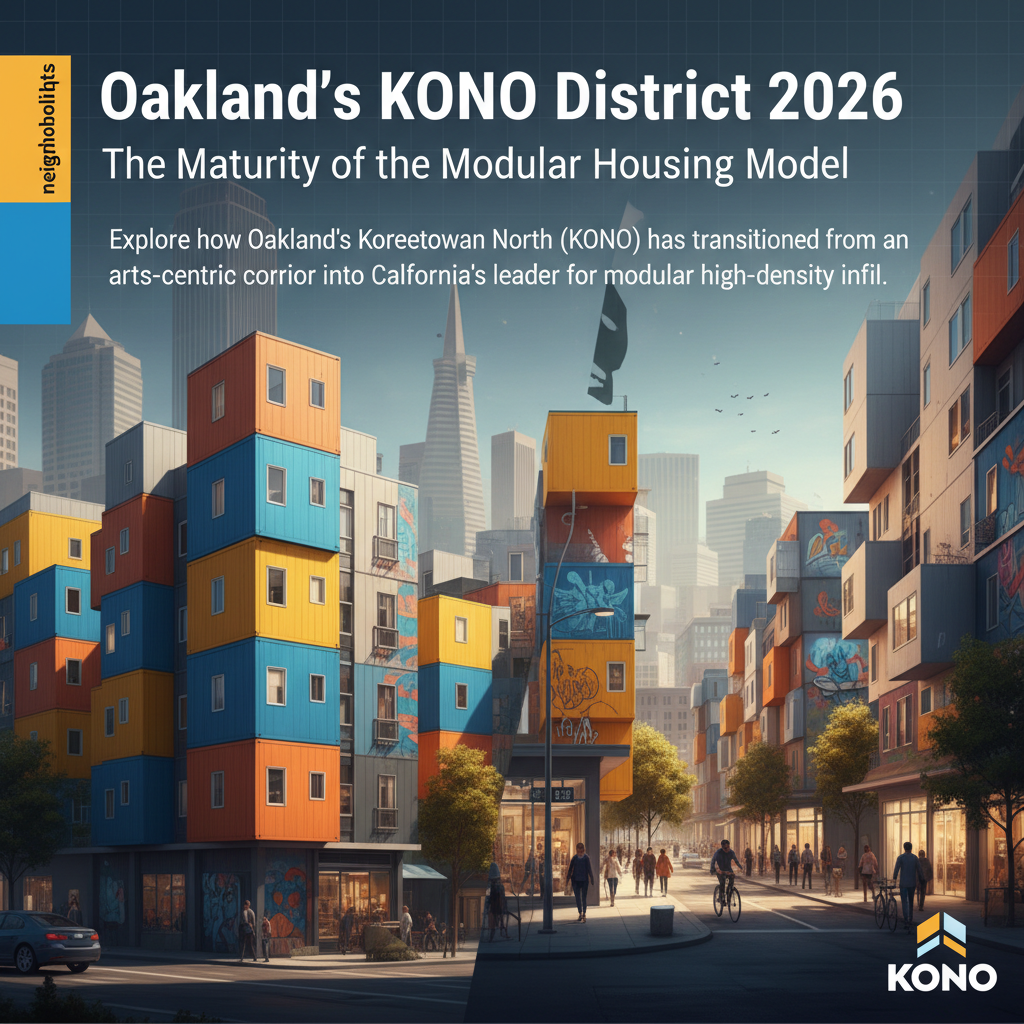
As of mid-2026, the Koreatown North (KONO) district in Oakland has moved past its reputation as a transitional arts corridor to become a primary case study in the efficacy of modular construction and cultural preservation. Extending along Telegraph Avenue from 20th to 35th Streets, KONO has successfully integrated over 2,500 new residential units since 2022, primarily through high-density infill projects. Unlike other Bay Area submarkets that struggled with post-pandemic vacancies, KONO’s unique blend of legacy commercial storefronts and new-age residential stacks has created a resilient 24-hour ecosystem.
Data: Pricing Power and Inventory Dynamics
Market data from the first quarter of 2026 indicates a stabilizing trend for KONO’s real estate. According to Bay Area MLS data, the median price for a two-bedroom condominium in KONO now sits at $845,000, representing a 4.2% year-over-year increase—outpacing the broader Alameda County average of 2.8%. Rental inventory remains tight, with vacancy rates hovering at 4.5%, bolstered by the neighborhood's popularity among workforce professionals who commute to San Francisco and the burgeoning biotech hubs in West Berkeley.
The Modular Advantage: Addressing the Supply Gap
The defining feature of KONO’s 2026 landscape is its reliance on modular housing. Developers in this district pioneered the use of off-site construction to bypass the labor shortages and rising costs that stalled projects elsewhere in California. This efficiency has allowed for a 'missing middle' pricing tier that remains rare in the San Francisco metro area. Furthermore, the Oakland 2045 General Plan Update has designated this corridor as a 'high-resource' zone, facilitating streamlined approvals for transit-oriented developments (TOD) that feature zero-parking requirements, reflecting a shift toward car-free urban living.
Connectivity and the 10-Minute Urban Core
Transportation infrastructure is a significant driver of KONO’s appeal. The neighborhood is anchored by the 19th Street BART station, which underwent a major renovation in 2025 to increase capacity. The AC Transit Tempo (Bus Rapid Transit) provides dedicated lanes along Telegraph Avenue, connecting residents to Uptown and Downtown Oakland in under five minutes. For families, the presence of the Oakland School for the Arts (OSA)—a premier public charter institution—continues to act as a localized magnet for residential demand, keeping turnover rates notably lower than in adjacent industrial-conversion districts.
Strategic Takeaways for Investors and Residents
For those looking to engage with the KONO market in 2026, several tactical opportunities exist:
- For Investors: Focus on 'retail-wrap' residential buildings. The neighborhood’s High-Street retail demand remains robust, with Telegraph Avenue storefronts seeing 12% higher foot traffic than the city average due to the First Fridays arts festival legacy.
- For Buyers: Look for units in LEED-Platinum certified modular builds. These properties are seeing higher appraisal values due to lower long-term utility overhead and superior seismic performance.
- For Sellers: The premium in 2026 is on 'flex-space' floor plans. With 35% of the local workforce utilizing hybrid models, units with dedicated home-office alcoves are selling 15% faster than traditional open-plan studios.
Ultimately, KONO’s success lies in its refusal to gentrify into a bland corporate corridor. By leveraging the Koreatown North Community Benefit District (CBD), the neighborhood has ensured that as high-density towers rise, the legacy businesses and the 'Oakland First' aesthetic remain the primary draw for a new generation of urbanites.