The Retail-to-Residential Revolution Hits its Peak
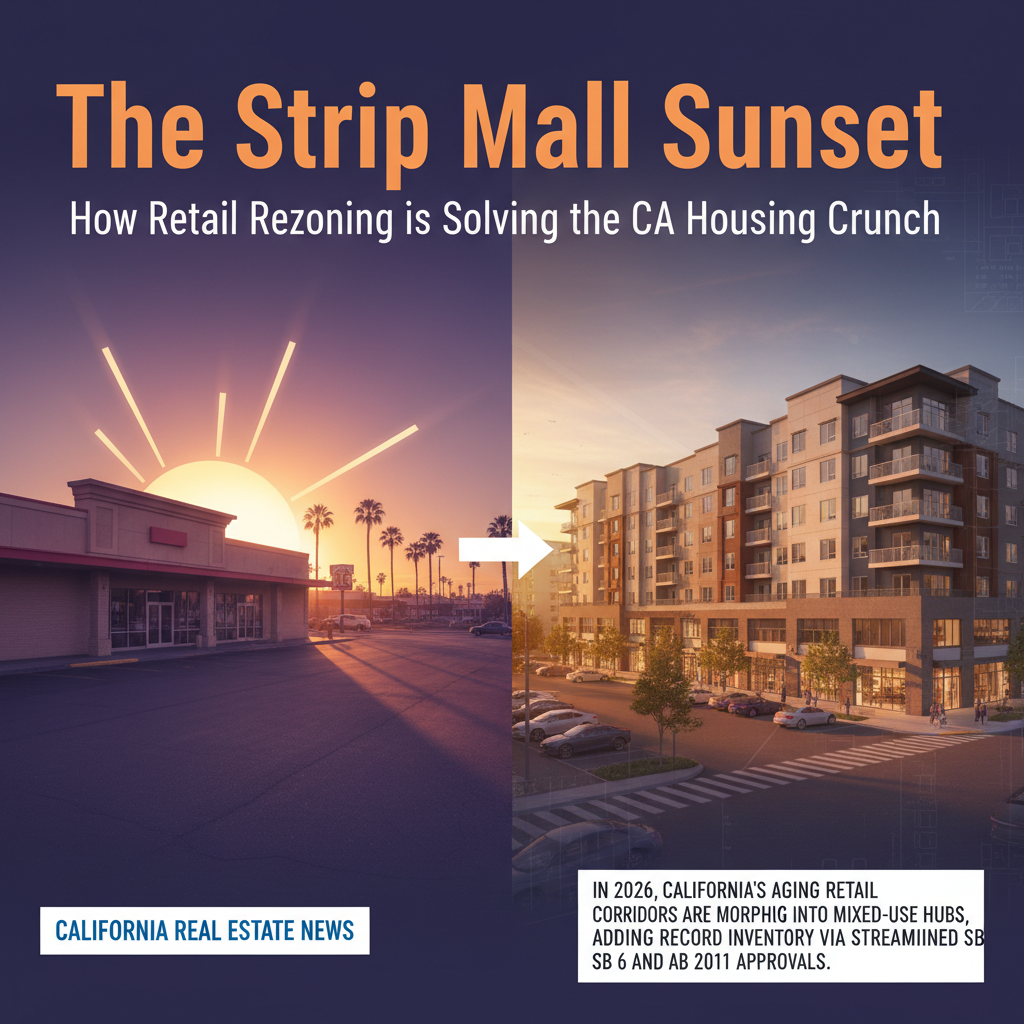
As of June 4, 2026, the California real estate landscape is witnessing a structural transformation that few predicted a decade ago. While high-rise office conversions have dominated headlines, the real inventory surge is happening at the street level. Under the mature frameworks of Senate Bill 6 (SB 6) and Assembly Bill 2011 (AB 2011), derelict strip malls and underutilized parking lots are being reborn as high-density, mixed-income housing at a pace that is finally moving the needle on statewide supply.
Data-Driven Shift: From Vacancy to Occupancy
According to the latest Q2 2026 report from the California Association of Realtors (CAR) and CoStar, retail vacancy across Southern California and the Bay Area has reached a ten-year high of 14.2%, driven by the continued consolidation of e-commerce. However, residential permit applications for these same zones have spiked by 210% year-over-year. The California Department of Housing and Community Development (HCD) reports that over 52,000 units are currently under construction on land previously zoned exclusively for commercial retail.
This 'Retail-to-Residential' pipeline is particularly potent because it bypasses the traditional CEQA (California Environmental Quality Act) hurdles that often stall coastal developments. By meeting specific affordability and labor standards, developers are utilizing 'by-right' approvals to transform aging shopping centers into 4-to-6 story residential complexes with ground-floor essential services.
Regional Hotspots and Market Movements
In Orange County and the Inland Empire, where land is at a premium, these conversions are providing the 'missing middle' housing that has been absent for a generation. In San Jose, the redevelopment of three major regional malls into 'urban villages' is projected to add 8,500 units by the end of the year. This shift is also exerting downward pressure on rents in adjacent suburban neighborhoods, as the influx of new supply competes with older, less efficient housing stock.
Strategic Takeaways for Stakeholders
For those looking to navigate this shifting market, the 2026 landscape offers several distinct opportunities:
- For Investors: Look to 'Class C' retail corridors in transit-rich areas. The ability to rezone these parcels under SB 6 allows for a significant valuation uplift without the multi-year entitlement risks of the past.
- For Homebuyers: These new mixed-use developments are offering 'attainable luxury.' Often priced 10-15% below traditional single-family homes in the same ZIP code, these units provide modern amenities and walkability that older suburbs lack.
- For Sellers: If you own property adjacent to a declining retail center, your land value may have shifted from residential-only to 'high-density transitional.' Professional appraisals should now account for the potential of neighboring redevelopments.
The era of the sprawling, empty parking lot is ending. In its place, California is building a more compact, integrated version of the suburban dream, proving that the solution to the housing crisis was hidden in plain sight along our commercial boulevards.