The Suburban Pivot: Orange County’s Urban Experiment
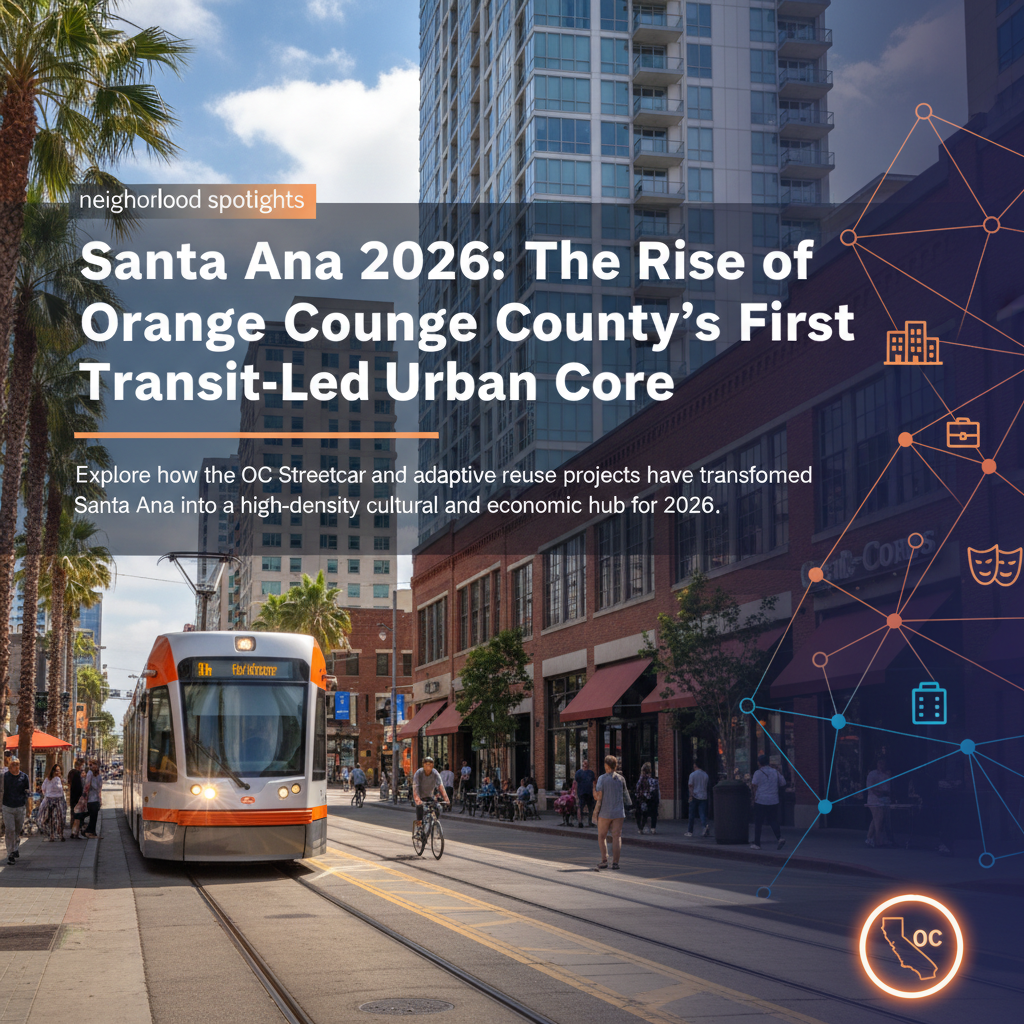
For decades, Orange County was defined by sprawling cul-de-sacs and master-planned car dependency. However, as of May 2026, Downtown Santa Ana (DTSA) has officially shattered that mold. Following the successful first full year of the OC Streetcar operations, the neighborhood has transitioned from a historic enclave into the county’s most significant transit-oriented development (TOD) success story. By blending high-density residential infill with a fiercely protected cultural identity, DTSA offers a blueprint for how mid-sized California cities can densify without losing their soul.
Infrastructure as a Catalyst: The OC Streetcar Effect
The 4.1-mile OC Streetcar, which connects the Santa Ana Regional Transportation Center (SARTC) to Garden Grove, has fundamentally altered local property values. According to 2026 MLS data, residential units within a half-mile of the streetcar line have seen a 12% premium in valuation compared to the broader Santa Ana market. This transit link provides a seamless connection to Metrolink and Amtrak, making DTSA a viable residence for professionals commuting to both Irvine and Downtown Los Angeles.
The Creative Economy and Amenities
At the heart of the neighborhood's appeal is the 4th Street Market and the Artists’ Village. Unlike the homogenized shopping centers found elsewhere in the county, DTSA thrives on adaptive reuse. The 2026 commercial landscape is dominated by micro-retail and 'maker spaces' housed in 1920s-era brick buildings. Key amenities include:
- The Artists’ Village: A four-block radius of galleries, studios, and the Orange County Center for Contemporary Art (OCCCA).
- Culinary Hubs: 4th Street Market continues to serve as a high-tech food hall incubator, launching over 15 local concepts into brick-and-mortar locations since 2024.
- Public Spaces: The reimagined French Park provides essential green space for the influx of new loft dwellers.
Educational Anchors and Demographic Shifts
The neighborhood is supported by the Santa Ana Unified School District, which has seen significant investment in specialized academies. The Santa Ana High School for the Arts has become a major draw for families prioritizing creative education. Furthermore, the proximity to Santa Ana College—specifically its Digital Media and Law pathways—has created a steady pipeline of young professionals looking for 'walkable urbanism' that was previously unavailable in the 714 area code.
Real Estate Data and Investor Outlook
Current 2026 market data from the California Association of Realtors (CAR) indicates that the median sales price for an adaptive reuse loft in DTSA stands at $785,000, while new-construction luxury apartments are commanding rents of $3,400 for a one-bedroom. Investor interest has shifted from purely residential to mixed-use 'flex' spaces, as vacancy rates for ground-floor retail have dropped to a record low of 4.2% following the streetcar’s completion.
Practical Takeaways
- For Buyers: Focus on the 'North of 4th' corridor. These historic homes and modern lofts offer the best balance of appreciation potential and proximity to the new transit stops.
- For Investors: Look toward adaptive reuse opportunities in the 'East End.' The city’s 2025 zoning updates have streamlined the conversion of underutilized office space into live-work units.
- For Residents: Leverage the 'OC Streetcar' pass, which in 2026 is fully integrated with the regional TAP system, allowing for car-free weekends to the Anaheim Packing District and beyond.