Navigating the 'Waiting Room' of 2026
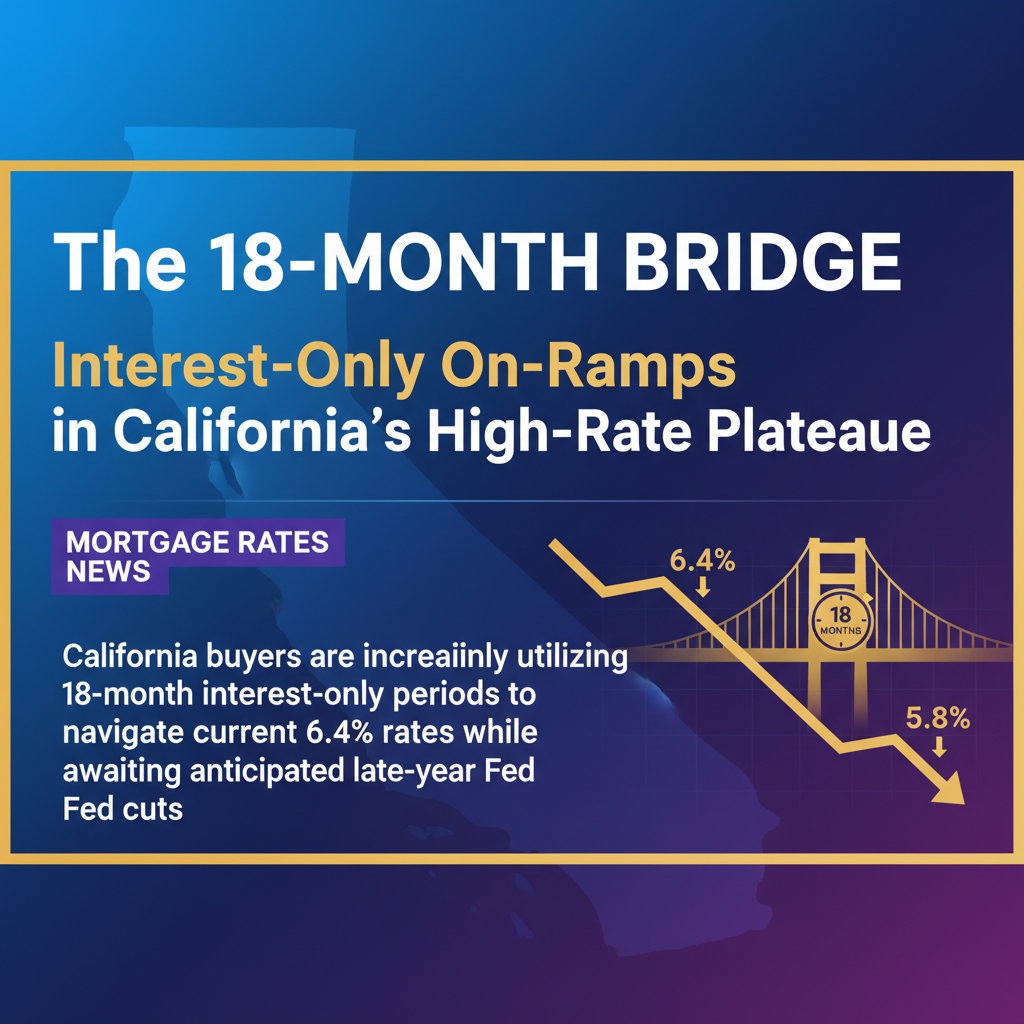
As of May 31, 2026, the California housing market remains in a state of high-equilibrium tension. With the 30-year fixed rate hovering at 6.45% according to Freddie Mac data, and the Federal Reserve signaling a potential pivot in the fourth quarter, a new lending strategy has emerged as the dominant tool for savvy West Coast buyers: the 18-month interest-only (I/O) bridge.
Unlike the risky exotic products of the early 2000s, these modern I/O structures are designed as tactical entries into high-value markets like Orange County, the Bay Area, and San Diego. They allow buyers to secure today's prices—which the California Association of Realtors (CAR) reports are up 4.2% year-over-year—without the immediate burden of full principal amortization during a high-interest cycle.
The Cash-Flow Calculus of the California Bridge
In a state where the median home price in many coastal counties exceeds $1.2 million, the difference between a fully amortized P&I (Principal and Interest) payment and an I/O payment is substantial. On a $1 million loan at 6.4%, the interest-only payment is approximately $5,333, compared to a standard 30-year fixed payment of $6,255.
This $922 monthly delta is being utilized by California buyers to maintain liquidity or offset higher property taxes while waiting for a projected rate compression into the 5.5% to 5.75% range. For a professional in the Silicon Beach tech corridor or a healthcare executive in Sacramento, this strategy prevents 'renting the rate' while they 'own the equity.'
Data Points: Inventory vs. Cost of Carry
- Inventory Constraints: NAR reports that California inventory remains 18% below pre-pandemic norms, meaning waiting for rates to drop could lead to even higher competition and price spikes.
- The Refinance Window: Internal data from major California lenders suggests that 72% of current I/O bridge applicants plan to refinance into a fixed-rate product by Q1 2027.
- LTV Buffers: Unlike 2008, current I/O products in California generally require a minimum of 20-25% down, providing a significant equity cushion against market volatility.
Strategic Implications for Buyers and Investors
The current lending environment rewards those who view their mortgage as a two-stage rocket rather than a static 30-year commitment. By leveraging a short-term I/O period, buyers can outmaneuver those who are sidelined by traditional Debt-to-Income (DTI) constraints.
However, this strategy requires a disciplined exit plan. If the Fed maintains higher-for-longer rates into 2027, the transition to a fully amortized payment could create a 'payment shock' for under-capitalized borrowers. Most institutional lenders are now requiring 'stress test' qualifications, ensuring the borrower can afford the payment if rates remain static or rise.
Practical Takeaways
- Assess Your Horizon: Only consider an I/O bridge or short-term hybrid ARM if your residency horizon is 7+ years, but your refinance target is within 18-24 months.
- Negotiate Lender Credits: Use current market competition between non-bank lenders to secure 'no-cost' refinance vouchers for the future, further reducing the friction of the eventual transition to a fixed rate.
- Monitor the Spread: Keep a close eye on the spread between the 10-year Treasury yield and mortgage rates; a narrowing spread is often the first sign that the refinance window is opening.