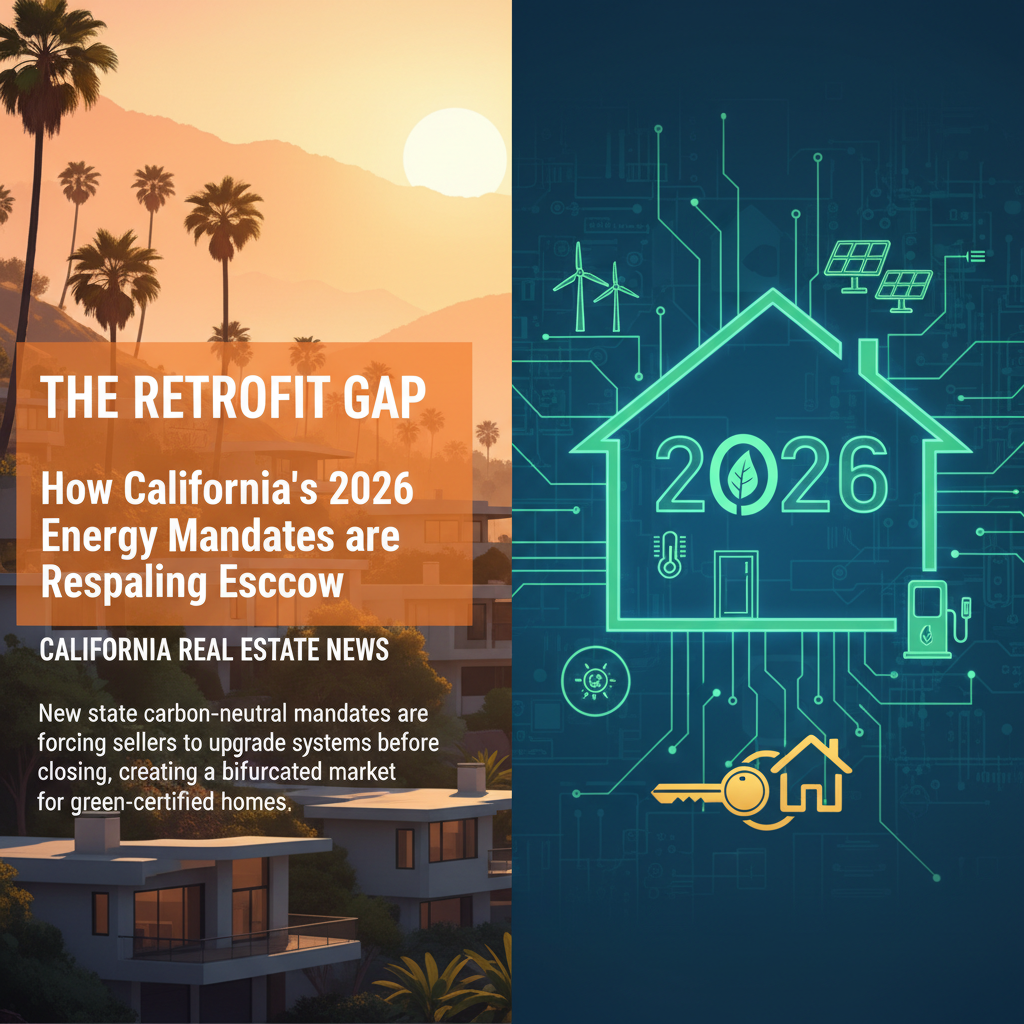
The Emergence of the 'Carbon-Compliant' Listing
As of May 2026, the California real estate landscape has been hit by the full implementation of the Building Decarbonization Act of 2023. This legislation, which reached its final enforcement phase earlier this year, requires that any residential property built before 2010 must meet specific energy-efficiency benchmarks or undergo HVAC electrification upon the transfer of title. The result is a widening 'Retrofit Gap' that is fundamentally altering how homes are priced and sold across the Golden State.
The Data: Divergent Paths for Sellers
According to the latest May data from the California Association of Realtors (C.A.R.), homes that enter the market with pre-certified 'Clean Heat' designations are selling on average 12 days faster than non-compliant counterparts. Furthermore, the MLS data indicates a 4.8% price premium for homes already equipped with high-efficiency heat pump systems and induction cooktops. Conversely, 'Legacy' homes—those still relying on gas-fired infrastructure—are seeing an average price reduction of $15,000 to $25,000 as buyers factor in the cost of mandatory post-close upgrades.
The Escrow Bottleneck
For many sellers, the new regulations have turned escrow into a logistical marathon. The California Energy Commission (CEC) reports a 30% surge in demand for certified energy auditors, leading to delays in the closing process. In high-demand markets like San Jose and San Diego, some sales have been derailed entirely when pre-sale inspections revealed that outdated electrical panels could not support the required heat pump systems without a significant utility-side upgrade, often costing upwards of $10,000.
Practical Takeaways for Market Participants
For Sellers:
- Commission a Pre-Listing Audit: Do not wait for the buyer's inspection. Hiring a CEC-certified auditor before listing allows you to price the home accurately or complete the upgrades on your own timeline.
- Leverage State Rebates: Utilize the 'Bright California' tax credits available for 2026, which can offset up to 40% of the cost of electrification if completed while the property is still primary-occupied.
For Buyers:
- Audit the Panel: When touring older CA homes, the electrical panel capacity is now as critical as the roof's age. An undersized panel (less than 200 amps) is a major liability under current mandates.
- Negotiate the 'Green Credit': Use the mandatory compliance costs as a direct negotiation lever. Many sellers would rather offer a credit than manage a construction project during a move.
For Investors:
- The 'Green Flip' Strategy: Value-add investors are pivotally targeting non-compliant properties. By streamlining the electrification process across multiple units, investors can capture the 5% 'green premium' with professional-scale efficiency.
A Permanent Shift in Value
While some industry veterans initially viewed the 2026 mandates as a temporary hurdle, the market has clearly priced in carbon compliance as a permanent metric of home value. As California moves toward its goal of a carbon-neutral housing stock by 2045, the real estate market is no longer just about location and square footage—it is about the efficiency of the systems behind the walls.


