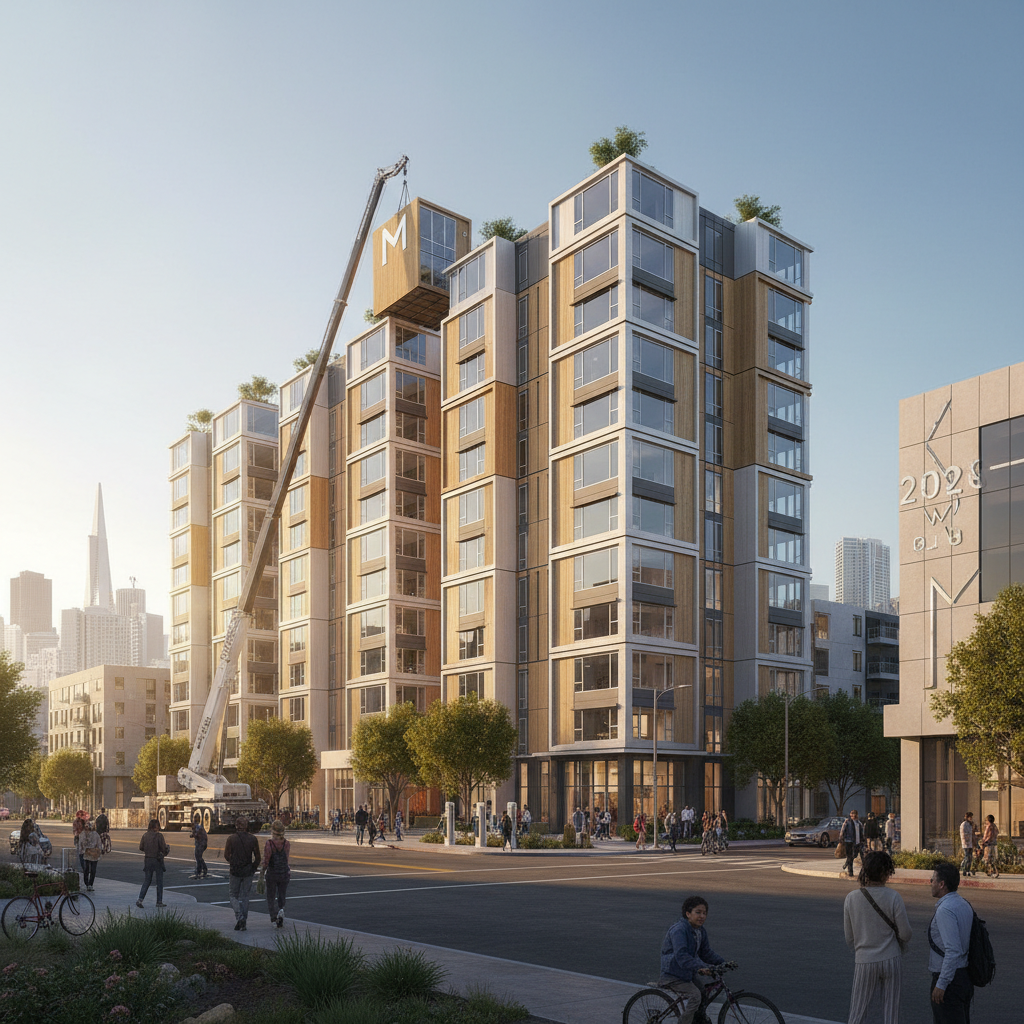
The Speed-to-Market Premium: Modular Multi-Family as California’s 2026 Alpha
As we reach the midpoint of 2026, the California real estate landscape has moved past the 'inventory shock' of previous years into a phase defined by a desperate need for scalable delivery. With the average cost of traditional stick-built construction in urban centers like Los Angeles and the Bay Area now exceeding $550 per square foot, the investment community has hit a hard ceiling. The result? A decisive pivot toward modular multi-family development as the primary vehicle for achieving risk-adjusted returns in a high-cost environment.
The Unit-Cost Disruption
Data from the California Department of Housing and Community Development (HCD) indicates that while material costs have stabilized since the volatility of 2024, the skilled labor shortage has worsened. In Q1 2026, the average lead time for a standard 50-unit stick-built apartment complex in California stretched to 28 months. In contrast, modular projects—where up to 80% of the build occurs in a controlled factory setting—are reaching certificate of occupancy in as little as 14 months.
For institutional investors, this 50% reduction in development timelines is not just a convenience; it is a critical hedge against interest rate risk. By slashing the 'carry period,' developers are realizing a 15-18% improvement in internal rate of return (IRR), even when accounting for the higher upfront logistics costs of transporting prefabricated modules.
Legislative Tailwinds and Zoning Autonomy
The 2026 market is also benefiting from the maturity of Senate Bill 423 and Assembly Bill 2011, which streamlined approvals for affordable and mixed-income housing. These laws have effectively stripped local municipalities of the ability to stall projects that meet objective zoning standards. When combined with modular efficiency, developers are finding 'alpha' in under-utilized commercial corridors. According to recent MLS and CoStar data, mid-market developers are increasingly targeting 'dead-retail' sites for modular conversion, taking advantage of existing parking infrastructure to further reduce costs.
Strategic Investment Perspectives
The current economic trend shows a bifurcation in the rental market. While luxury 'Class A' builds are seeing plateauing rents, the 'missing middle' housing—aimed at households earning 80% to 120% of the Area Median Income (AMI)—remains chronically undersupplied. Modular construction is uniquely suited for this segment, allowing for standardized, repeatable designs that lower architectural overhead. CBRE’s 2026 Outlook highlights that modular-built multi-family assets in 'Inland Empire West' and 'Sacramento North' are currently yielding 120 basis points higher than traditional builds due to lower entry costs and faster stabilization.
Practical Takeaways for 2026 Stakeholders
- For Developers: Prioritize 'Design-for-Manufacturing' (DfM) from the site acquisition phase. Retrofitting a traditional design for modular assembly later in the process often negates the cost savings.
- For Investors: Focus on 'Time-to-Stabilization' as your primary metric. In a 2026 environment where refinancing windows are narrow, getting a property to 90% occupancy a year ahead of the competition is the ultimate safety net.
- For Sellers: Land parcels with pre-approved entitlements for modular-compatible footprints are commanding a 10-15% premium over unentitled land, as buyers look for 'shovel-ready' opportunities to deploy capital quickly.
The 2026 California market rewards speed. As the gap between housing demand and labor supply continues to widen, modular construction has transitioned from a niche architectural experiment to the essential blueprint for California’s next cycle of growth.


