The Emergence of the Climate-Risk Premium
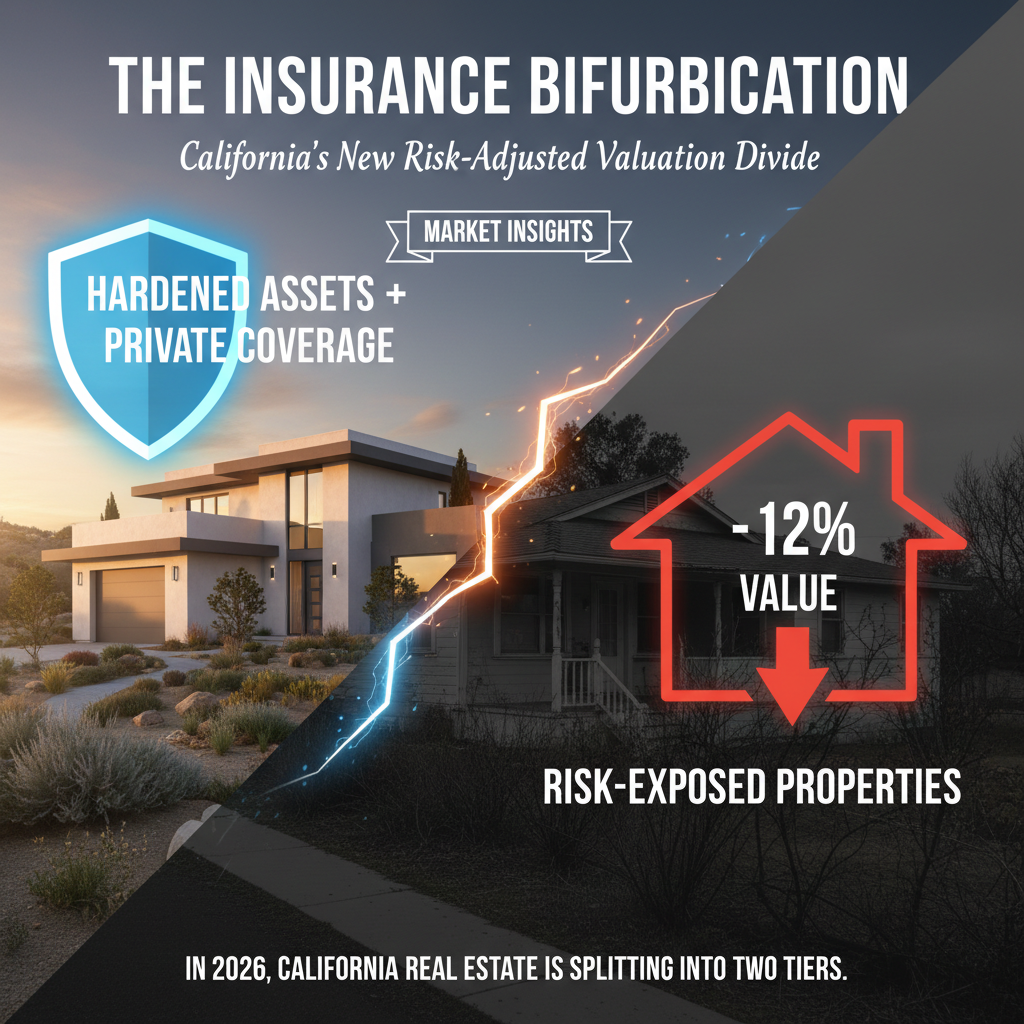
As of May 2026, the California real estate landscape has moved beyond the broad volatility of the early 2020s into a period of sophisticated stratification. The primary driver of this shift is no longer just interest rate fluctuations, but the Insurance Bifurcation. Following the full implementation of the California Department of Insurance (CDI) Sustainable Insurance Strategy, we are seeing a definitive price gap between 'hardened' properties and those reliant on state-backed residual markets.
According to recent MLS data and regional risk assessments, homes that meet the 'Wildfire Prepared Home' standards set by the Insurance Institute for Business & Home Safety (IBHS) are commanding an average price premium of 8% to 12% over comparable non-retrofitted properties in the same zip codes. This is a fundamental shift in how valuation is calculated in the Golden State.
Data-Driven Market Stratification
The 2026 market is characterized by a flight to safety. Data from the first quarter of the year reveals three critical trends:
- The FAIR Plan Discount: Properties that can only secure coverage through the California FAIR Plan are seeing an average 'Time on Market' (TOM) increase of 22 days compared to those with private admitted carrier options.
- Commercial Resilience: CBRE reports that multi-family assets in urban infill areas with updated fire suppression and non-combustible building materials are seeing cap rates compress by 40 basis points relative to older, high-risk wood-frame developments.
- The Retrofit ROI: Homeowners who invested in Class A fire-rated roofs and five-foot non-combustible zones around their structures are seeing a 140% return on those specific improvement costs at the point of sale.
The Transition from Crisis to Calculation
While 2024 and 2025 were marked by insurer exits and consumer panic, 2026 represents the 'New Normal.' Large carriers have returned to the market under the new rate-making rules that allow for the inclusion of catastrophe modeling and reinsurance costs. However, this return is highly selective. Investors are no longer just looking at the 'Price Per Square Foot'; they are scrutinizing the 'Cost to Insure Per Square Foot.'
In regions like the Sierra Foothills and parts of the Santa Monica Mountains, we are seeing 'Value-Add Insurance Plays.' Institutional investors are acquiring under-insured properties at significant discounts, performing comprehensive vegetation management and structural hardening, and سپس securing private-market coverage to instantly unlock equity.
Practical Takeaways for 2026 Stakeholders
For Buyers and Investors:
- Due Diligence 2.0: Never enter a contract without a preliminary insurance quote. In the 2026 market, the 'insurability contingency' is as vital as the inspection contingency.
- Target 'Hardened' Assets: Prioritize properties that have already achieved IBHS certification. The cost of retrofitting is rising, making pre-hardened homes a more stable store of value.
For Sellers:
- Pre-emptive Hardening: Before listing, perform a professional risk assessment. Clearing brush to the 100-foot state standard and installing ember-resistant vents can be the difference between a quick sale and a stalled listing.
- Transparency as a Tool: Provide a 'Risk Disclosure Package' including current premium costs and a history of mitigation efforts to reassure nervous buyers.
Economic Outlook: The Stabilization Phase
The broader California economy remains resilient, bolstered by a 3.8% projected growth in the state's GDP for 2026. However, the real estate market’s health is now inextricably linked to climate-risk mitigation. As we move into the second half of the year, expect the Insurance Bifurcation to widen. Regions that invest in community-wide fire-safe initiatives will likely see higher overall appreciation rates than those that leave mitigation to individual property owners.