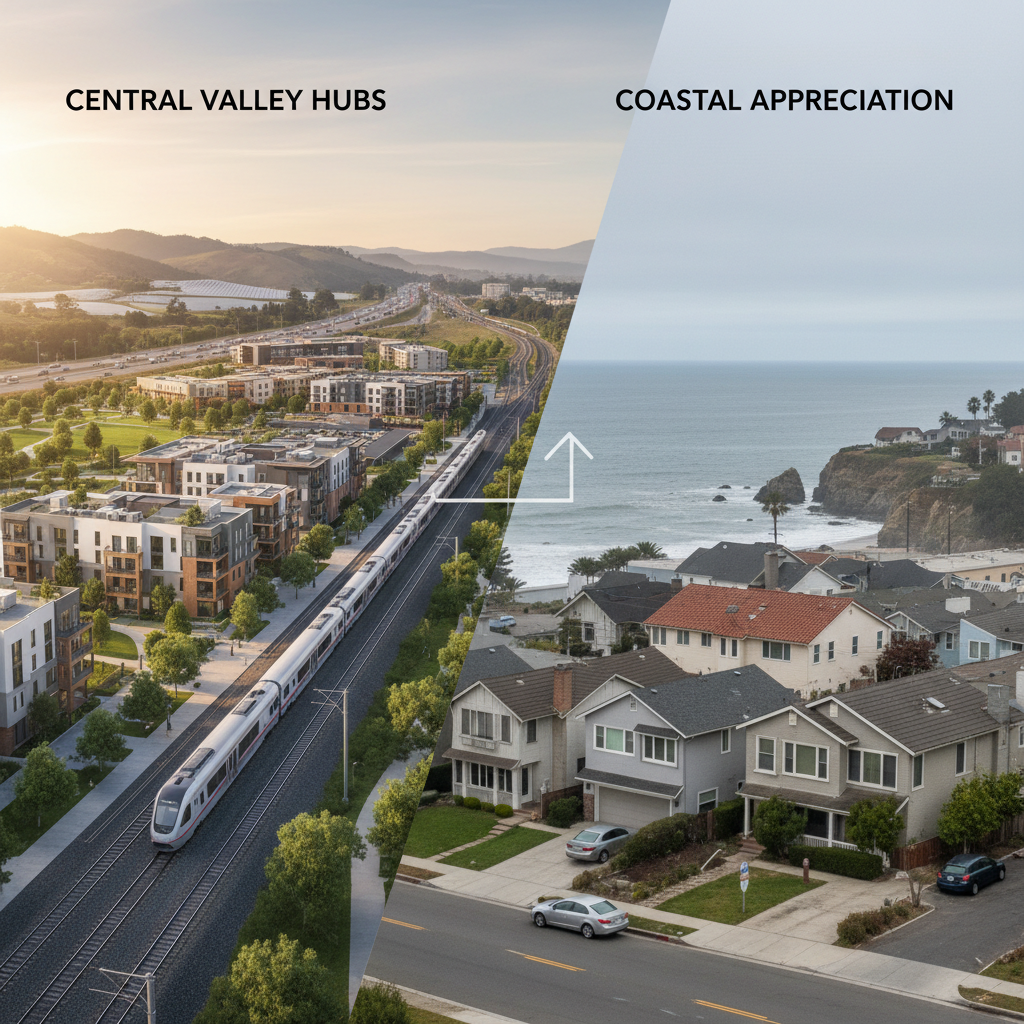
The Rise of the 100-Mile Commute
As of May 2026, the California real estate landscape is witnessing a structural shift that few predicted a decade ago. Data released this week by the California Association of Realtors (CAR) indicates that inland hubs—specifically Fresno, Merced, and Bakersfield—have seen a 12.4% year-over-year increase in median home prices. This significantly outpaces the 3.1% growth seen in the San Francisco Bay Area and Greater Los Angeles during the same period.
The catalyst for this divergence is the 'Rail-Link Renaissance.' With the California High-Speed Rail (CHSR) Authority moving into advanced testing phases for the Central Valley segment and integrated express transit corridors reaching completion, the concept of the 'super-commuter' has evolved. What was once a grueling drive is now a predictable, Wi-Fi-enabled rail journey, allowing hybrid workers to trade a 600-square-foot condo in San Jose for a four-bedroom estate in Fresno.
Data-Backed Migration Patterns
According to recent Census Bureau migration flow data, the Central Valley received a net influx of 45,000 residents from coastal counties in the last 12 months. Unlike the 'Pandemic Exodus' of 2020, which was driven by temporary remote work, the 2026 movement is anchored by permanent infrastructure. Real estate investment trusts (REITs) have taken notice, with institutional capital flowing into multifamily developments within a five-mile radius of transit-oriented development (TOD) zones.
MLS data shows that 'Time on Market' for properties in Downtown Fresno has dropped to a historic low of 14 days. Developers are pivoting from suburban sprawl to high-density infill, mirroring the urban revitalization seen in Sacramento over the previous decade. Current appraisals in these areas are increasingly factoring in 'Transit Proximity Premiums,' which have added an average of 18% to property valuations near future station sites.
Practical Takeaways for Stakeholders
For those navigating this shifting market, the following strategies are recommended based on current 2026 market conditions:
- For Buyers: Look for 'Opportunity Zones' near planned transit hubs in Merced and Madera. While the 'early adopter' window has closed, the 'utility phase'—when rail services actually begin—typically triggers a second wave of appreciation.
- For Sellers: In coastal markets like Santa Clara or San Mateo, emphasize 'commuter flexibility.' If your property is near a Caltrain or Metrolink station that feeds into the statewide rail network, it remains a competitive asset despite the inland drain.
- For Investors: Focus on the 'Middle-Market' niche. There is a supply vacuum in the Central Valley for modern, energy-efficient three-bedroom homes priced between $550,000 and $700,000—the sweet spot for relocating coastal families.
The Infrastructure Arbitrage
The 2026 market is no longer defined by ZIP codes, but by transit intervals. As California's inland and coastal economies become physically integrated, the price-per-square-foot gap is narrowing. Investors who once viewed the Central Valley as a secondary agricultural market are now treating it as the state's newest residential frontier. The 'Infrastructure Arbitrage' is in full swing, and for many Californians, the track to homeownership now runs through the heart of the state.


