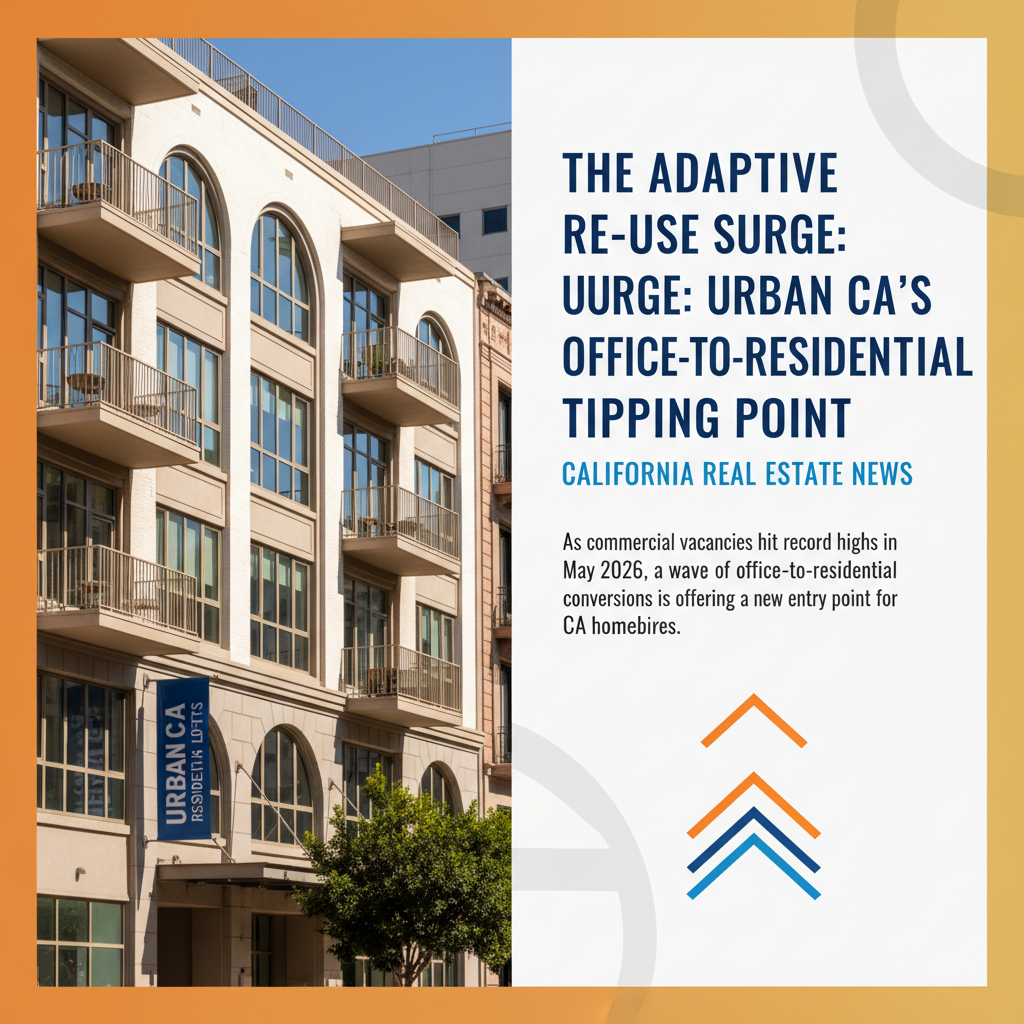
The Death of the Desk, The Birth of the Home
As of Tuesday, May 26, 2026, the California skyline is undergoing its most radical transformation since the post-war boom. Data from CBRE indicates that Class B and C office vacancies in San Francisco and Los Angeles have reached a terminal plateau of 38.2% and 31.5%, respectively. However, what was initially feared as a 'commercial doom loop' has catalyzed a residential revolution. The first major wave of 'Adaptive Re-Use' conversions, fast-tracked by the 2025 Housing Accountability Act expansion, has officially hit the market this month, providing a much-needed inventory injection into the state's starving housing supply.
The Data: A New Asset Class Emerges
According to the California Association of Realtors (CAR), urban core inventory levels have seen a 14% year-over-year increase, with 65% of that growth attributed to office-to-residential conversions. The California Department of Housing and Community Development (HCD) reports that over 12,000 converted units have received certificates of occupancy in the first five months of 2026 alone. Unlike the 'Builder’s Remedy' projects that focus on high-density luxury, these conversions are largely manifesting as 'attainable lofts' and 'micro-condos,' with a median price point roughly 18% lower than traditional new-construction condominiums in the same ZIP codes.
Regulatory Catalysts and Tax Credits
The acceleration of these projects is no accident. The implementation of the 2026 California Commercial Conversion Tax Credit has allowed developers to offset up to 25% of the structural seismic retrofitting costs required to turn 1980s-era office plates into livable units. Furthermore, local jurisdictions have been forced to waive parking minimums for these projects, reducing the final unit cost for buyers who are increasingly opting for transit-oriented lifestyles. For the first-time buyer, this represents the most significant expansion of 'entry-level' urban ownership in decades.
Market Impact and Investor Sentiment
While the luxury market remains cooled by high interest rates, the 'Conversion Corridor' is seeing bidding wars. In San Diego's Little Italy and San Francisco's Financial District, units under 600 square feet are moving in an average of 18 days. Investors are also pivoting; rather than chasing commercial leases, institutional capital is flowing into 'managed residential' conversions that offer short-term stay flexibility, a nod to the hybrid work culture that remains dominant in the 2026 economy.
Practical Takeaways for Today’s Market
- For First-Time Buyers: Look for 'Phase 1' conversion releases in San Francisco and Oakland. These units often come with 2-1 interest rate buydowns offered by developers eager to prove the viability of the project to their lenders.
- For Investors: Scrutinize the HOA reserves. Converted office buildings often have higher-than-average utility and maintenance costs for shared systems (HVAC and plumbing) compared to purpose-built residential buildings.
- For Urban Sellers: If you own a traditional condo, emphasize your building's 'residential-first' amenities. Newer conversions often lack the outdoor green space or balconies found in legacy residential designs.


