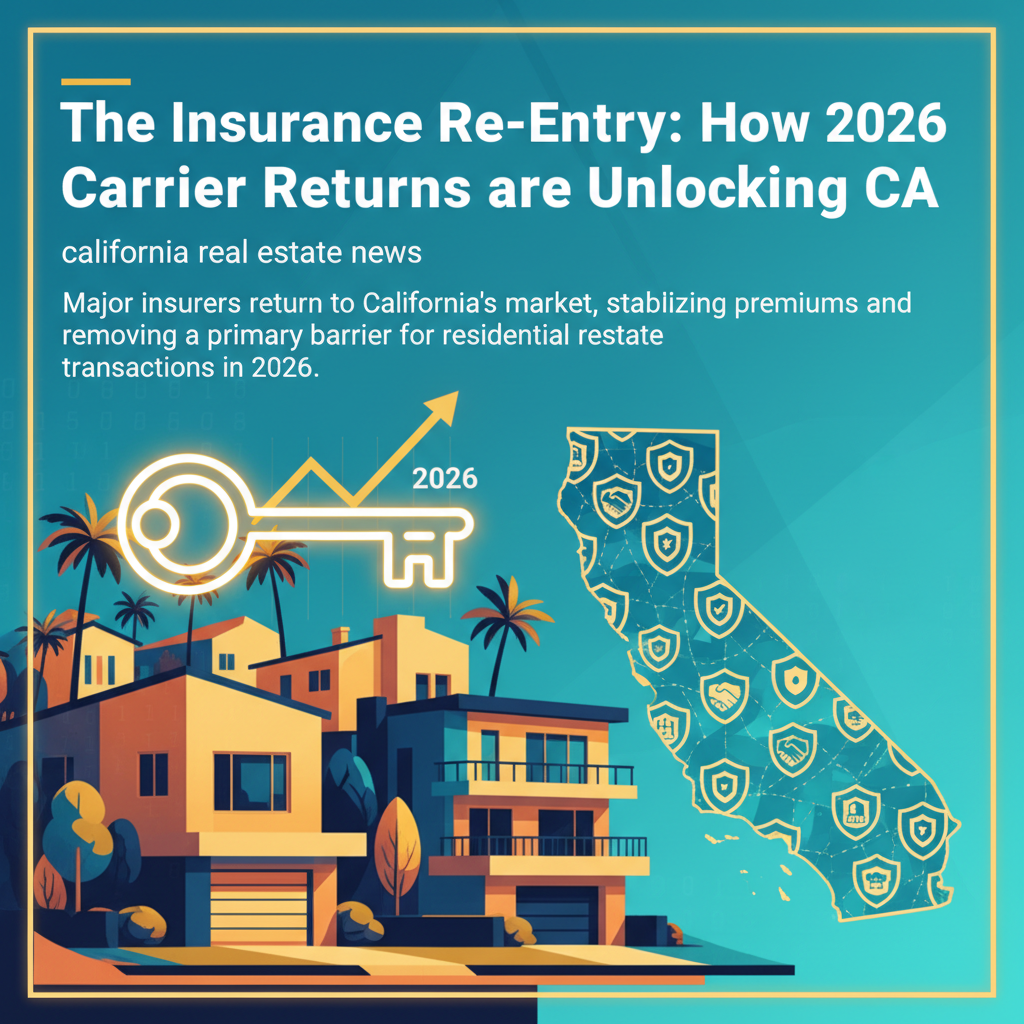
The Great Re-Entry: Major Carriers Stabilize the Golden State
For the first time in four years, California’s residential real estate market is breathing a sigh of relief. Following the full implementation of the Department of Insurance's 2025 Sustainable Insurance Strategy, May 2026 data shows a 14% increase in new policy originations from Tier-1 carriers like State Farm and Allstate. This influx of capacity is effectively ending the 'coverage-contingency' crisis that saw thousands of deals collapse in 2024 and 2025.
The Data Behind the Shift
According to the California Association of Realtors (CAR) May report, the average time to secure a bindable quote for a single-family home has dropped from 22 days to just 4 days. Key factors driving this recovery include:
- CAT Modeling Integration: New regulations now allow insurers to use forward-looking catastrophe modeling, a move that initially raised premiums by 12-18% but successfully lured private capital back to the state.
- Wildfire Mitigation Credits: Homeowners who invested in 'Hardened Home' standards (pursuant to AB-38) are seeing premium discounts of up to 25%, creating a new value-add category for sellers.
- FAIR Plan De-population: The state’s insurer of last resort has seen its total liability exposure drop for three consecutive months as homeowners migrate back to the private market.
Impact on Escrow and Lending
The stabilization of the insurance market is directly correlating with a decrease in failed escrows. In Q1 2026, only 3% of transactions fell through due to insurance unavailability, compared to 19% in the same period of 2024. Lenders, previously hesitant to fund in high-fire-risk zones (WUI), are now easing debt-to-income (DTI) requirements as insurance costs become more predictable and less likely to spike mid-escrow.
Practical Takeaways for Market Participants
For Sellers
Prioritize 'Home Hardening' documentation. In the 2026 market, a certified defensible space inspection is as critical as a roof or pest report. Properties with transferable, preferred-tier insurance policies are fetching a 4-6% premium over those limited to the FAIR Plan.
For Buyers
The 'Insurance Contingency' is still a necessary tool, but the focus has shifted from availability to affordability. Buyers should require sellers to provide three years of loss history reports (CLUE reports) early in the due diligence period to ensure the property qualifies for the newly available private-market tiers.
For Investors
Focus on areas previously deemed 'uninsurable.' As major carriers return to the Sierra Foothills and Inland Empire, there is a significant 'recovery play' opportunity in purchasing distressed assets that were sidelined solely due to lack of coverage. As liquidity returns to these zones, cap rates are compressing back to historical norms.
The Long-Term Outlook
While premiums remain significantly higher than 2020 levels, the return of competition among insurers suggests a ceiling has been reached. For California real estate, the narrative has shifted from 'managed retreat' to 'managed resilience,' providing the stability necessary for a sustained recovery in the state's most supply-constrained regions.


