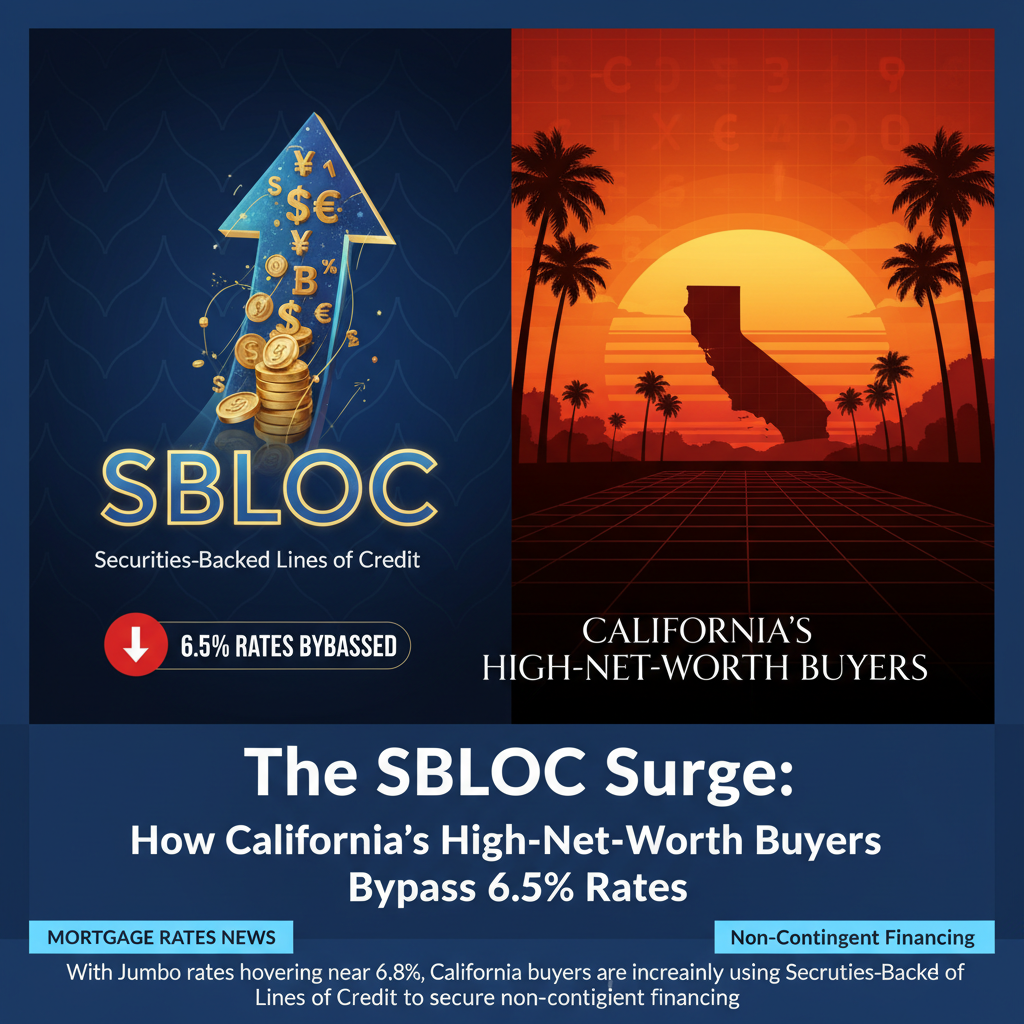
The 2026 Liquidity Trap and the Rise of Alternative Financing
As of May 25, 2026, the California real estate market faces a unique paradox. While inventory has marginally improved from the historic lows of 2024, mortgage rates have plateaued at a restrictive 6.25% to 6.5% for conforming loans, with Jumbo products often exceeding 6.8%. For California’s tech-heavy and equity-rich buyer pool, the traditional 30-year fixed mortgage has become an inefficient tool. In response, a significant shift toward Securities-Backed Lines of Credit (SBLOC) is reshaping how high-end transactions are closed in markets like Silicon Valley, Orange County, and San Diego.
Why Traditional Mortgages are Losing Favor in the Golden State
According to data from the California Association of Realtors (CAR), the median home price in the state remains firmly above $880,000, pushing a vast majority of coastal transactions into Jumbo territory. Traditional lenders, wary of persistent volatility in the secondary bond market, have maintained strict debt-to-income (DTI) requirements and higher reserve mandates. This has created a bottleneck for buyers who have significant wealth tied up in brokerage accounts but lack the liquid cash flow to satisfy 2026’s stringent DTI thresholds.
The SBLOC Advantage: Speed and Rate Arbitrage
An SBLOC allows a borrower to use their investment portfolio (stocks, bonds, or mutual funds) as collateral for a revolving line of credit. In the current lending environment, this strategy offers three distinct advantages for California residents:
- Rate Flexibility: While a 30-year Jumbo might sit at 6.8%, an SBLOC is often priced at a spread over the Secured Overnight Financing Rate (SOFR). For borrowers with high-balance portfolios, the effective rate can be 100 to 150 basis points lower than a conventional mortgage.
- Cash-Offer Competitiveness: Using an SBLOC allows a buyer to submit a non-contingent 'cash' bid. In competitive regions like Los Angeles or the Bay Area, where multiple offers are still the norm for turnkey properties, this removes the appraisal and financing contingencies that often kill deals.
- Tax Efficiency: By borrowing against their assets rather than selling them to fund a down payment, California buyers avoid triggering significant capital gains taxes—a crucial consideration given the state's high personal income tax brackets.
Data Points: The 2026 Lending Landscape
Recent reports from SIFMA indicate a 22% year-over-year increase in non-purpose lending against securities. In California specifically, the use of SBLOCs for real estate acquisitions has risen from 4% of luxury transactions in 2023 to nearly 15% in the first half of 2026. This trend reflects a broader move toward 'asset-based' rather than 'income-based' qualification in the high-net-worth segment.
Risks and Practical Takeaways
Despite the benefits, the SBLOC strategy is not without peril. The primary risk is the 'maintenance call.' If the market value of the pledged securities drops significantly, the lender may require the borrower to deposit more collateral or pay down the line of credit immediately. For California buyers considering this route, the following steps are essential:
- Maintain a Buffer: Never borrow the maximum allowable percentage (typically 50-70% of the portfolio). Aim for a 30-40% loan-to-value ratio to weather market volatility.
- Diversify the Collateral: Lenders offer better rates and higher LTVs for diversified portfolios compared to concentrated stock positions, which are common among California tech employees.
- Have an Exit Strategy: Many buyers use an SBLOC to acquire the property and then transition to a traditional mortgage or a 'recast' once rates soften or their income profile changes.
As the 2026 summer buying season accelerates, the ability to pivot away from traditional mortgage products is becoming the defining characteristic of a successful California home search. For those with the assets to back it up, the SBLOC is no longer a niche financial product—it is a primary weapon in the fight against high interest rates.


