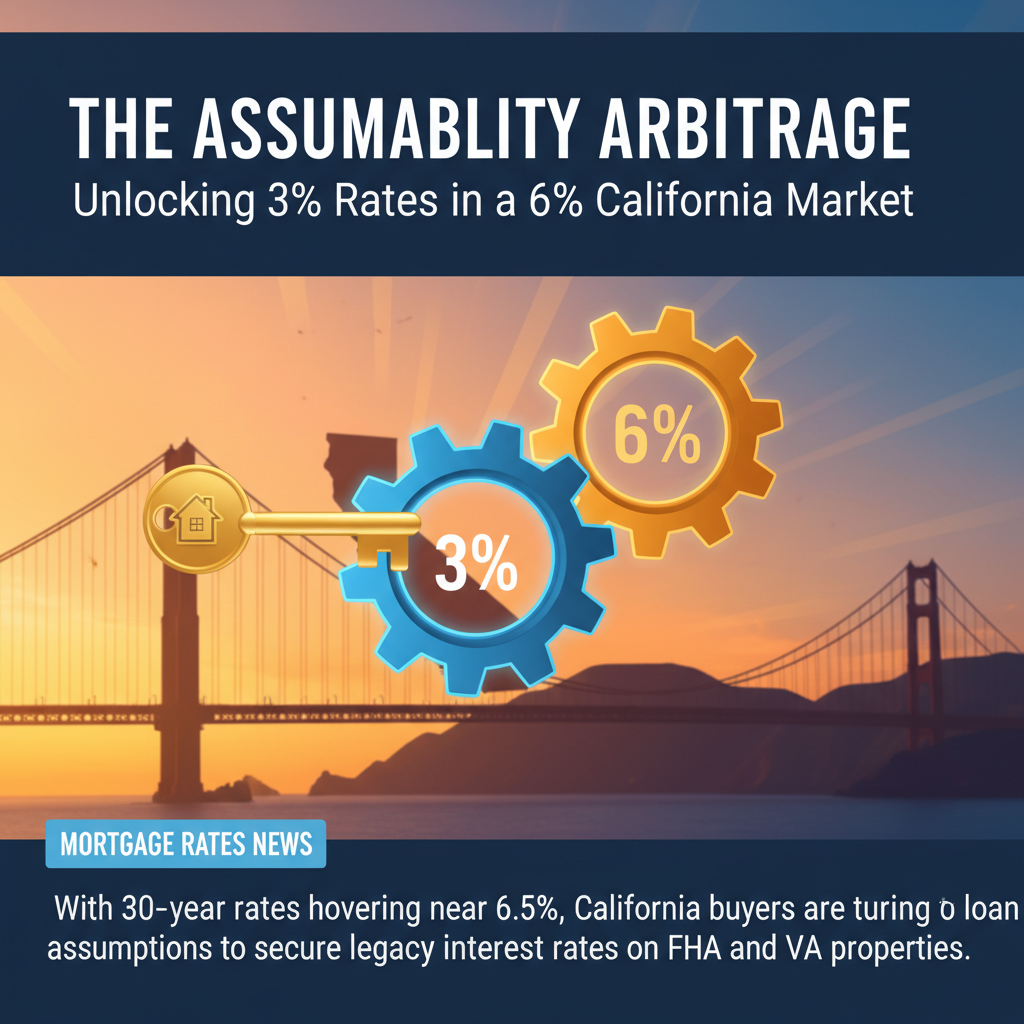
The 2026 Rate Plateau and the Search for Value
As of late May 2026, the mortgage landscape in California has reached a tentative equilibrium. According to the Mortgage Bankers Association (MBA), the national average for a 30-year fixed-rate mortgage is currently 6.48%, a figure that has remained stubbornly resistant to downward pressure despite cooling inflation. For the California homebuyer, where the median home price remains approximately 140% higher than the national average at $875,000, this 'higher-for-longer' environment has necessitated a shift from traditional financing to creative acquisition strategies.
The Assumption Advantage: Buying a Seller’s Interest Rate
While the market has exhausted many conventional tools, the 'Assumability Arbitrage' is emerging as a dominant trend. Approximately 22% of active California residential listings currently carry FHA or VA government-backed loans. Unlike conventional mortgages, these instruments are frequently 'assumable,' meaning a qualified buyer can take over the seller's existing loan—and, more importantly, their interest rate. For a home purchased in 2021, that rate could be as low as 2.75% or 3.25%.
Data from the California Association of Realtors (CAR) suggests that utilizing an assumption can save a buyer in high-cost areas like the Bay Area or Orange County upwards of $2,400 per month compared to a new 6.5% origination. However, this is not a friction-less transaction; the primary hurdle is the 'equity gap'—the difference between the remaining loan balance and the agreed-upon purchase price.
Solving the Equity Gap in High-Value Markets
In California's current market, where home equity has remained resilient, the gap between a legacy loan balance and today's market value can be substantial. For example, a property valued at $900,000 might have a 3% FHA loan with only $550,000 remaining. To bridge the $350,000 difference, buyers are increasingly employing a 'hybrid financing' model. This involves combining the low-interest assumption with a high-LTV second lien or a substantial cash down payment.
Lenders are beginning to streamline these 'Assumption-Plus-Second' packages. According to recent reports from CoreLogic, the use of subordinate financing in conjunction with loan assumptions has increased by 42% year-over-year in the California market, allowing buyers to achieve a 'blended' rate that still sits significantly below current market averages.
Practical Takeaways for the 2026 Buyer
- Verify Loan Type Early: Buyers should instruct their agents to filter for FHA and VA loans in the MLS. These are the primary vehicles for assumptions, as conventional loans typically contain 'due-on-sale' clauses.
- Prepare for Longer Escrows: While a standard mortgage can close in 21–30 days, a loan assumption often takes 60–90 days as it requires the existing servicer’s approval. Sellers may require a premium on the sales price in exchange for this patience.
- Mind the VA Entitlement: For VA assumptions, non-veteran buyers can assume the loan, but the seller’s VA entitlement remains tied to the property until the loan is paid off. Veteran sellers should be aware this may limit their ability to use a VA loan on their next purchase unless the buyer is also a veteran who 'substitutes' their entitlement.
As California's housing market navigates the 6% era, the ability to 'buy' a legacy interest rate is no longer a niche tactic—it is a critical tool for maintaining purchasing power in one of the world's most expensive real estate environments.


