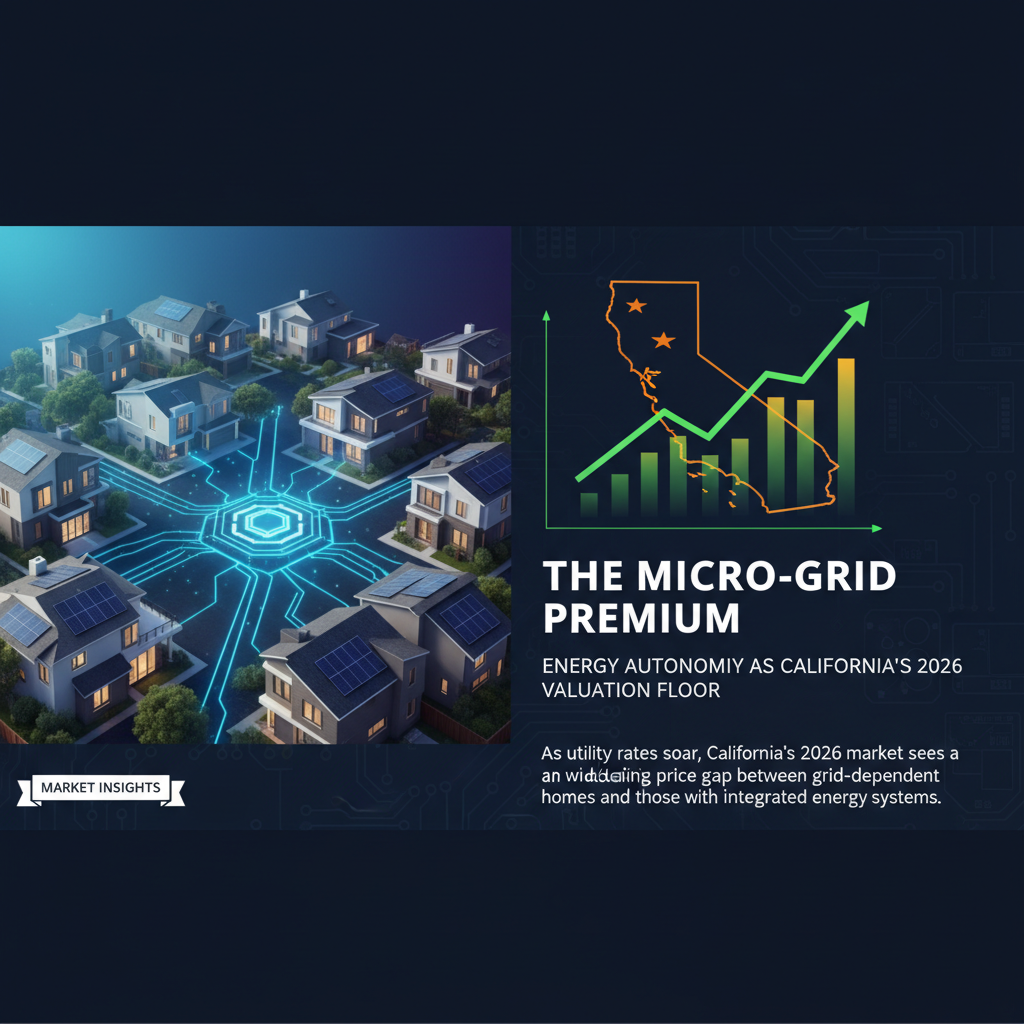
As we cross the mid-point of 2026, the California real estate landscape is being redefined by a factor that was once a secondary concern: energy sovereignty. While the 'Insurability Alpha' and 'Water-Rights Premium' have already segmented the market, a new valuation floor is emerging. Data from the first two quarters of 2026 indicates that homes equipped with localized micro-grids—integrated solar, advanced battery storage, and smart management systems—are outperforming the broader market in both liquidity and price retention.
The Utility Rate Catalyst
The driver behind this trend is a sharp escalation in retail electricity costs. According to recent filings with the California Public Utilities Commission (CPUC), the average residential rate for the state’s three largest investor-owned utilities has climbed nearly 28% since 2024. For the first time, the monthly 'energy carry' of a standard 2,500-square-foot home in the Inland Empire or Central Valley is rivaling property tax obligations. This has fundamentally shifted buyer psychology from viewing solar as a 'green bonus' to an essential hedge against inflation.
Quantifying the Micro-Grid Alpha
According to 2026 MLS data and a recent study by the Lawrence Berkeley National Laboratory, California homes with 'islanding' capabilities—the ability to operate independently during grid outages—are commanding a 7% to 12% price premium over comparable non-equipped homes. In high-demand corridors like the Tri-Valley and North Orange County, these properties spend an average of 14 fewer days on the market.
Institutional investors are also pivoting. Real Estate Investment Trusts (REITs) focusing on California multi-family assets are increasingly allocating capital toward retrofitting older complexes with centralized micro-grids. The logic is defensive: by stabilizing energy costs for tenants, owners can maintain higher effective rents and lower turnover rates, protecting the asset's Capitalization (Cap) Rate in a volatile economic environment.
Investment Perspectives: The Retrofit Arbitrage
For investors, the 2026 market offers a unique arbitrage opportunity. As traditional buyers shy away from homes with high monthly utility overhead, 'energy-inefficient' properties are trading at a discount. Savvy renovators are acquiring these assets and focusing their 'flip' budget on energy infrastructure rather than just cosmetic upgrades. The ROI on a $40,000 integrated energy system is now frequently exceeding that of a kitchen remodel, specifically because it addresses the buyer’s long-term debt-to-income (DTI) ratio concerns.
Practical Takeaways for 2026
- For Sellers: If your property lacks battery storage, consider an 'Energy Audit' disclosure. Highlighting a low fixed energy cost is now as crucial as a clean home inspection. Properties with transferable, owned (not leased) solar systems are the clear winners in the current cycle.
- For Buyers: Look beyond the list price to the 'True Cost of Ownership.' A lower-priced home with a $600 monthly utility bill may be more expensive over a 10-year horizon than a higher-priced micro-grid home.
- For Investors: Focus on the 'Energy-Gentrification' of sub-markets. Areas with aging grid infrastructure are prime for micro-grid developments, as residents prioritize reliability in the face of increasingly frequent 'Public Safety Power Shutoffs' (PSPS).
As we look toward the remainder of 2026, the California market is proving that sustainability is no longer an ideological choice—it is a fiscal necessity. The home is evolving from a mere shelter into a self-contained utility plant, and the market's pricing is following suit.