The 15-Minute City on the Bay
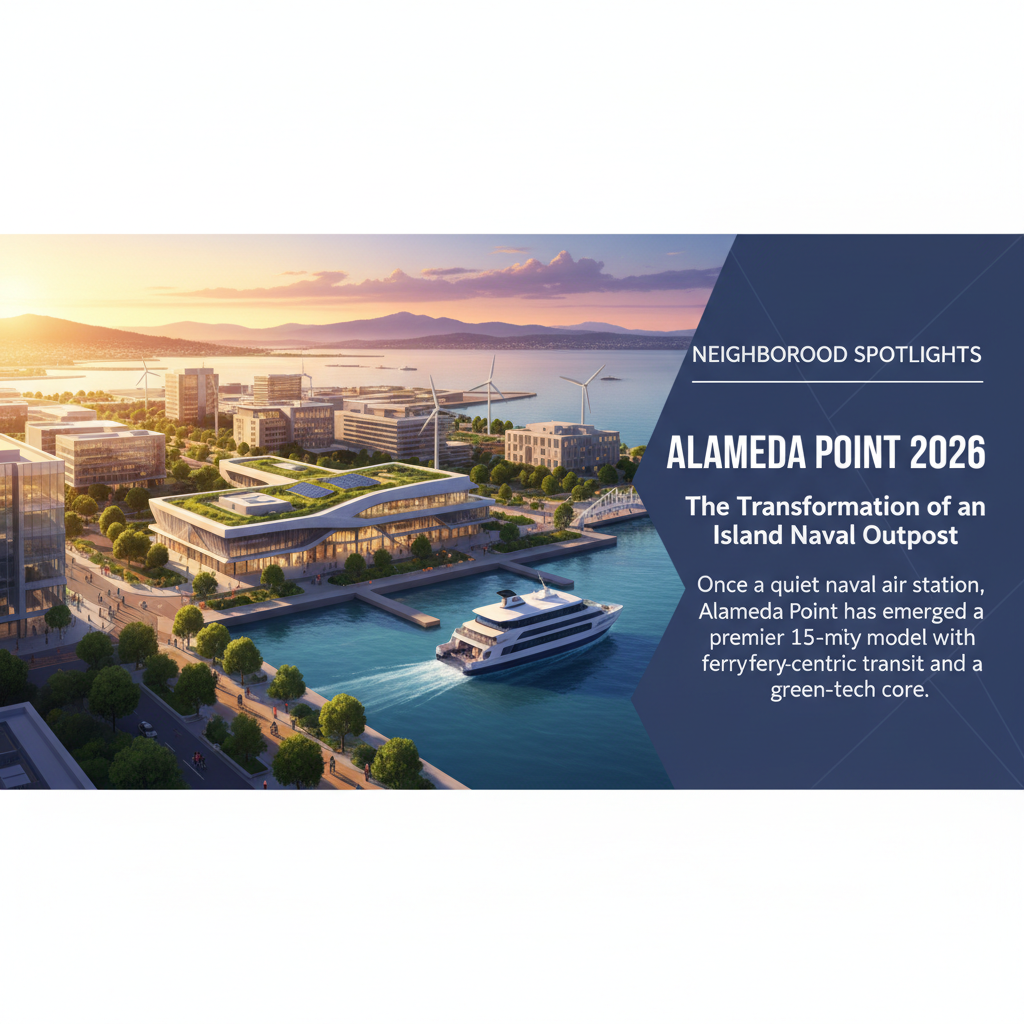
In mid-2026, Alameda Point stands as a testament to the power of patient, vision-led urban planning. No longer just a collection of historic hangars and runways, this 870-acre master-planned community has successfully transitioned into one of the East Bay’s most desirable residential and commercial anchors. By leveraging its geographic isolation as a strength, Alameda Point has fostered a '15-minute city' ecosystem where housing, high-tech employment, and transit are seamlessly integrated.
Connectivity: The Ferry-First Advantage
The primary driver of the neighborhood’s 2026 valuation surge is the Seaplane Lagoon Ferry Terminal. Recent data from the Water Emergency Transportation Authority (WETA) indicates a 22% year-over-year increase in ridership as commuters eschew the traffic-laden Posey Tube in favor of the 20-minute crossing to San Francisco’s Ferry Building. This connectivity has decoupled Alameda Point property values from the broader East Bay stagnation, with 2026 MLS data showing a median home price of $1.35 million—a 12% premium over 2024 averages in the surrounding West End.
Amenities and The 'Spirits Alley' Evolution
The neighborhood's appeal is anchored by its unique adaptive reuse projects. 'Spirits Alley,' once a nascent collection of craft distilleries, has matured into a world-class culinary district. The completion of the 8-acre Waterfront Park has provided a public focal point, connecting residential blocks to the San Francisco Bay Trail. For families, the neighborhood is served by the highly-rated Alameda Unified School District (AUSD), specifically the newly modernized Maya Lin School, which has seen its enrollment grow alongside the influx of young tech and maritime professionals.
Employment: The Green-Tech Anchor
Unlike traditional bedroom communities, Alameda Point is a job generator. The 'Enterprise District' now hosts over 50 green-tech and maritime firms, including leaders in autonomous shipping and carbon sequestration. CBRE’s Q1 2026 report highlights a sub-4% vacancy rate for R&D space in the hangars, citing the appeal of large-format, high-ceiling spaces that are unavailable in more dense urban cores like San Francisco or Oakland.
Practical Takeaways for Market Participants
- For Buyers: Focus on the 'Site A' developments. These newer builds offer the highest energy efficiency ratings and are positioned closest to the Seaplane Lagoon ferry, providing the best long-term equity insulation.
- For Investors: The rental market for high-earning professionals remains undersupplied. Multi-family assets within three blocks of the transit hub are commanding a 15% rent premium compared to inland Alameda properties.
- For Sellers: Highlight 'coastal resilience' features. Alameda Point’s infrastructure was built to the latest 2020s-era flood and sea-level rise standards, a major selling point in a climate-conscious California market.
As we move through 2026, Alameda Point serves as a blueprint for how military-to-civilian transitions can move beyond retail-only footprints to create sustainable, transit-oriented neighborhoods that cater to the modern hybrid workforce.