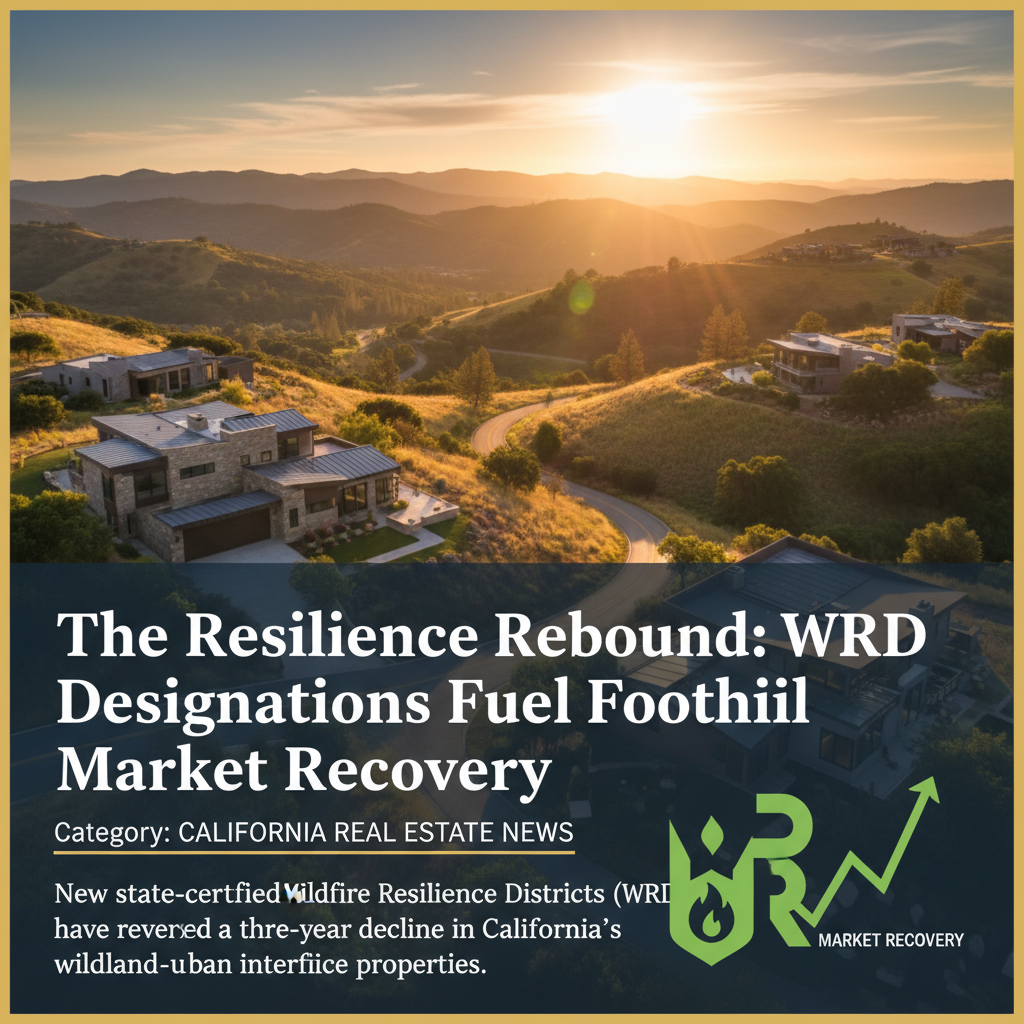
The Insurance Stalemate Finally Breaks
As of May 24, 2026, the California real estate landscape is witnessing an unexpected resurgence in a sector once deemed ‘un-insurable.’ Following the 2025 passage of the California Safer Communities Act, the establishment of Wildfire Resilience Districts (WRDs) has begun to fundamentally decouple fire risk from property devaluation. For the first time in five years, homes in the Sierra Foothills and the Santa Cruz Mountains are seeing competitive bidding wars, driven by a new state-backed insurance guarantee for certified resilient communities.
Data Points: The WRD Premium
According to the latest May report from the California Association of Realtors (CAR), transaction volume in WRD-certified ZIP codes has surged by 18.2% year-over-year. More importantly, the ‘Insurance-to-Value’ ratio—a metric that peaked in late 2024—has stabilized. Properties within these districts are now fetching an average of 12% more than comparable non-certified homes in similar high-risk zones.
- Median Price Recovery: In El Dorado and Placer Counties, median prices for hardened homes have risen to $745,000, up from a 2024 low of $660,000.
- Insurance Stability: The California Fair Access Guarantee (CFAG) now caps annual premiums at 1.2% of the home's appraised value for properties meeting the 'Gold Standard' of vegetation management and structural hardening.
- Inventory Shift: Institutional buyers, who largely exited the wildland-urban interface (WUI) in 2023, have returned, accounting for 9% of purchases in these districts this quarter.
The Mechanism of Resilience
The WRD framework allows local municipalities to issue ‘Resilience Bonds’ to fund community-wide infrastructure improvements, such as undergrounding utilities and installing high-capacity perimeter sprinkler systems. For individual homeowners, the state’s 2026 tax credit covers up to 40% of the cost of retrofitting roofs with non-combustible materials. This collective approach has satisfied major reinsurers, who are now re-entering the California market after a multi-year hiatus.
Practical Takeaways for Market Participants
For those looking to navigate this shifting landscape, the following strategies are becoming industry standard:
For Buyers:
Prioritize properties with a ‘Hardening Score’ of 85 or higher. In the current 2026 market, these homes are not just safer; they are the only assets with guaranteed secondary market liquidity. Verify that the property is within a formally recognized WRD to ensure long-term insurance premium predictability.
For Sellers:
Before listing, invest in a certified brush-clearance audit. The 2026 CAR disclosure forms now require a ‘Resilience Rating.’ Sellers who proactively achieve ‘Gold’ status are seeing days-on-market metrics drop from 65 days to 14 days on average.
For Investors:
The largest arbitrage opportunity currently exists in ‘Resilience Flips.’ Investors are acquiring non-certified properties at a discount, performing state-mandated hardening upgrades, and capturing the valuation lift provided by the WRD designation. This value-add strategy is currently yielding a 22% average ROI in the Ventura and Ojai markets.
The Bottom Line
The ‘Resilience Rebound’ marks a pivotal shift in California real estate. By treating wildfire risk as a manageable engineering challenge rather than an inevitable catastrophe, the state has successfully stabilized property values for millions of residents. As we look toward the summer of 2026, the WRD model is already being studied by other Western states as the gold standard for climate-adaptive real estate policy.


