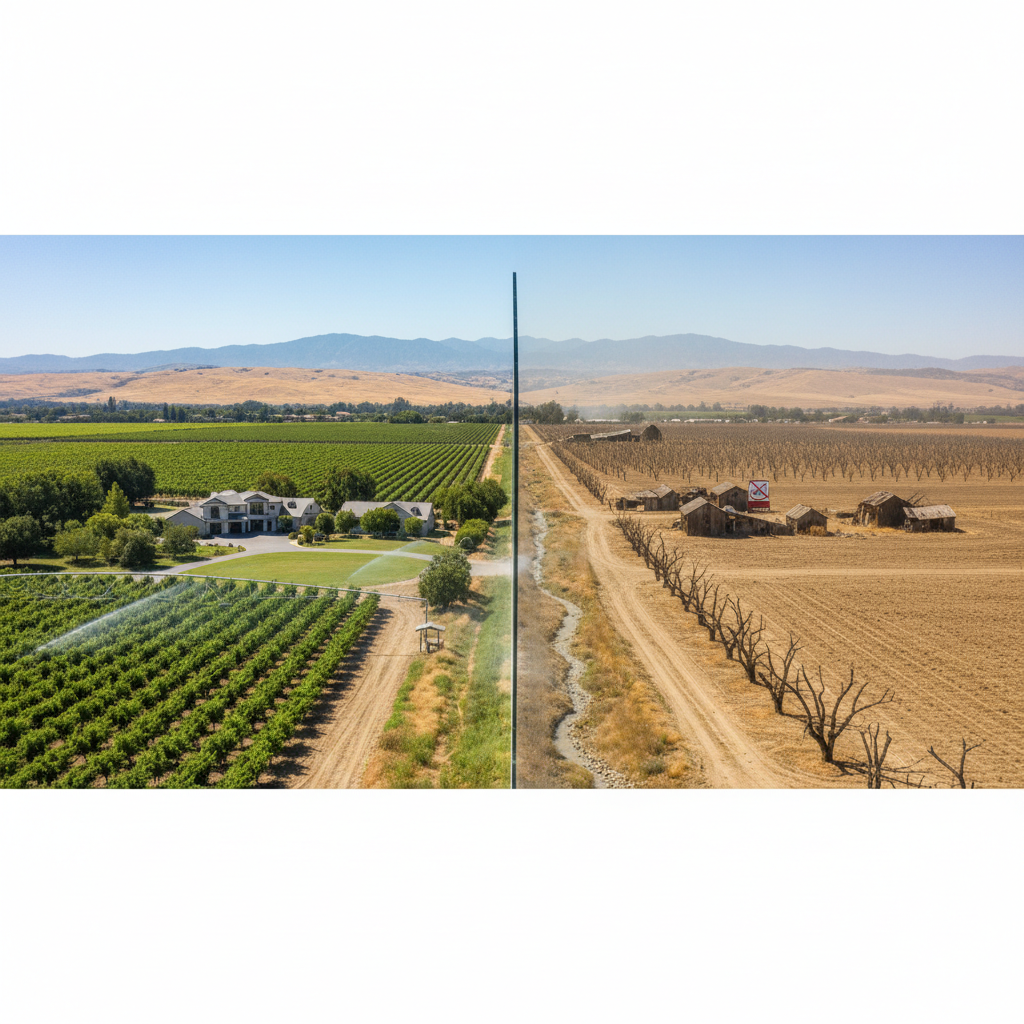
The 2026 Water Reality: Enforcement Meets Appraisal
As of May 2026, the California real estate market has hit a critical inflection point where the Sustainable Groundwater Management Act (SGMA) has moved from a regulatory framework into a primary driver of residential and commercial valuation. For the first time, the state’s Groundwater Sustainability Agencies (GSAs) are strictly enforcing extraction limits, creating a bifurcated market defined by hydrological security. Data from the California Association of Realtors (CAR) suggests that properties with secured, adjudicated water rights or reliable municipal connections are now commanding a 12% to 18% premium over well-reliant parcels in critically overdrafted basins.
The Erosion of the 'Dry' Parcel Value
The Inland Empire and the Central Valley's peri-urban fringes have seen the most significant shift. According to recent MLS data, the average time-on-market for luxury estates reliant on private wells has increased by 45 days compared to this time last year. Appraisal models are now routinely discounting these properties if they fall within a GSA 'high-priority' zone where pumping restrictions are nearing their 2030 targets. This 'Hydrological Discount' reflects the rising cost of deepening wells—which now averages over $45,000 in parts of the San Joaquin Valley—and the potential for future usage caps that limit landscaping and swimming pool maintenance.
Municipal Advantage vs. Rural Risk
The shift is also driving a migration toward 'Tier 1' municipal districts. Recent data from the California Department of Water Resources indicates that cities with diversified portfolios (including recycled water and desalinization offsets) are seeing higher demand for new construction. For investors, the 'Municipal Buffer' has become a key metric.
"In 2026, we aren't just looking at school districts and square footage; we are looking at the Groundwater Sustainability Plan (GSP) for the specific basin," says Marcus Thorne, a Senior Analyst at CBRE. "A home in a managed district is simply more liquid than a similar home three miles away that is subject to pumping curtailments."
Practical Takeaways for Buyers and Sellers
- For Buyers: Perform a 'Hydrological Audit' before closing. Beyond a standard well-inspection, verify the property's status with the local GSA. Ensure that any existing water rights are fully transferable and not subject to pending litigation.
- For Sellers: If your property is on a private well, proactively provide data on well depth, historical recharge rates, and any water-sharing agreements. Transparency can prevent a deal from collapsing during the appraisal phase.
- For Investors: Focus on 'Water-Neutral' retrofits. Xeriscaping and greywater systems are no longer just aesthetic choices; they are value-protection strategies that make a property more resilient to future extraction limits.
Looking Ahead: The Securitization of Water
As we move through the 2026 summer season, the industry anticipates the rise of 'Water-Linked Mortgages,' where interest rates may be tied to the hydrological sustainability of the location. With California's climate volatility becoming a permanent fixture of the economy, the transition from 'land value' to 'resource value' is nearly complete. Buyers are no longer just purchasing a home; they are purchasing a guaranteed share of a finite, state-regulated resource.


