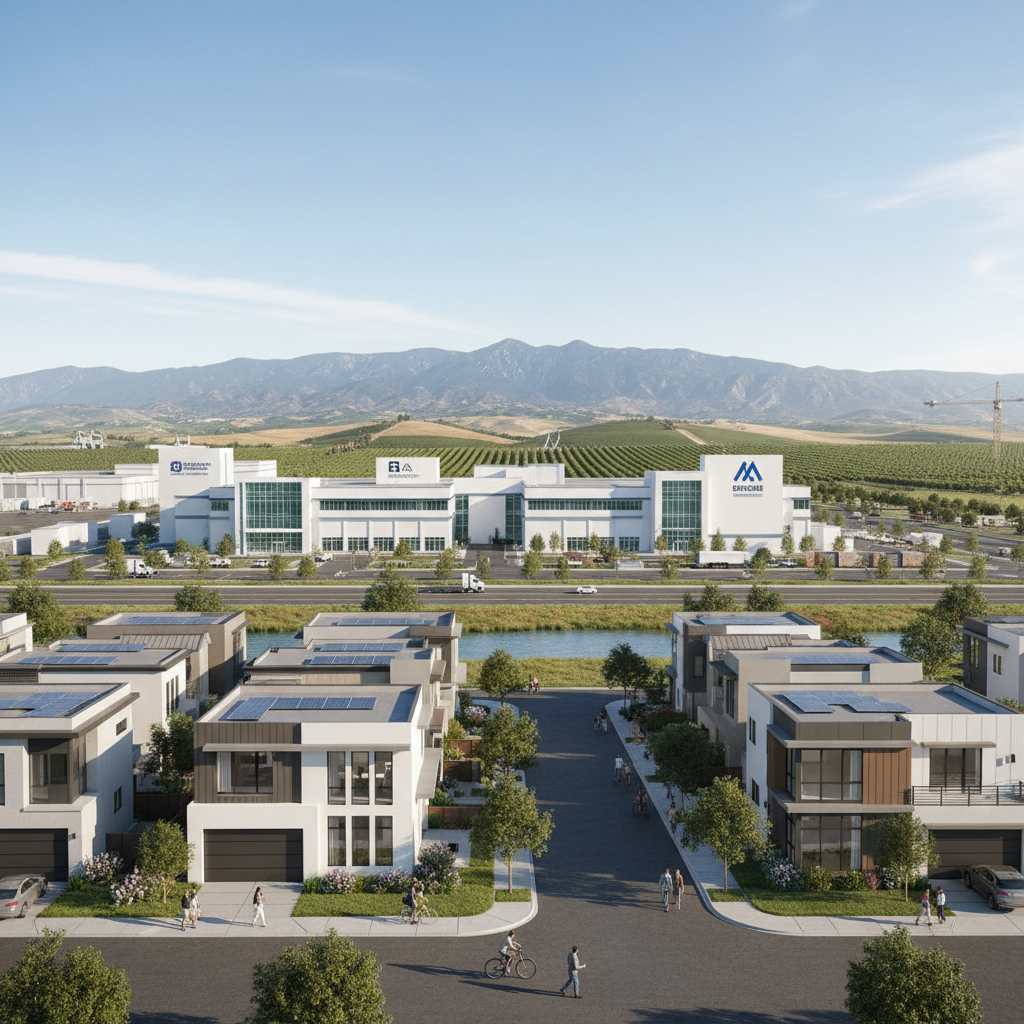
The Great Interior Pivot: Beyond Logistics
In mid-2026, the California real estate narrative has shifted from the coastal 'tech-flight' of years past to a robust industrial renaissance in the interior. As federal incentives for domestic manufacturing have matured, the Central Valley and Inland Empire have transformed from mere pass-through logistics corridors into high-production 'reshoring' hubs. This economic pivot is creating a unique residential alpha for investors who can navigate the industrial-residential symbiosis.
The Industrial-Residential Symbiosis
Historically, proximity to industrial zones was a valuation detractor. However, the 2026 landscape has inverted this logic. According to recent CBRE Industrial Outlook data, California’s inland manufacturing footprint has expanded by 14% year-over-year. This expansion is no longer dominated by automated 'dark warehouses' but by advanced manufacturing facilities requiring a skilled, permanent workforce.
As these specialized workers move inland, they are seeking high-quality, long-term housing. This has led to a divergence in the California market: while coastal metros see 1-2% annual appreciation, 'Reshoring Hubs' like Stockton, Modesto, and Riverside-San Bernardino are witnessing 6.5% growth in median residential values, fueled by a 22% increase in local median household income since 2024.
Key Data Points for Q2 2026
- Absorption Rates: New industrial leases in the Central Valley reached 12 million square feet in Q1 2026, a 15% increase over Q1 2025 (Source: CoStar).
- Rent Growth: Class-A multi-family rents in manufacturing-heavy zip codes have outpaced the state average by 400 basis points.
- Inventory Tightness: The California Association of Realtors (CAR) reports that active listings in San Joaquin and Fresno counties remain 30% below 2019 levels, despite the statewide 'Builder’s Remedy' surge, due to the rapid influx of new industrial employees.
Macro-Economic Catalysts
The primary driver is the 'Supply Chain Sovereignty' movement. Large-scale semiconductor assembly and EV component manufacturing plants have established roots in the Fresno-Bakersfield corridor. This has created a secondary 'Knowledge Economy' in the interior—engineers, technicians, and project managers who are priced out of the $1.5M coastal mid-tier but are aggressive buyers in the $600k–$850k inland luxury segment.
Strategic Takeaways for Investors and Sellers
- For Investors: Focus on 'Workforce Luxury.' In 2026, the highest yields are found in high-amenity townhomes and single-family rentals (SFR) located within a 15-minute commute of new manufacturing campuses.
- For Sellers: If you own property in the Inland Empire or Central Valley, 2026 represents a peak liquidity window. The demand from institutional SFR aggregators looking to capture manufacturing-driven rent growth has created a highly competitive bidding environment.
- Risk Mitigation: Monitor local zoning. As municipalities prioritize 'Industrial-Residential' mixed zones, older residential properties may see significant land-value appreciation through potential rezoning into higher-density workforce housing.
While the 'Coastal Reprieve' remains a factor for the ultra-wealthy, the true economic engine of California's 2026 real estate market is the reshoring of American industry and the permanent, high-income workforce it has anchored in the state's interior.