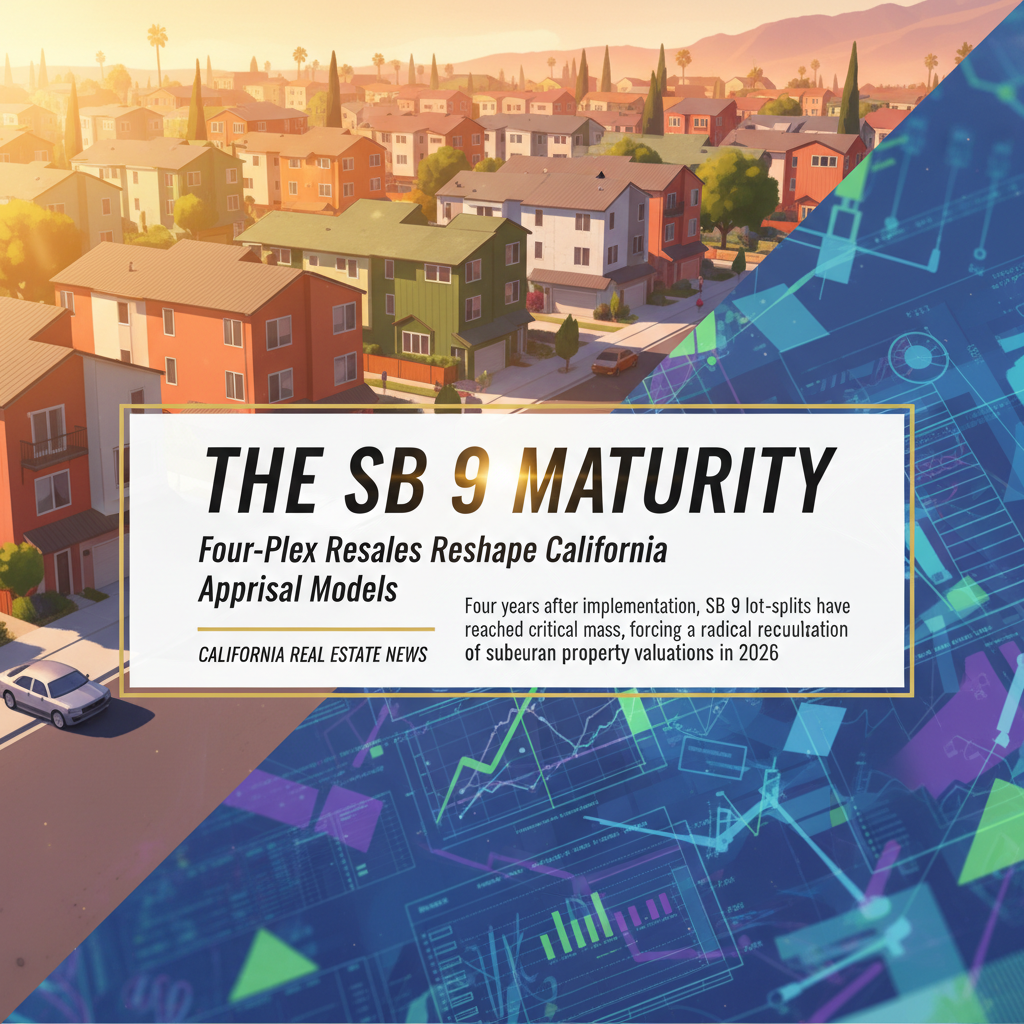
The 'Missing Middle' Hits the Resale Market
For years, California’s Senate Bill 9 (SB 9) was more of a legislative promise than a market reality. However, as of May 2026, the first significant wave of SB 9-enabled developments—lot splits and four-plex conversions—has finally hit the resale market. This influx is creating a structural shift in how appraisers and investors calculate value in historically R1-zoned neighborhoods.
The Data: A 22% Rise in Split-Lot Appraisals
According to the latest data from the California Department of Housing and Community Development (HCD) and recent MLS filings, the number of 'split-lot' residential transactions has increased by 22% year-over-year in the first quarter of 2026. Unlike the ADU boom, which focused on secondary structures, SB 9 has allowed for the creation of entirely new legal parcels.
Research from the UC Berkeley Terner Center for Housing Innovation indicates that in high-demand pockets of Los Angeles and San Jose, the combined value of two split lots now averages 35% higher than the value of the original single-parcel lot. This 'valuation gap' is driving a secondary market where institutional buyers are no longer looking for turnkey homes, but for 'divisible assets'—properties with the specific setbacks and street frontage required for a clean split.
The 'Micro-Comp' Challenge
The emergence of these multi-unit developments is disrupting traditional neighborhood comps. Real estate professionals are reporting a 'Bifurcation of the Suburbs.' On one side, traditional single-family homes with large yards are maintaining a premium for privacy; on the other, SB 9 four-plexes are offering a higher yield per square foot, attracting a new class of 'owner-investors.'
"We are seeing a move toward micro-comps," says Marcus Thorne, a senior analyst at CBRE. "In 2026, you cannot compare a 2,000-square-foot home on a 10,000-square-foot lot to its neighbor that has been split into four units. They are effectively different asset classes existing on the same street."
Practical Takeaways for the 2026 Market
- For Sellers: Before listing an older home on a large lot, commission a feasibility study for an SB 9 split. Even if you don't build, the 'entitlement potential' can add a significant premium to your asking price.
- For Buyers: Look for 'strata-titled' opportunities. In 2026, buying one unit of a newly split four-plex provides the entry-level price point that has vanished from the traditional market, often with lower HOA fees than traditional condos.
- For Investors: Focus on 'Split-Ready' inventory. Properties with alley access or wide side-yards are the 'gold mines' of the 2026 California market because they minimize the infrastructure costs associated with new utility hookups for split parcels.
The Regulatory Horizon
While local municipalities initially resisted these density increases, the 2026 fiscal cycle has seen a shift in attitude. Cities are beginning to favor SB 9 developments due to the increased property tax base generated by the creation of new parcels. For the California homeowner, the 'backyard' is no longer just a patch of grass—it is the state’s most liquid new commodity.


