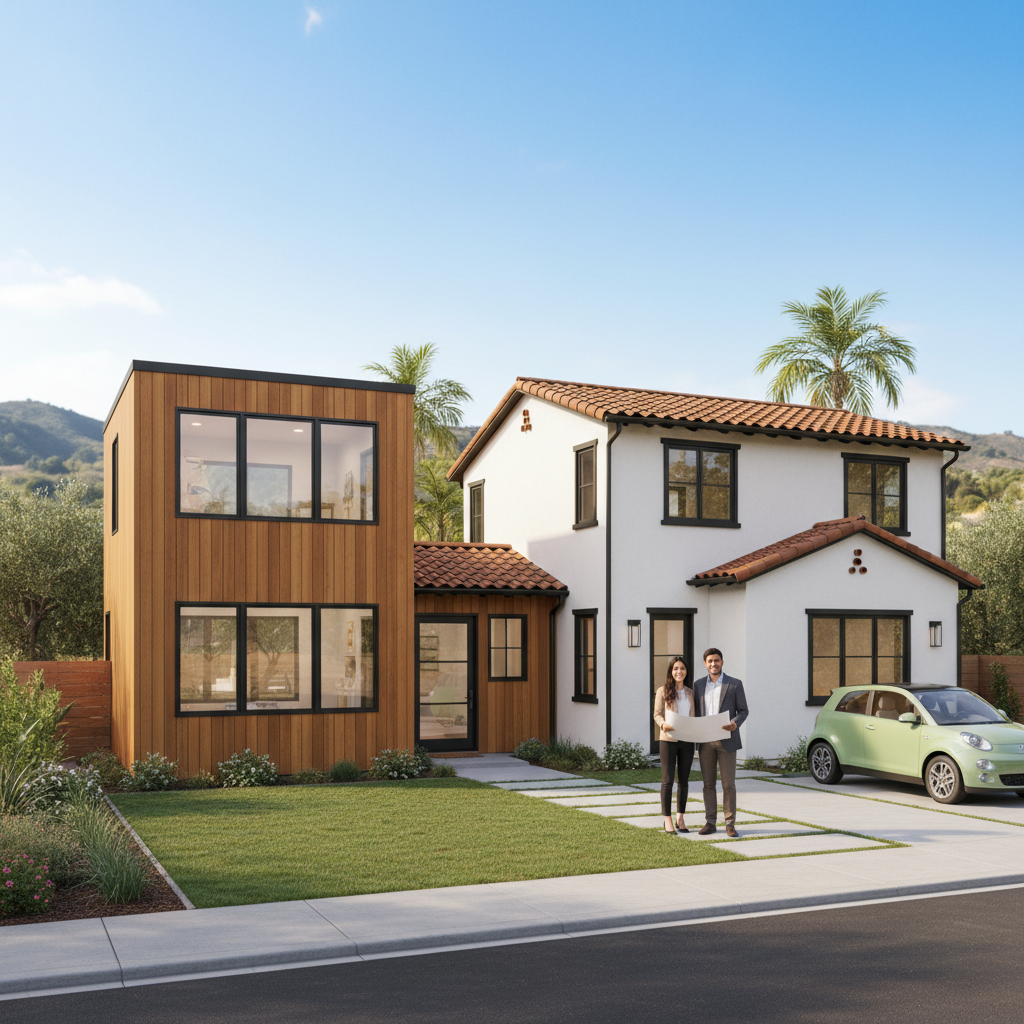
Navigating High-Interest Realities with the 'Income-Producing' Offer
As of May 2026, the California housing market remains characterized by a persistent supply-demand imbalance. With the average 30-year fixed rate hovering around 6.2%, the path to homeownership for many Californians now requires a shift from seeking the 'perfect finished home' to identifying properties with high density potential. This guide outlines how to leverage California’s robust Accessory Dwelling Unit (ADU) laws to offset mortgage costs and build immediate equity.
1. The Regulatory Context: SB 9 and the 2026 ADU Landscape
California’s legislative push for density has matured. According to the California Department of Housing and Community Development (HCD), ADU permit applications increased by nearly 20% year-over-year in 2025. Under current law, most single-family lots are entitled to at least one regular ADU (up to 1,200 sq. ft.) and one Junior ADU (JADU) within the existing structure. In 2026, savvy buyers are no longer looking at backyard space as 'landscaping' but as 'revenue-generating square footage.'
2. Leveraging Projected Income for Qualification
A critical shift in 2025-2026 lending guidelines has changed the game for buyers. Both Fannie Mae and Freddie Mac now allow lenders to count up to 75% of the *projected* rental income from a proposed ADU to help a buyer qualify for their primary mortgage, provided the appraisal includes an ADU addendum. This can effectively increase a buyer’s purchasing power by $100,000 to $150,000 in high-rent markets like the Bay Area or Southern California.
3. Identifying the 'ADU-Ready' Property
When touring homes in the 2026 market, look for these physical and legal 'green flags' that minimize construction costs:
- Electrical Capacity: Look for a 200-amp main panel. Upgrading from an older 100-amp service can add $5,000 to $8,000 to an ADU project.
- Sewer Lateral Access: Properties with a cleanout located near the proposed ADU site can save thousands in trenching costs.
- The 'Pre-Approved' City Advantage: Cities like San Diego, Sacramento, and Los Angeles now offer 'Standard Plan' programs. Buying in a jurisdiction with pre-approved architectural plans can shave 4 months off the permitting timeline and save $10,000 in design fees.
- The Garage Conversion Trap: While often the cheapest route, ensure the garage structure is slab-on-grade and free of termites. In 2026, California seismic requirements for 'Change of Use' conversions have tightened, making some old garages more expensive to retro-fit than to build new.
4. Financing the Build Post-Closing
Most buyers cannot afford the $150,000–$250,000 cash outlay for a detached ADU immediately after a down payment. In the current market, three vehicles are dominant:
- FHA 203(k) Limited: Ideal for JADUs or internal conversions, allowing up to $35,000 in repairs bundled into the mortgage.
- HomeStyle Renovation Loans: A conventional product that allows for the construction of a full detached ADU based on the 'as-completed' value of the property.
- California ADU Grant Programs: Check for the 2026 cycle of CalHFA’s ADU Grant, which has historically provided up to $40,000 for pre-development costs for low-to-moderate income earners.
Practical Takeaways for 2026 Buyers
- Run the 'Net Payment' Math: Don't just look at the $5,500 monthly mortgage. Factor in the $2,200 potential ADU rent. In many CA coastal markets, the net payment after ADU income is lower than renting a 2-bedroom apartment.
- Verify Local Setbacks: While state law mandates a maximum 4-foot side and rear setback, local fire codes (especially in Very High Fire Hazard Severity Zones) may require more. Check the 'Zone' on the Natural Hazard Disclosure (NHD) report early.
- Interview an 'ADU-Specialist' Inspector: Standard home inspectors focus on the main house. Hire a specialist to assess the feasibility of a second meter and the slope of the lot for gravity-fed sewage.


