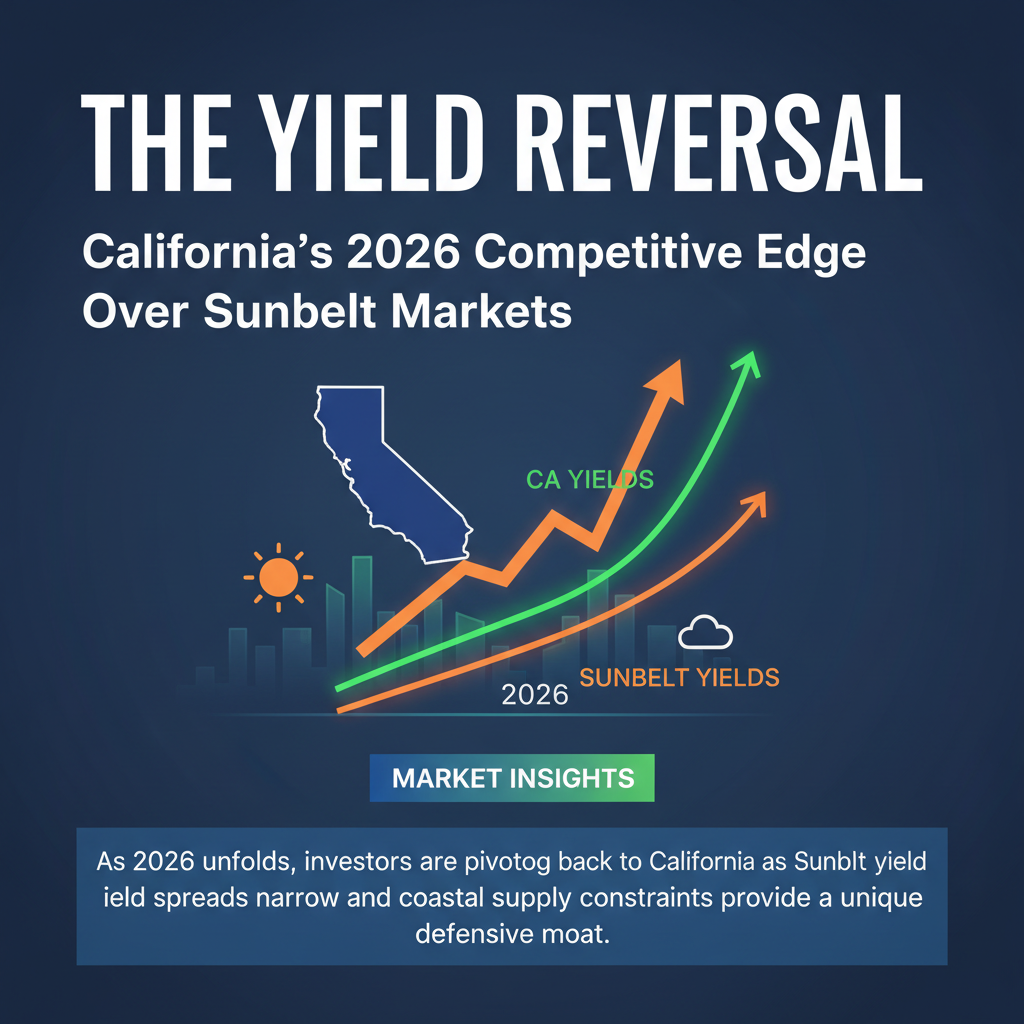
The Great Yield Convergence
For the past half-decade, the prevailing narrative in California real estate was one of capital flight. Investors, weary of regulatory hurdles and chasing high cap rates, funneled billions into "Smile State" markets like Austin, Phoenix, and Nashville. However, by May 2026, the data indicates a massive reversal. According to recent analysis by the National Association of Realtors (NAR) and regional MLS data, the yield spread between California’s coastal tier-1 cities and former Sunbelt darlings has compressed to an average of just 42 basis points, the narrowest margin since 2012.
The Sunbelt Saturation vs. The California Moat
The primary driver of this 2026 trend is the exhaustion of the Sunbelt "value-add" play. Massive oversupply in multi-family units across the Phoenix-Mesa-Chandler corridor has led to stagnant or negative rent growth in the first half of the year. Conversely, California’s inherent supply constraints—long seen as a liability—have become its greatest strength for capital preservation. With California housing starts still 28% below the state's required threshold for 2026, existing assets in markets like San Diego and San Jose are seeing 4.5% annual rent appreciation, significantly outpacing the national average of 1.9%.
Investment Perspectives: The Coastal Alpha
Institutional capital is leading this "Homecoming." Private equity firms that exited the Los Angeles market in 2023 are now returning, citing the "Infill Stability Factor." While California's legislative environment remains complex, the predictability of its demand is proving more attractive than the volatile boom-bust cycles observed in the Mountain West over the last three years. Furthermore, the normalization of property valuations following the 2025 interest rate stabilization has allowed for more accurate long-term underwriting in high-density urban nodes.
Economic Trends: Re-urbanization and the 3-Day Mandate
The 2026 market is also buoyed by a significant shift in corporate labor policy. The "Hybrid Finality" has settled into a mandatory 3-day-in-office structure for 75% of California’s tech and financial sectors. This has revitalized demand for high-end residential units in San Francisco’s South of Market and Los Angeles’s Arts District. Current Census Bureau migration data suggests that the outward flow of high-earners has slowed to its lowest rate in a decade, as employees prioritize proximity over the long-distance commutes that characterized the pandemic era.
Practical Takeaways for 2026 Investors
- Identify Sunbelt Liquidity: Look for opportunities to acquire California assets from funds that are currently over-leveraged in saturated Sunbelt markets and seeking to rebalance their portfolios with stable coastal appreciation.
- Prioritize Core Coastal Infill: With housing supply still lagging, any asset within a 15-mile radius of major employment hubs in Orange County or the Bay Area offers superior risk-adjusted returns compared to out-of-state growth markets.
- Leverage the Rent Gap: Target Class-B properties in coastal cities where the gap between current rents and market potential remains wide due to the recent 2025 economic rebound.


