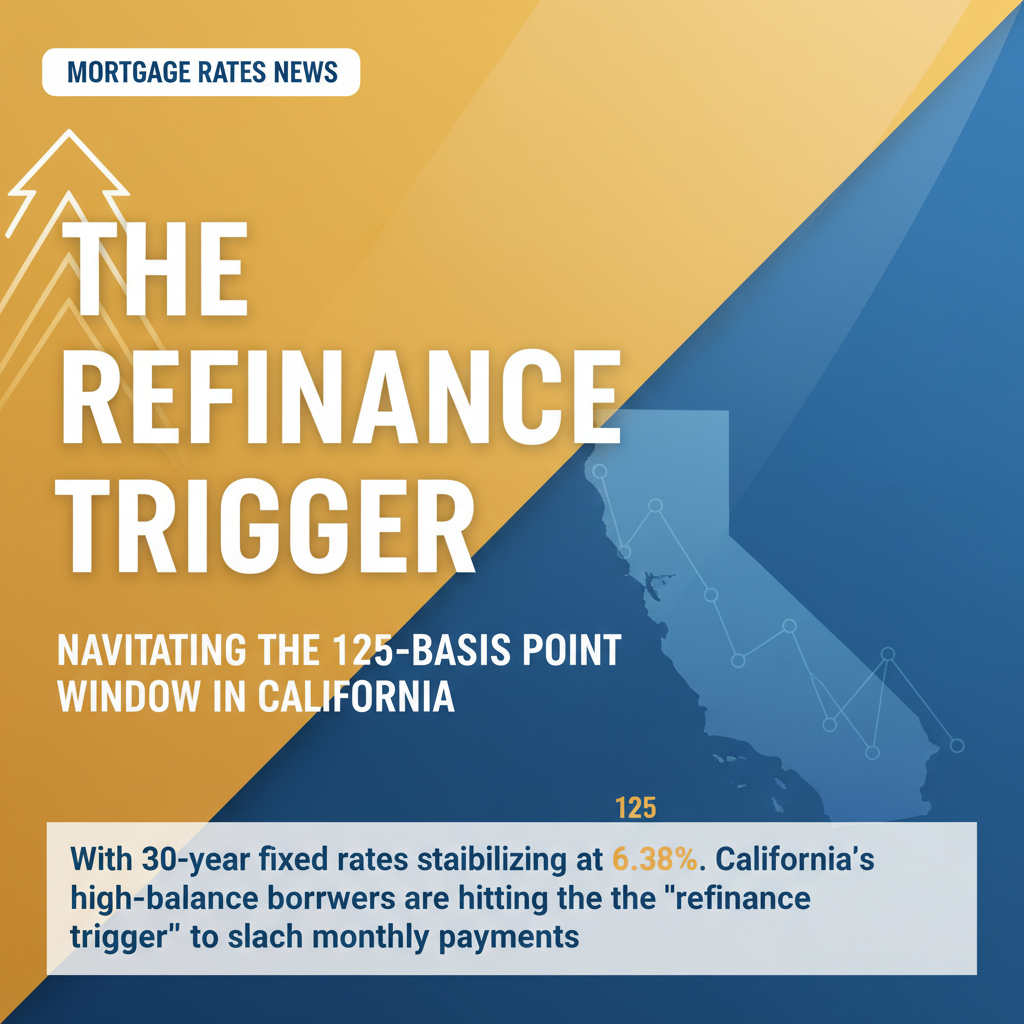
The 2026 Refinance Window Opens
As of May 18, 2026, the mortgage landscape in California has reached a long-awaited equilibrium. After the volatility of 2024 and 2025, the Freddie Mac Primary Mortgage Market Survey (PMMS) reports the 30-year fixed-rate mortgage averaging 6.38%. For the national market, this is a modest improvement, but for California homeowners who locked in rates near 7.75% during the peak inflation cycle, this represents the '125-basis point trigger'—the threshold where refinancing becomes mathematically undeniable.
The High-Balance Leverage Factor
Data from the Mortgage Bankers Association (MBA) shows a 14% surge in refinance applications in the Western United States over the last month. This trend is amplified in California due to the state's high-balance loan environment. In counties like Los Angeles, Orange, and Santa Clara, where the 2026 conforming loan limit for one-unit properties has climbed toward $1.2 million, even a 1% reduction in interest rates yields significant savings. For a borrower with a $1.1 million loan, dropping from 7.6% to 6.35% reduces the monthly principal and interest payment by approximately $920, or over $11,000 annually.
Market Data and Economic Tailwinds
The stabilization in rates follows the Federal Reserve's most recent pivot toward a neutral stance, coupled with a moderating Consumer Price Index (CPI) that has calmed the bond market. According to recent MLS data from the California Association of Realtors (C.A.R.), inventory remains tight, but the 'locked-in' effect is beginning to soften as the gap between existing 3% rates and current 6% rates narrows. However, the real story for May 2026 is the emergence of the 'Mid-Cycle Buyer'—those who purchased at the top of the rate cycle and are now aggressively seeking to recapitalize.
Practical Takeaways for California Borrowers
- Calculate the Breakeven: In high-cost California markets, closing costs (typically 2-3% of the loan amount) can be recouped in less than 18 months if the rate drop is at least 1%. Use a net-present value (NPV) calculation rather than just a simple monthly savings look.
- Appraisal Resilience: Despite higher rates over the last two years, California home equity has remained remarkably stable. Many 2024 buyers will find that their Loan-to-Value (LTV) ratios have actually improved due to lack of supply, facilitating easier credit approvals.
- Streamline Opportunities: For those with FHA or VA loans from the 2025 peak, 'Streamline' refinance options are currently bypassing the need for full appraisals, providing a fast track to lower payments as the 10-year Treasury yield stays in the 4.1% range.
As we head into the summer of 2026, the strategy for California homeowners is shifting from survival to optimization. While the days of 3% mortgages remain a historical anomaly, the transition from 7.5% to 6.3% provides the necessary liquidity to sustain the state's housing momentum.


