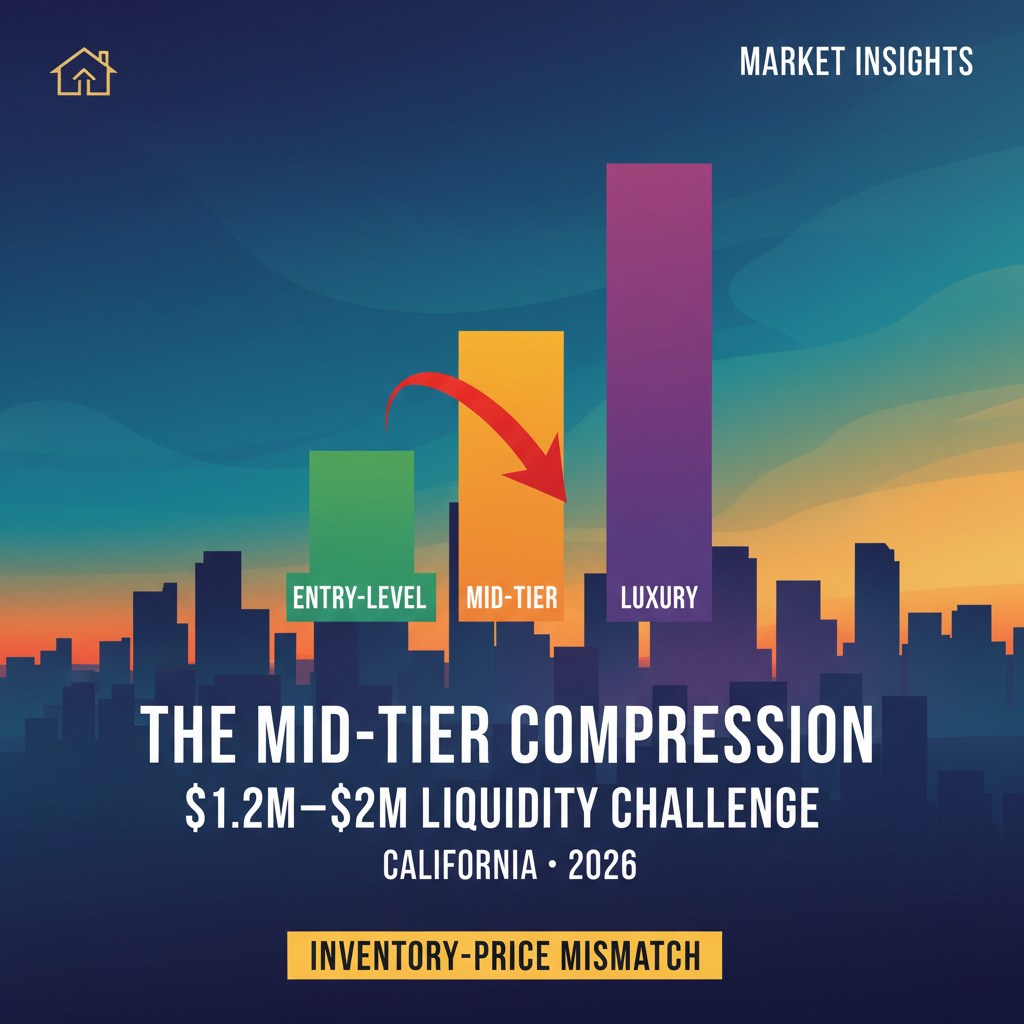
The Hollow Middle: Analyzing the 2026 Mid-Market Stagnation
As we cross the midpoint of 2026, the California real estate landscape has entered a phase of distinct bifurcation. While the 'Builder’s Remedy' has finally begun to alleviate pressure at the lower end of the market, and institutional capital has stabilized the multi-family sector, a new friction point has emerged: the $1.2 million to $2 million 'mid-tier' bracket. This segment, historically the engine of the California move-up market, is currently experiencing a liquidity trap that is reshaping suburban investment strategies.
The Data: A Disconnect in Market Velocity
According to April 2026 data from the California Association of Realtors (CAR), homes priced between $1.2M and $1.8M in coastal counties (Los Angeles, Orange, and San Diego) are seeing a 19% increase in Days on Market (DOM) compared to the same period in 2025. In contrast, inventory in the sub-$900,000 category is moving 12% faster. This 'mid-tier compression' is the result of a significant 'Equity Gap' that has widened over the last 24 months.
Despite mortgage rates stabilizing near 5.75%, the jump from a starter home to a mid-tier family home now requires an average household income increase of $155,000—a threshold that many dual-income professional households are finding difficult to clear. This has led to a 'Renovate in Place' culture, further dampening the transaction volume in what was once the most liquid portion of the market.
The Investment Perspective: From Appreciation to Yield Management
For investors, the mid-tier segment currently represents a 'valuation no-man's land.' The high carry costs associated with these properties, combined with the deceleration of appreciation in suburban corridors, have shifted the focus toward yield-producing alternatives. CBRE’s 2026 Western Regional Outlook suggests that capital is moving away from speculative mid-market flips and toward high-density redevelopment or 'lifestyle-proximate' rentals.
Interestingly, the only mid-tier properties maintaining velocity are those that offer 'multi-generational configurations'—properties already equipped with permitted junior ADUs or separate entrances that allow for immediate income offset. In the 2026 market, a home’s ability to generate internal cash flow is now a primary determinant of its liquidity, rather than just its school district or square footage.
Economic Trends: The Suburban Inventory Overhang
MLS data indicates that for the first time in five years, active listings in the mid-tier bracket have surpassed the 4-month supply mark in several Inland Empire and Bay Area satellite communities. This inventory overhang is creating a buyer’s market in a very specific niche, even as the broader state remains supply-constrained. Sellers who bought between 2021 and 2023 are finding that their equity, while substantial, is 'trapped' by the high cost of the next rung on the ladder.
Practical Takeaways for 2026 Stakeholders
- For Sellers: Price discovery in the $1.2M–$2M range is currently volatile. Sellers should consider offering 'rate buy-downs' or renovation credits upfront to distinguish their property from the growing list of stagnant inventory. A property sitting past 45 days in this market is likely to face aggressive low-ball offers from opportunistic 'lifestyle' buyers.
- For Buyers: This is the first significant window of negotiation leverage in years. Buyers looking in this bracket should focus on properties with high 'Days on Market' counts, as many sellers in this tier are 'relocation-motivated' and increasingly willing to accept contingencies that were unthinkable in 2024.
- For Investors: Avoid 'clean-and-flip' strategies in the mid-tier. Instead, look for properties with underutilized lot coverage where 'forced appreciation' can be achieved through density—specifically targeted at the growing demand for co-living or home-based business suites.
The 2026 California market is no longer a monolith. Success this year requires recognizing that the 'middle' is where the most significant price corrections are likely to occur, offering both a warning to over-leveraged sellers and a rare opening for well-capitalized buyers.