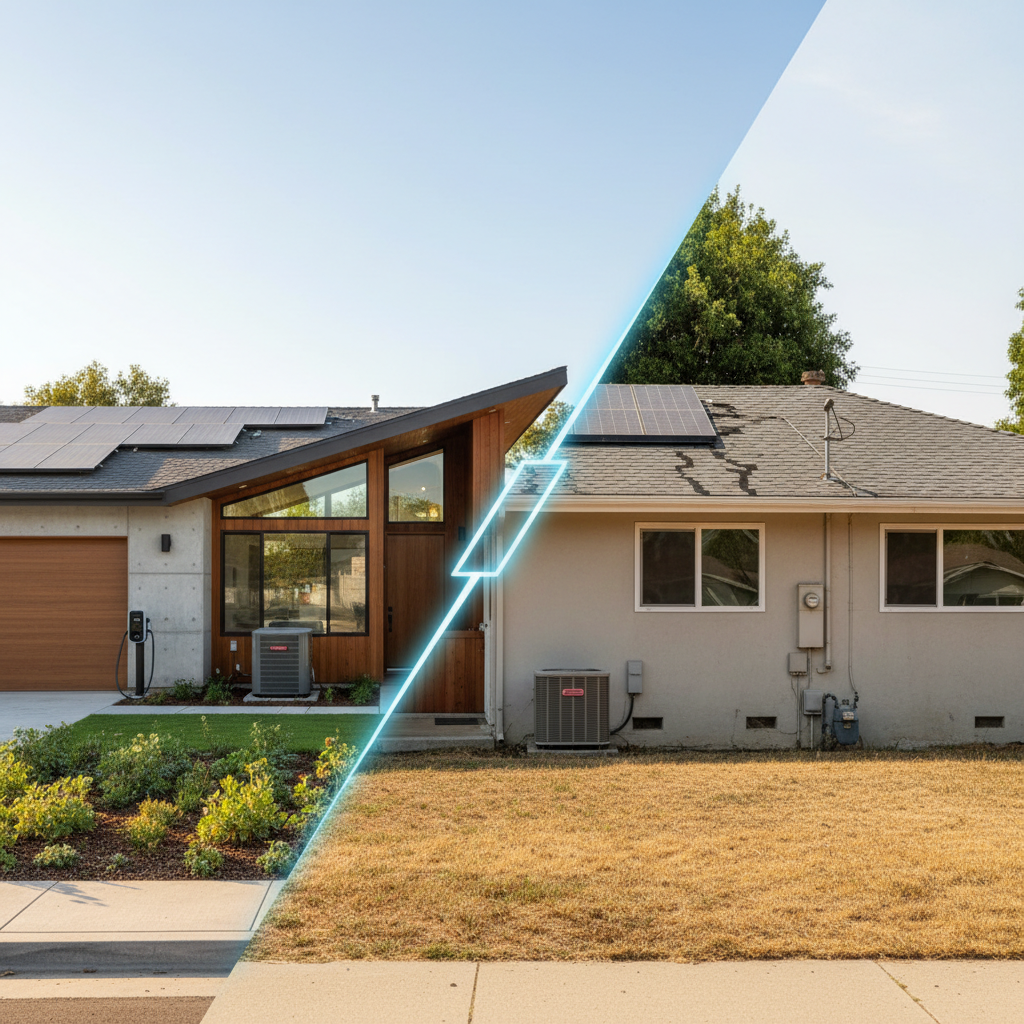
The Shift from Curb Appeal to Carbon Footprints
As of May 2026, the California real estate landscape is witnessing a profound shift in valuation metrics. For decades, a gourmet kitchen or an ADU was the primary driver of 'over-ask' offers. Today, according to the California Association of Realtors (CAR) mid-quarter report, the primary differentiator has become a home’s Carbon Performance Score (CPS).
Following the full implementation of the 2024 Residential Decarbonization Act, which mandated point-of-sale energy audits for all single-family homes starting last year, a clear price bifurcation has emerged. Homes classified as 'Fully Electrified' are now trading at a 12.4% premium compared to those still reliant on legacy natural gas infrastructure.
Data Trends: The Efficiency Premium
Data from the California MLS reveals that in April 2026, the median price for an electrified home in the East Bay reached $1.25 million, while comparable gas-heated homes lagged at $1.11 million. This 11% gap is not merely a preference for modern appliances; it is a calculated move by buyers to avoid the 'Retrofit Tax.'
- Inventory Breakdown: Currently, only 18% of California’s resale inventory meets the 'Net-Zero Ready' tier.
- Days on Market: High-efficiency homes (CPS 80+) are selling in an average of 14 days, versus 42 days for homes with low scores.
- The Rebate Factor: Federal and state subsidies covering up to 60% of heat pump installations have spiked, but labor shortages have pushed wait times for contractors to five months.
Regulation Driving Reality
The regulatory catalyst is the state’s aggressive push toward carbon neutrality. Cities like San Jose and Santa Monica have introduced 'Building Performance Standards' that will require older homes to meet specific efficiency benchmarks by 2030 or face annual carbon penalties. Investors and savvy homebuyers are pricing these future costs into their offers today.
"We are seeing a 'Green-lining' effect," says Marcus Thorne, a senior analyst at CBRE. "Buyers are no longer just looking at the mortgage. They are looking at the 10-year projected cost of carbon compliance. If a home requires a $40,000 panel upgrade and heat pump transition, that amount is being slashed directly from the seller’s asking price."
Practical Takeaways for the 2026 Market
For Sellers:
Do not list your home without a pre-inspection of your electrical capacity. Upgrading to a 200-amp service before hitting the market is currently yielding a 3x return on investment. If your home has a low CPS, consider offering a 'Decarbonization Credit' at closing to prevent deals from falling through during the appraisal contingency period.
For Buyers:
Target 'hybrid' homes—those that have upgraded electrical panels but haven't yet installed heat pumps. These properties often lack the 'Net-Zero' sticker price but are positioned for easy upgrades, allowing you to capture equity through state-funded rebate programs available through the California Energy Commission.
For Investors:
The real opportunity lies in the 'Efficiency Flip.' Purchasing 1970s-era stock with low CPS ratings and performing whole-home electrification is currently the highest-margin strategy in the Inland Empire and Central Coast, where cooling costs are skyrocketing.
The Bottom Line
In May 2026, the California home is no longer just a shelter; it is a power plant. As the state moves further away from fossil fuels, the value of a property is increasingly tied to its ability to operate independently of the gas grid. Sellers who ignore this trend risk holding 'stranded assets' in a market that is rapidly cooling on carbon.


