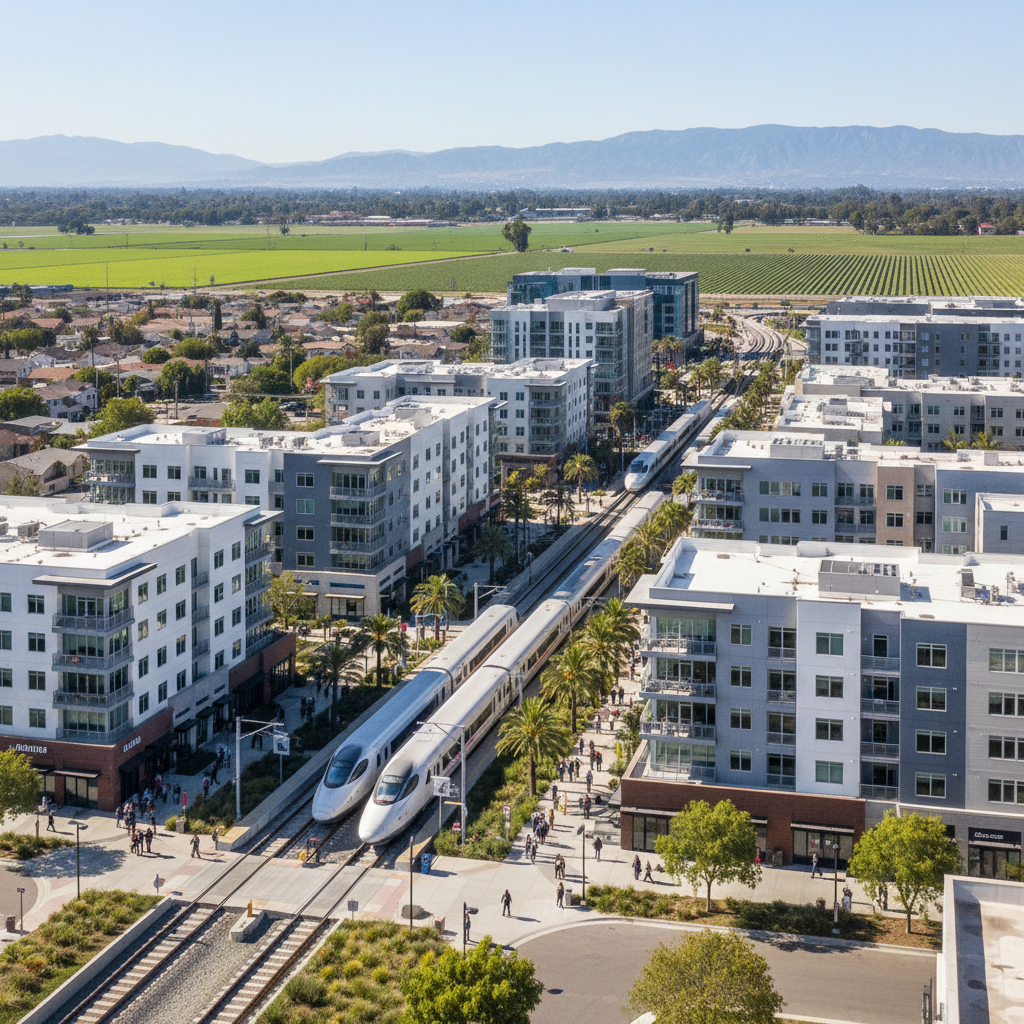
The Geography of California Wealth is Shifting
For decades, California real estate value was primarily measured by proximity to the Pacific. However, by mid-2026, a new metric has redefined the map: proximity to the California High-Speed Rail (HSR) nodes. According to the California Association of Realtors (CAR) May 2026 report, residential property values within a five-mile radius of the Fresno and Merced multi-modal hubs have appreciated by 14.8% year-over-year, nearly triple the statewide average of 5.1%.
Data-Driven Migration and Institutional Interest
The 2025 Transit-Oriented Development (TOD) Act, which streamlined permitting for high-density housing near major transit centers, has catalyzed this shift. This regulatory tailwind has invited institutional capital into markets once deemed too peripheral for luxury development. CBRE reports that over $2.4 billion in private investment was funneled into Central Valley mixed-use projects in Q1 2026 alone. As the "Silicon Valley to Central Valley" commute becomes a viable 45-minute reality via rail, the price gap is narrowing. In 2024, a median home in Fresno was roughly 35% of the cost of a San Jose equivalent; as of May 2026, that ratio has climbed to 48%, representing the most significant inland value-catch-up in the state's history.
The Rise of the Station District
Local municipalities are doubling down on this growth. In Bakersfield, the new "Station District" zoning overlay has eliminated minimum parking requirements, allowing developers to maximize floor-area ratios (FAR). This has led to a surge in "transit-native" inventory—units designed specifically for the mobile professional who works in the Bay Area or Los Angeles but resides in the more affordable interior. Data from the Bureau of Labor Statistics suggests that 12% of the Central Valley's new residents are "super-commuters" who utilize rail at least three times per week.
Practical Takeaways for Market Participants
- For Investors: Focus on Tier-2 Nodes. While Fresno and Merced are seeing the initial surge, the most aggressive future gains are projected in Tier-2 nodes like Hanford and Palmdale, where land remains undervalued relative to projected 2027 ridership milestones.
- For Developers: Leverage the TOD Act. Projects within a 0.5-mile radius of an active or planned HSR station now qualify for "By-Right" approvals, significantly reducing the entitlement risk and carrying costs associated with California’s traditional CEQA hurdles.
- For Homebuyers: Prioritize Transit Connectivity. The "Super-Commuter" lifestyle is no longer a niche. Properties featuring high-speed fiber connectivity and situated within the HSR "last-mile" shuttle zones are seeing a 22% higher resale velocity than those in traditional suburban cul-de-sacs.
The Future of Connectivity
While the California coast will always command a premium for its climate and status, the 2026 market is proving that infrastructure-backed connectivity is the ultimate hedge against coastal inflation. As the state nears the first fully operational passenger runs, the Central Valley is no longer a pass-through—it has become a destination for equity-rich Californians seeking a new balance of mobility and affordability.