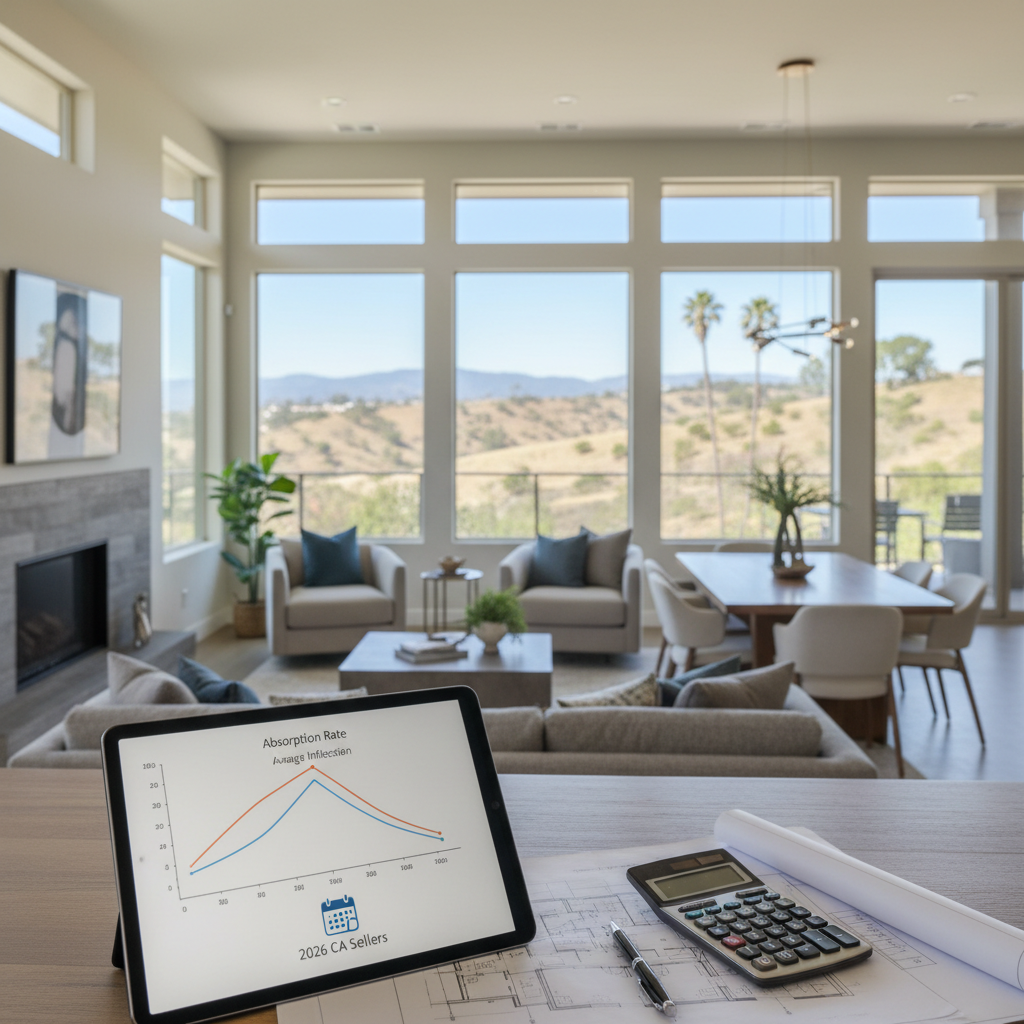
The Mid-May Pivot: Navigating California's 2026 Peak Window
Today, May 14, 2026, marks the statistical 'sweet spot' for the California real estate market. According to recent data from the California Association of Realtors (CAR), homes listed in the second week of May historically garner a 2.8% premium over the annual median. However, in the 2026 landscape—defined by stabilized yet elevated interest rates—success is no longer about simply being on the market; it is about mastering absorption-based pricing.
Decoding the Absorption Rate
To maximize value, sellers must look beyond comparable sales and calculate their neighborhood's absorption rate. This metric determines how many months it would take to sell the current inventory at the current pace of sales. In high-demand hubs like Santa Clara County and Orange County, 2026 data shows an absorption rate of 1.4 months, indicating a deep seller's market. Conversely, regions in the Inland Empire are seeing rates closer to 3.8 months.
- Seller's Market (Under 3 months): Price aggressively at or slightly above the last comparable sale.
- Balanced Market (3–6 months): Price exactly at the last comparable sale to drive traffic.
- Buyer's Market (Over 6 months): Price 2-3% below the last sale to capture the limited pool of active buyers.
The 21-Day Pricing Rule
In the 2026 California market, the 'first look' is more critical than ever. MLS data indicates that 82% of successful sales in the first half of this year occurred within the first 21 days of listing. If a property does not receive a qualified offer within this window, the probability of a price cut increases by 40%. Sellers should have a pre-planned 'adjustment strategy' ready before the home even hits the market to avoid the stigma of a stale listing.
Maximizing Value Through High-ROI Preparations
While previous years focused on cosmetic staging, 2026 buyers are prioritizing systemic integrity. Practical investments that yield the highest return in the current California climate include:
- Smart-Home Climate Integration: With Title 24 energy requirements becoming more stringent, homes with integrated heat pump monitoring and smart thermostats are seeing a 1.5% valuation bump.
- Drought-Resilient Curb Appeal: Replacing traditional turf with California-native xeriscaping remains a top ROI move, particularly in the Central Valley and Southern California, often returning 120% of the investment at closing.
- Verified Square Footage: In a tight market, discrepancies between tax records and actual usable space can kill a deal. Hiring a professional appraiser to certify square footage before listing prevents mid-escrow renegotiations.
Practical Takeaways for the 2026 Seller
- Audit the Competition Weekly: Don't just look at what sold; look at what is 'Pending.' Pending prices represent the current market sentiment, while 'Sold' prices represent the market 30-60 days ago.
- Leverage the 'Tuesday Refresh': If adjusting price or status, do so on a Tuesday. This ensures the update is processed by major aggregators in time for the Thursday/Friday weekend planning cycle for buyers.
- Prioritize 'Certainty' over 'Price': In an environment where financing can be brittle, an offer at 98% of asking with a 20% down payment and a 14-day appraisal contingency is often superior to a 102% offer with 3.5% down and lengthy contingencies.
As we move into the latter half of May, the window for capturing the 'Spring Surge' is closing. By shifting from a purely aesthetic focus to a data-driven strategy centered on absorption and systemic efficiency, California sellers can secure not just a sale, but a market-leading premium.


