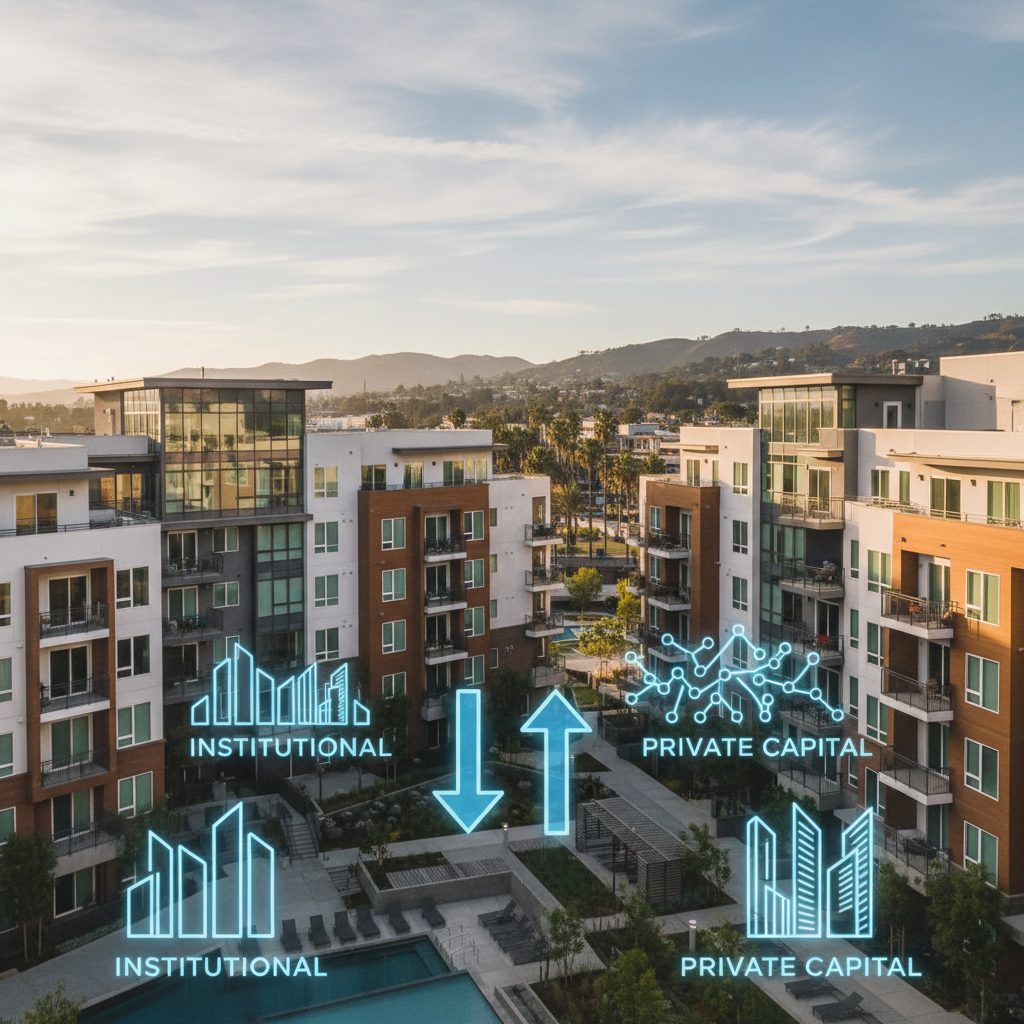
The Institutional Offload: Private Capital Reclaims California’s Multi-Family Sector
For much of the last decade, California’s multi-family landscape was dominated by institutional behemoths. However, as of May 2026, a significant structural shift is underway. Large-scale Real Estate Investment Trusts (REITs) and institutional funds are increasingly rotating their portfolios, offloading 'Class B' and 'Class C' assets in favor of new-build developments in the Sun Belt. This migration has opened a rare window for private syndicators and local high-net-worth investors to reclaim the 'middle market' of California real estate.
The Data Behind the Rotation
According to Q1 2026 data from CBRE, institutional divestment from California multi-family assets built between 1970 and 2005 has increased by 22% year-over-year. Simultaneously, the National Association of Realtors (NAR) reports that private buyer participation in the $5M to $25M price bracket has reached its highest level since 2019. This 'Institutional Offload' is driven by a desire for lower-maintenance, ESG-compliant new construction, leaving behind older California assets that possess significant 'value-add' potential through targeted renovations.
The Yield Gap: Why Local Expertise Wins
Institutional funds often struggle with the granular management required for California’s regulatory environment. In contrast, local private capital is proving more adept at navigating 2026’s landscape. With the 10-year Treasury yield finally stabilizing near 4.2%, the 'spread'—the difference between cap rates and borrowing costs—has widened enough to make value-add plays viable again. In markets like the East Bay and the Santa Clarita Valley, cap rates for secondary assets have expanded to 5.8%, while stabilized debt costs hover around 6.1%, allowing for positive leverage through strategic rent growth and operational efficiencies.
Targeting the 'Renovation Beta'
The current opportunity lies in the 'Renovation Beta.' Investors are targeting 20- to 50-unit complexes that require seismic retrofitting or energy-efficiency upgrades—projects that institutions view as liabilities but private investors see as equity-building milestones. By utilizing State Bill 35 (SB 35) streamlined approvals for minor footprint expansions, these private owners are adding ADUs (Accessory Dwelling Units) to existing lots, effectively lowering their per-unit basis by up to 15%.
Practical Takeaways for Investors
- Focus on the Gap: Seek assets in the $5M–$15M range, which is typically too small for major institutions and too large for the average retail investor.
- Leverage Local Incentives: Utilize California’s 'Property Tax Postponement' and energy-efficiency grants to offset initial renovation costs.
- Underwrite for Retention: In a high-cost environment, tenant retention is the new growth. Prioritize assets with 'sticky' amenities like secure bike storage and high-speed mesh Wi-Fi.
- Monitor the Spread: As the Fed maintains a neutral stance in mid-2026, lock in five-year fixed-rate debt to hedge against late-cycle volatility.
The 2026 California market is no longer a monolith of institutional dominance. It is becoming a playground for the local specialist who understands that value in the Golden State is found not in the shiny and new, but in the strategic rehabilitation of the existing fabric.


