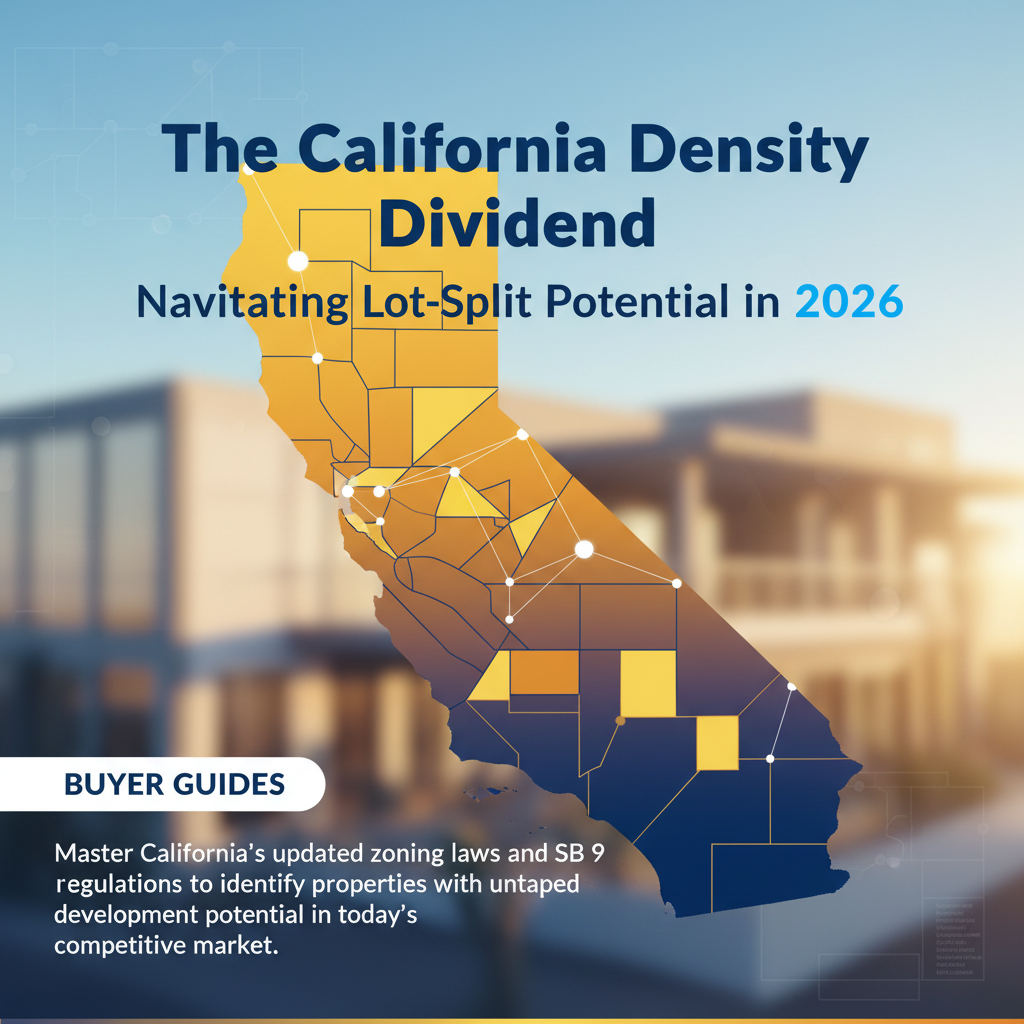
The Shift Toward Density: Understanding SB 9 in 2026
As of May 2026, the California housing market remains defined by scarcity, with the California Association of Realtors (C.A.R.) reporting a median home price hovering near $915,000. In this high-cost environment, savvy buyers are shifting their focus from turnkey aesthetics to 'density potential.' The California Home Design Act (SB 9) and subsequent 2025 refinements have fundamentally altered the value proposition of single-family lots, allowing many homeowners to split lots or build up to four units on a single-family parcel. For the 2026 buyer, the goal is no longer just finding a home, but identifying a 'development-ready' asset.
The ADU Multiplier: Beyond the Backyard Cottage
While Accessory Dwelling Units (ADUs) have been a staple of California real estate for years, 2026 marks a turning point in how they are financed and integrated. New state-backed grant programs and streamlined local permitting have made 'Junior ADUs' (converted space within the existing footprint) and detached units more accessible. Data from the California Department of Housing and Community Development (HCD) suggests that properties with ADU potential command a 12-15% premium in markets like San Diego and Sacramento. Buyers should look for 'clear-to-build' setbacks and utility capacity during their initial walkthroughs.
The 2026 Due Diligence Checklist: Zoning and Feasibility
Traditional inspections are no longer sufficient in the modern California purchase process. A 'Density Audit' is now a critical component of the 17-day contingency period. Buyers must verify several factors before removing contingencies:
- Zoning Designations: Verify the specific R-1 or R-2 sub-designations and how local 'Objective Design Standards' might limit your SB 9 dreams.
- Utility Lateral Capacity: Older neighborhoods in Los Angeles or the Bay Area may require expensive sewer or electrical upgrades to support additional units.
- Easement Encumbrances: Check the preliminary title report for utility easements that could bifurcate a lot and prevent a split.
- Topography: California's hilly terrain can turn a simple ADU project into a million-dollar foundation nightmare.
Market Conditions: The 2026 Inventory Reality
Current MLS data indicates that inventory remains 20% below pre-pandemic norms, yet the 'lock-in effect' of low 2021 mortgage rates has begun to thaw. As more sellers list their homes to move into downsized high-density developments, traditional single-family lots are becoming rare commodities. Targeting properties with larger-than-average lots—even if the primary structure needs work—is the primary strategy for buyers looking to 'manufacture' equity in a flat-growth environment.
Practical Takeaways for the Strategic Buyer
- Hire a Zoning Consultant: Before placing an offer on a lot-split candidate, spend the $500–$1,000 for a professional feasibility study.
- Review the 'Specific Plan': Many California municipalities have 'Specific Plans' that override general zoning. Ensure your target property isn't in a restricted historic or environmental zone.
- Calculate the 'Residual Land Value': If you plan to split and sell a portion of the lot, work backward from the expected sale price of the new parcel to ensure your purchase price makes sense.
- Look for 'Attached' ADU Potential: Converting a garage or a basement is often 40% cheaper than a ground-up build, offering a faster path to rental income.