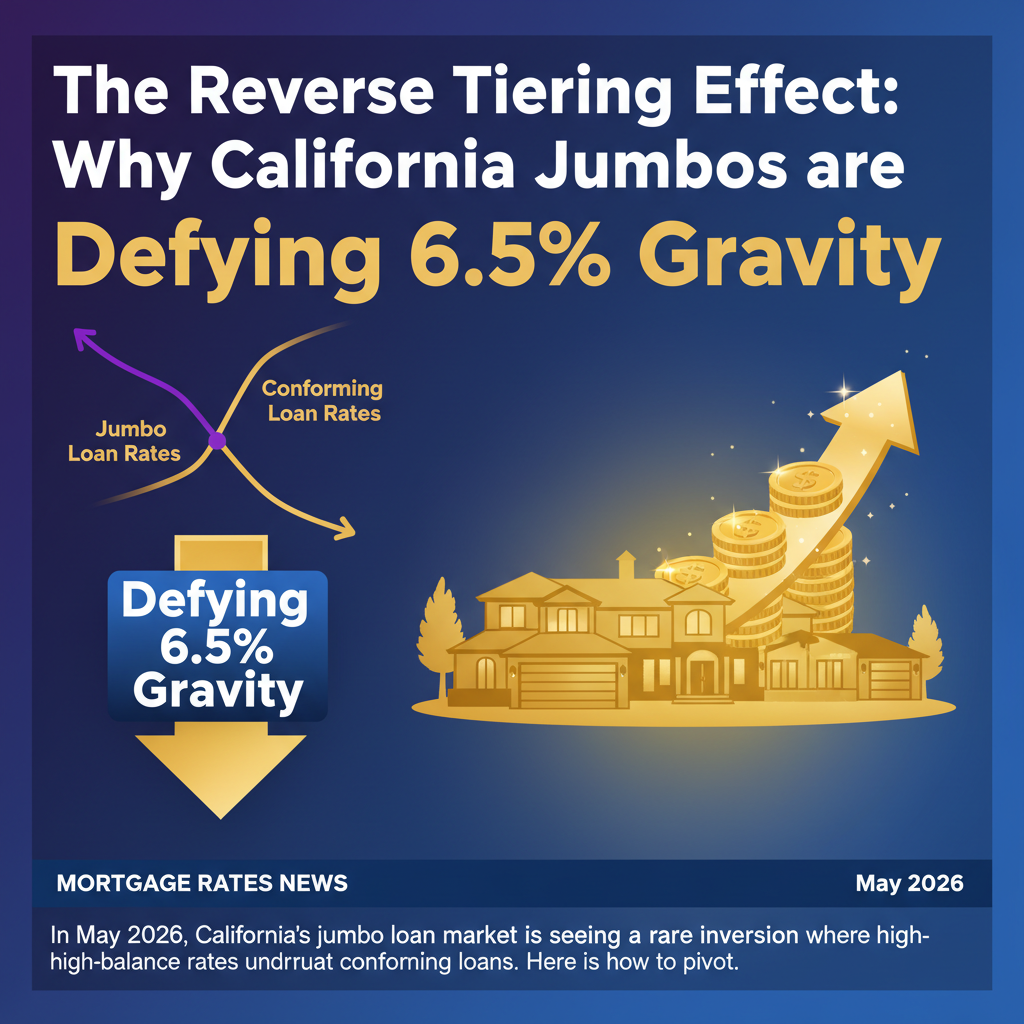
The Great Rate Inversion of May 2026
As we move into the second week of May 2026, the California mortgage landscape has produced a phenomenon rarely seen in high-interest cycles: the 'Reverse Tiering Effect.' While the national average for a conforming 30-year fixed mortgage has plateaued near 6.55%, high-net-worth lenders in California’s coastal hubs are aggressively pricing Jumbo products as low as 6.125%.
Data from the Mortgage Bankers Association (MBA) suggests that this 40-to-50 basis point spread in favor of Jumbo loans is driven by a surge in bank liquidity. After two years of cautious lending, California’s regional and national banks are competing for the high-FICO, low-LTV (Loan-to-Value) borrowers that dominate the $1.2M+ market in counties like San Francisco, Orange, and Santa Clara.
Why the Conforming-Jumbo Spread has Flipped
Traditionally, Jumbo loans carry a premium because they cannot be sold to Fannie Mae or Freddie Mac. However, in the current 2026 climate, several factors have inverted this logic:
- Deposit Stability: Major California institutions have seen a 12% year-over-year increase in private wealth deposits, providing them with 'cheap' capital to deploy into stable mortgage assets.
- Secondary Market Appetite: Private-label securitizations of California residential debt are currently yielding better risk-adjusted returns for institutional investors than volatile 10-year Treasuries.
- Portfolio Retainment: Banks are increasingly choosing to hold these loans on their own balance sheets rather than selling them, allowing for bespoke pricing that bypasses the standard 'hits' seen in the conforming market.
The California Conundrum: Mid-Market Pressure
While the luxury tier finds relief in the 6.1% range, the California mid-market—homes priced between $600,000 and $1,100,000—remains in a 'Conforming Crunch.' Buyers in this bracket often fall under FHFA high-balance limits, which, as of May 2026, are actually pricing higher than true Jumbo loans. This creates a strange reality where a borrower taking a $1.5 million loan may secure a monthly payment disproportionately close to someone taking a $900,000 loan.
Strategic Takeaways for May 2026 Buyers
For those navigating the current California inventory, the following strategies are proving most effective:
- Threshold Optimization: If your loan amount is near the Jumbo threshold (approx. $1,150,000 in high-cost counties), it may be mathematically advantageous to borrow more or put less down to move into the Jumbo pricing tier, then apply a 'recast' later.
- Relationship Banking Tiers: Several ‘Big Four’ banks are offering 0.125% to 0.250% rate discounts for every $250,000 in assets moved into their ecosystem. In a 6.5% environment, these relationship discounts are the primary way buyers are reaching the 5% handle.
- The 90-Day Lock Strategy: With the Fed signaling a ‘higher for longer’ stance through the summer, volatility is high. Secure lenders offering 90-day locks with a one-time 'float down' option if the 10-year Treasury dips below 4.2% before your June or July closing.
The Outlook: Summer 2026
According to recent California Association of Realtors (CAR) sentiment surveys, inventory is up 14% compared to last spring, but absorption remains fast. The 'Jumbo Discount' is currently the primary engine of the California move-up market. Prospective sellers who were hesitant to give up their 3% rates are finding the 6.1% Jumbo rate a 'palatable pivot' when moving into higher-value primary residences.


