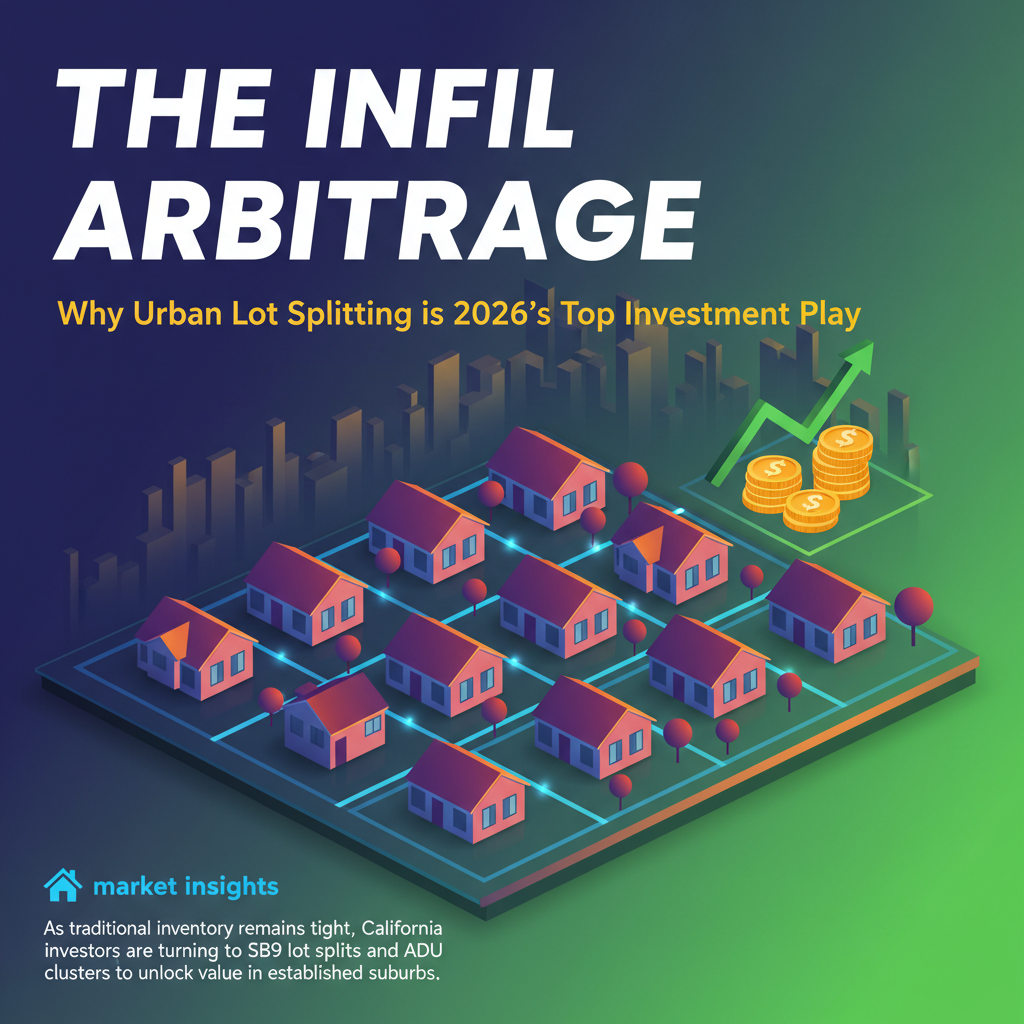
Redefining the California Dream: From Single-Family to High-Density Infill
In May 2026, the California real estate narrative has shifted from waiting for rates to drop to manufacturing equity through density. With the California Housing Opportunity and More Efficiency (HOME) Act—better known as SB9—now in its fifth year of implementation, the market is witnessing a professionalization of the lot split strategy. This transition is creating a new class of asset: the subdivided suburban parcel.
The Maturation of SB9 and ADU Legislation
According to the California Department of Housing and Community Development (HCD) 2025 year-end report, lot-split applications across Tier 1 cities like San Diego, Los Angeles, and Sacramento increased by 34% year-over-year. The regulatory friction that initially hampered density-focused legislation has smoothed out as municipalities updated their general plans to comply with state mandates. For investors, this means the entitlement risk—historically the biggest hurdle in California development—has reached a five-year low.
The Math of the Split: ROI Analysis
Data from the National Association of Realtors (NAR) and regional MLS platforms indicate that while the median price of a single-family home in California has plateaued near $840,000, the combined valuation of a split lot—featuring a primary residence and a newly deeded second lot—can command a 20-25% premium over the original single-asset price. In high-demand corridors like Orange County and the San Gabriel Valley, the Infill Arbitrage is outperforming traditional fix-and-flip margins by nearly 400 basis points.
Key Investment Indicators for 2026
- Zoning Compliance: Properties previously restricted by local character ordinances are now protected by state pre-emption, allowing for up to four units on many single-family lots via splits and ADUs.
- Infrastructure Readiness: Savvy investors are targeting 1950s-era suburbs where utility capacity is sufficient for dual-metering without massive municipal surcharges.
- The ADU Multiplier: By 2026, the Junior ADU (JADU) has become a standard requirement for appraisal uplift, often providing enough rental income to cover the debt service of the primary structure.
Practical Takeaways for the 2026 Market
For Sellers: Before listing, consult a land-use attorney to determine if your property qualifies for a ministerial lot split. Providing a pre-entitled split package can attract a developer premium, even if you do not perform the construction yourself.
For Investors: Focus on R1-zoned parcels larger than 1,200 square feet per the state minimums, but prioritize lots over 8,000 square feet for maximum design flexibility. The sweet spot is the post-war bungalow where the existing structure can be retained while the rear lot is converted into a separate, sellable parcel.
For Buyers: Look for hidden density potential. Purchasing a home that accommodates an ADU or a lot split is the most effective hedge against the rising cost of living in California’s coastal and transit-adjacent markets, providing future-proof equity growth.