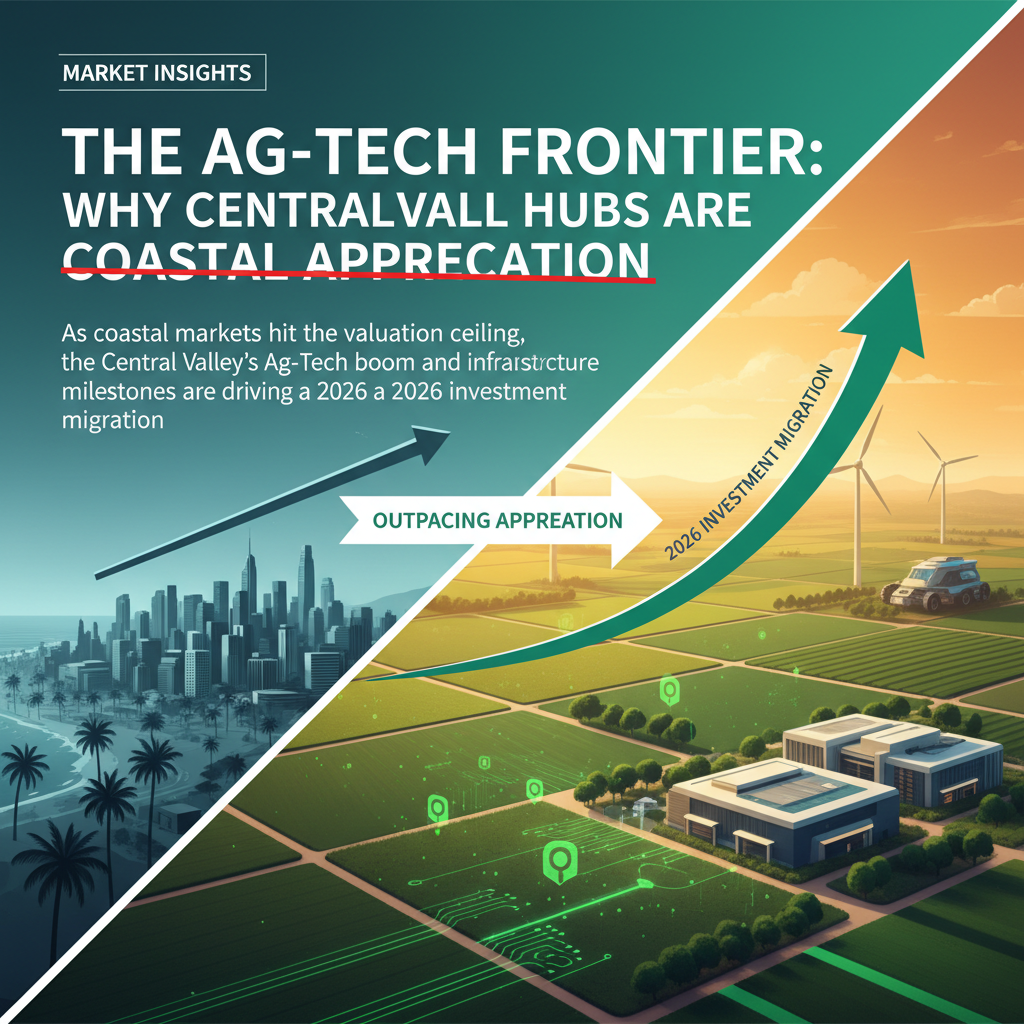
The Great Inland Migration: Analyzing California’s 2026 Growth Engines
For decades, California’s real estate narrative was written almost exclusively along its coastline. However, as of May 2026, a seismic shift in capital allocation is underway. While San Francisco and Los Angeles grapple with a period of price consolidation, the Central Valley—specifically the Fresno-Bakersfield-Sacramento corridor—is experiencing a surge in both residential demand and institutional investment. This trend, often referred to as the "Ag-Tech Synergy," is redefining the state’s economic geography.
Data-Driven Growth: The Yield Gap Widens
According to recent MLS data and California Association of Realtors (CAR) quarterly reports, median home prices in the Central Valley have appreciated by 8.4% year-over-year as of Q1 2026. In contrast, coastal metros have seen a more modest 2.1% growth. The catalyst is not merely affordability, but a robust job market anchored by the burgeoning Ag-Tech sector. Investment in agricultural robotics and sustainable water technology has brought high-paying technical roles to regions previously dominated by seasonal labor.
Furthermore, CBRE’s 2026 Industrial Outlook highlights a 15% increase in laboratory and R&D footprint in the Sacramento-Roseville area. This diversification of the labor pool is creating a "sticky" population—high-income earners who are choosing the Valley not as a temporary refuge, but as a permanent primary residence.
The Infrastructure Catalyst: High-Speed Rail and Connectivity
The 2026 real estate landscape is also being reshaped by tangible progress in the California High-Speed Rail project. With the operational testing phases in the Central Valley segment now highly visible, land valuations within a 15-mile radius of planned stations in Fresno and Hanford have seen a speculative premium of 12% to 18%. Investors are no longer viewing these regions as isolated pockets, but as interconnected nodes of a future mega-region that links the northern and southern economic engines.
Investment Perspectives: The Pivot to Secondary Markets
For real estate investors, the 2026 play is centered on the "Yield Arbitrage." Cap rates in the Central Valley for multi-family assets are currently averaging 5.8%, compared to the 3.9% seen in the saturated Orange County and Silicon Valley markets. The risk-adjusted return profile has shifted in favor of these secondary hubs, supported by a 2025-2026 Census Bureau report showing that net domestic migration within California is moving decisively eastward.
Practical Takeaways for 2026 Stakeholders
- For Investors: Look for multi-family opportunities in "Tier 2" cities like Visalia and Modesto. These areas are benefiting from the overflow of the Ag-Tech boom but have not yet seen the full price appreciation of Sacramento or Fresno.
- For Developers: The demand for "Work-From-Home Plus" floor plans remains high in the Valley. Buyers in these regions are looking for larger square footage and dedicated office spaces that coastal condos cannot provide.
- For Sellers: If you are holding assets in the Central Valley, the current supply-demand imbalance favors a hold strategy or a 1031 exchange into larger commercial assets in the same region to capitalize on the sustained upward trajectory.
As we move further into the 2026 fiscal year, the Central Valley is proving to be more than just a pressure valve for coastal housing costs; it is becoming the new frontier for California’s economic and real estate expansion.