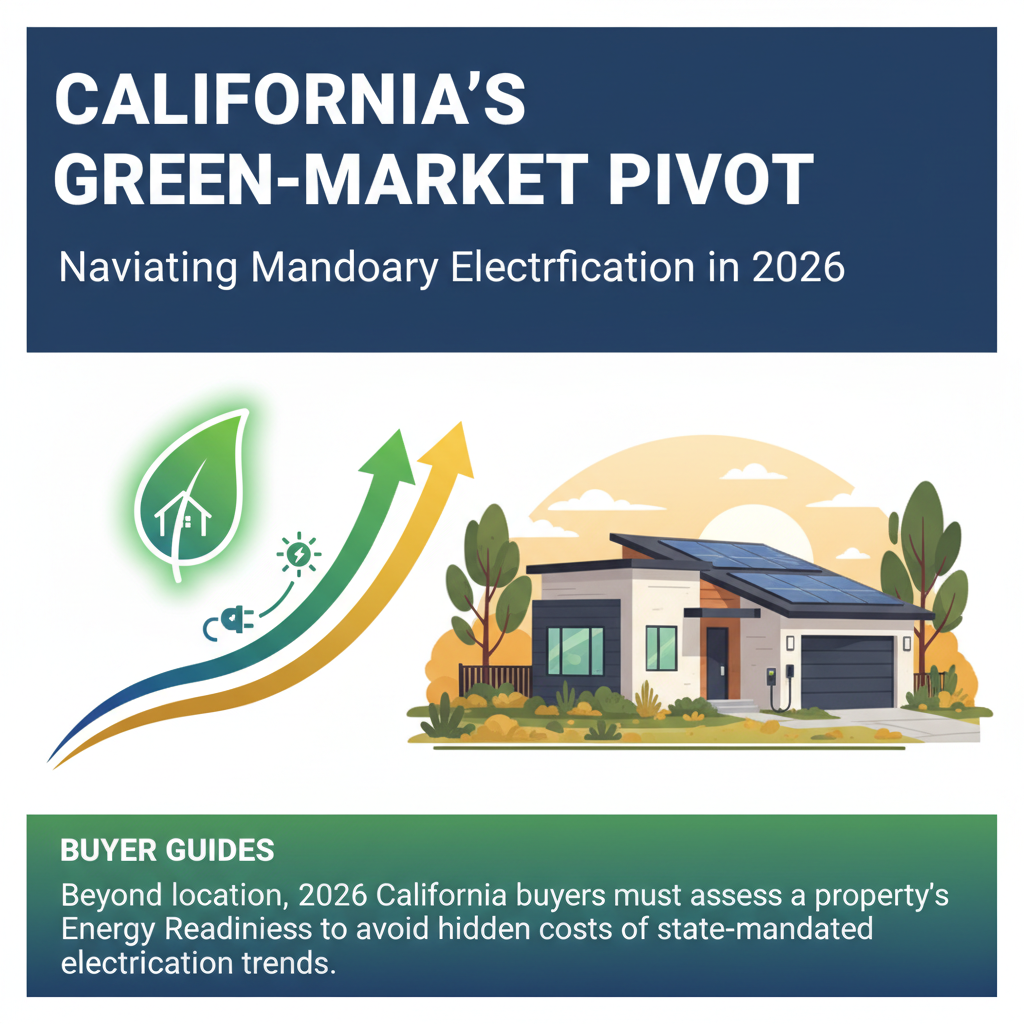
The 2026 California Energy Landscape
In May 2026, the California residential market is no longer defined solely by square footage and school districts. As the state moves closer to its 2030 climate goals, home buyers are facing a new reality: the 'Energy Readiness' of a property. With the latest iterations of Title 24 Building Standards and various local 'Reach Codes,' the distinction between gas-reliant older stock and modern all-electric homes has become a primary driver of long-term value. According to recent California Energy Commission (CEC) reports, homes meeting the highest efficiency standards are commanding a 4-7% premium over non-compliant peers.
Understanding the Electrification Gap
For buyers in 2026, the 'Electrification Gap' represents the potential cost of retrofitting a home to meet future standards or local mandates. Many municipalities in the Bay Area and Southern California now require 'time-of-sale' energy disclosures or upgrades. When touring properties, it is essential to look beyond aesthetics and evaluate the infrastructure. A home with an outdated 100-amp electrical panel may require a $3,000 to $6,000 upgrade just to support the Level 2 EV charging and heat pump technology that is becoming standard in the 2026 market.
Data-Backed Value Drivers
Data from the National Association of Realtors (NAR) 2025 Sustainability Report indicates that 63% of California agents find that high-efficiency features are now 'very important' to their clients. Furthermore, properties equipped with integrated battery storage systems (like the Tesla Powerwall 3 or equivalent) see an average of 12 fewer days on market compared to those without. This is particularly relevant in 2026 as utility rates from providers like PG&E and SCE continue to rise, making energy independence a financial necessity rather than a luxury.
Practical Takeaways for the 2026 Buyer
- Audit the Panel: Ensure the electrical service is at least 200 amps. If the home is still on a 100-amp service, use the cost of an upgrade as a negotiation point in your offer.
- Verify Heat Pump Maturity: Check the age and SEER2 rating of HVAC systems. Systems installed prior to 2023 may not meet current efficiency expectations and could face higher maintenance costs.
- Check for 'Solar Grandfathering': If the home has solar, determine if it falls under NEM 2.0 or NEM 3.0. Properties with NEM 2.0 status are highly coveted in 2026 because they offer significantly better export rates for solar energy.
- Look for Induction Readiness: As cities move toward banning gas stove hookups in major renovations, having an existing 240V outlet behind the range is a significant future-proofing asset.
The Long-Term Investment Perspective
While the initial cost of a highly efficient, all-electric home may be higher, the 2026 market is increasingly penalizing 'energy-legacy' homes. Buyers who prioritize properties with solar-plus-storage and high-performance envelopes are seeing lower total cost of ownership (TCO). As California’s grid continues its transition, the 'Green-Market Pivot' ensures that your 2026 purchase remains liquid and competitive in the decade to come.