The Collision of Demographics and Tax Policy
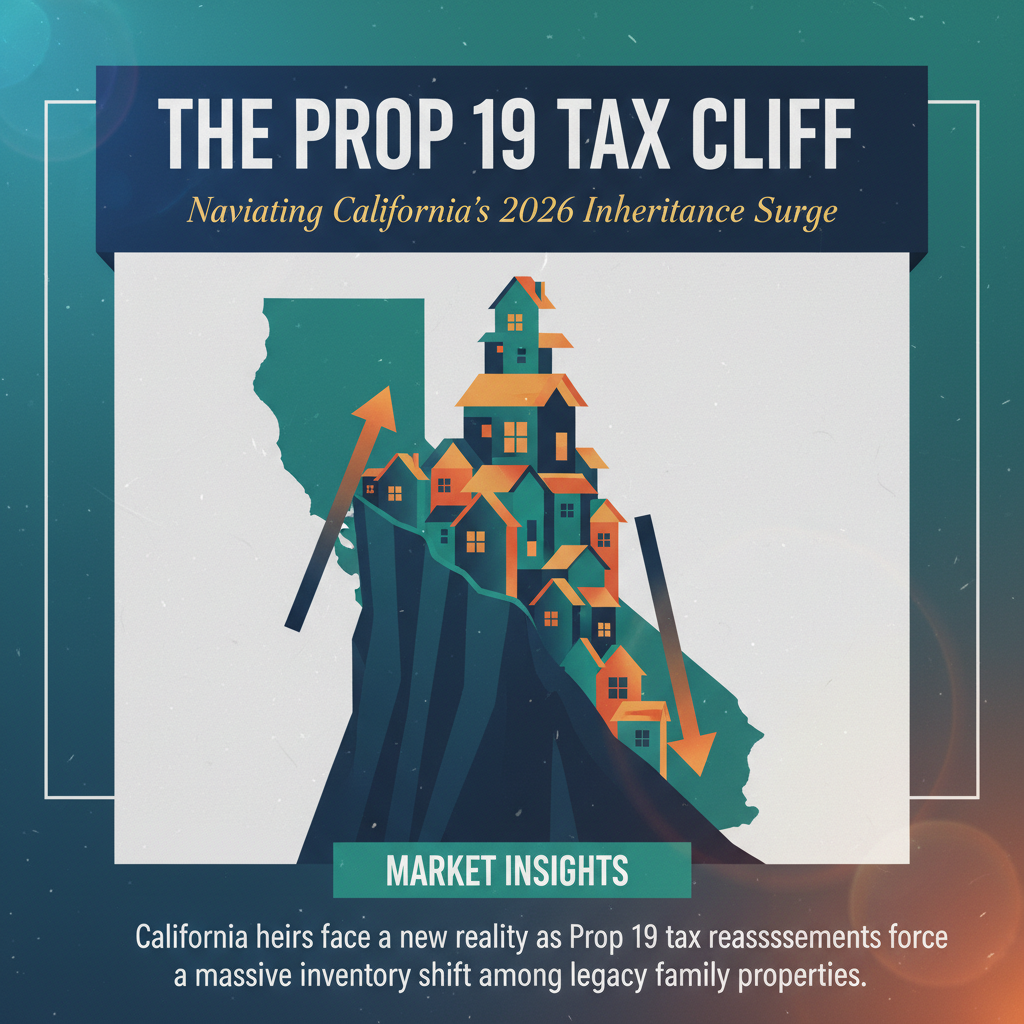
In May 2026, the California real estate market is grappling with the full-scale impact of Proposition 19, five years after its implementation. While initial headlines focused on its portability benefits for seniors, the 'inheritance cliff' has now become the primary driver of inventory in mid-to-high-tier coastal markets. As the 'Silver Tsunami' accelerates, heirs are discovering that the legacy tax protections of Proposition 13 no longer apply to properties not used as a primary residence, leading to a structural shift in how family wealth is managed and liquidated.
The End of the Legacy Tax Shield
Historically, California's Proposition 13 allowed children to inherit their parents' property tax basis, regardless of the property's use. Proposition 19 curtailed this, requiring that the heir must move into the home as their principal residence within one year to avoid a market-rate reassessment. According to data from the California Association of Realtors (CAR), by Q2 2026, the average tax reassessment for inherited properties in the San Francisco Bay Area and Los Angeles County has resulted in a 450% increase in annual property tax liabilities for non-resident heirs.
Quantifying the 2026 Inventory Influx
The Legislative Analyst’s Office (LAO) projected that billions in property value would be reassessed annually. In 2026, this has manifested as a 'forced liquidity event.' MLS data suggests that approximately 18% of new listings in affluent ZIP codes are 'estate-driven sales,' where heirs have opted to list the property rather than shoulder the new carrying costs. This influx is providing a rare window of opportunity for buyers who were previously shut out of established neighborhoods where turnover was historically low.
Investment Perspectives: The Reassessment Arbitrage
For investors, the Prop 19 environment creates a specific type of motivated seller. Many heirs are 'house rich but cash poor,' unable to service a $25,000 annual tax bill on a home their parents paid $1,500 for. This has led to an increase in creative acquisition strategies, including seller-financed deals where heirs maintain a stream of income without the burden of property management and taxation. Furthermore, institutional buyers are increasingly targeting these legacy assets, converting them into high-end rentals that can absorb the higher tax basis through premium lease rates.
Practical Takeaways for 2026 Market Participants
- For Heirs: Immediate consultation with a tax professional is mandatory. Strategies such as forming a family LLC or utilizing an 'intergenerational transfer' must be executed with precision to mitigate the $1 million valuation exclusion limit provided under the law.
- For Buyers: Target neighborhoods with high concentrations of long-term owners (30+ years). These areas are seeing the highest rate of tax-driven turnover, leading to more negotiable pricing compared to newly developed tracts.
- For Investors: Look for 'Step-up in Basis' opportunities. The tax-advantaged reset of the capital gains basis upon death remains a powerful tool, even if the property tax basis is lost. The goal is to maximize the net proceeds from a quick resale or a high-yield conversion.
As we move through 2026, the 'Inheritance Cliff' is doing what decades of market cycles could not: unlocking the most coveted residential land in California. The transition is painful for legacy families but vital for a market starved for supply and mobility.


