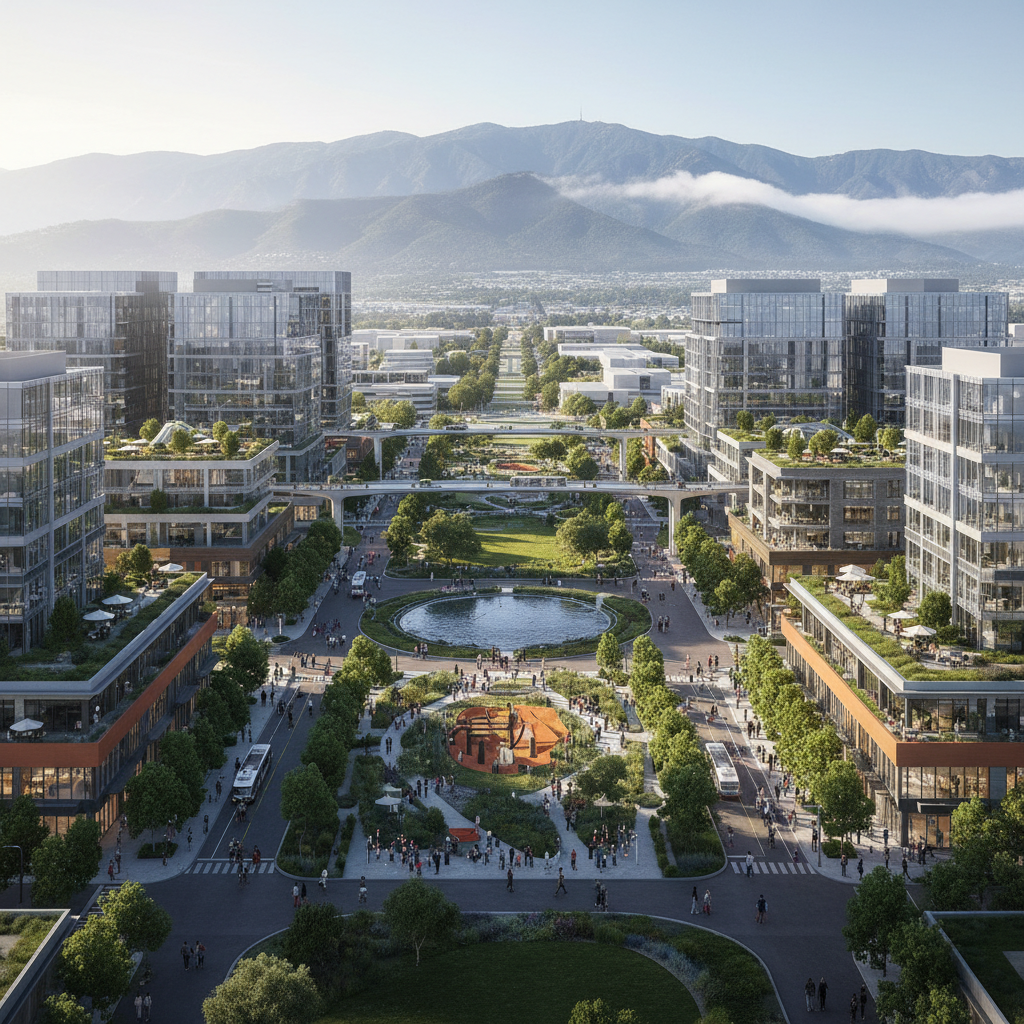
The Evolution of the Silicon Valley Office Park
In 2026, the definition of a 'neighborhood' in Northern California has undergone a fundamental shift. Nowhere is this more evident than in Mountain View’s North Bayshore. Historically known as the secluded headquarters of global tech giants, the district has successfully completed its first phase of the 'North Bayshore Master Plan,' transforming 150 acres of parking lots and low-rise offices into a vibrant, mixed-use ecosystem. This transition reflects a broader California trend: the dismantling of single-use zoning in favor of 'Live-Work-Wild' environments.
Housing Data and Urban Density
According to 2025 MLS data and city housing reports, North Bayshore has introduced over 3,500 new residential units in the last 24 months, with an additional 4,000 in the pipeline. These are not traditional suburban homes; they are high-performance, LEED Platinum-certified apartments and condos. While the median home price in Mountain View remains high at $2.1 million, the North Bayshore inventory offers a unique entry point for high-earning professionals, with luxury two-bedroom units commanding rents 15% higher than the South Bay average due to their proximity to 'campus-adjacent' amenities.
The 'Wild' Component: Sustainability and Amenities
Unlike the dense urbanism of San Francisco, North Bayshore’s appeal lies in its integration with the natural landscape. The district serves as a gateway to the Shoreline at Mountain View parkland. Residents benefit from over 10 miles of restored marshland trails and the 50-acre Shoreline Lake. Community features in 2026 include:
- The Gateway Commons: A 5-acre central plaza hosting year-round farmers markets and outdoor co-working pods.
- Ecological Corridors: Elevated greenways that allow local wildlife to navigate between the bay and the Santa Cruz Mountains.
- Retail Integration: 200,000 square feet of street-level retail focusing on sustainable grocery concepts and local makers.
Transportation and Connectivity
The neighborhood has moved away from car-dependency. In 2026, North Bayshore is a 'Transit-First' zone. The VTA’s expanded light rail service now connects directly to the Mountain View Caltrain station, facilitating a 45-minute commute to San Francisco or a 15-minute hop to the newly completed San Jose Diridon High-Speed Rail hub. Furthermore, the district’s internal autonomous micro-shuttle network has reduced internal combustion vehicle traffic by 30% since 2023, according to Metropolitan Transportation Commission (MTC) data.
Education and Schools
For families, the neighborhood falls within the highly-ranked Mountain View-Los Altos Union High School District. To accommodate the population surge, the city has opened the North Bayshore Primary School, a state-of-the-art facility focusing on STEAM (Science, Technology, Engineering, Arts, and Math) curricula, leveraging partnerships with neighboring tech research labs to provide real-world learning opportunities.
Investor and Buyer Takeaways
For those looking to act in the 2026 market, North Bayshore presents a high-growth opportunity with a focus on long-term stability. Key insights include:
- Institutional Stability: The heavy presence of 'Big Tech' anchors ensures low vacancy rates and consistent demand for high-end rentals.
- Resale Premium: Properties within '15-minute' walkable radius of the Google Landings and Middlefield Park developments are seeing a 5-8% annual appreciation, outperforming traditional single-family zones.
- Future-Proofing: High ESG (Environmental, Social, and Governance) standards in local construction make these assets more resilient to future California energy regulations.
Mountain View’s North Bayshore is no longer just a place where the world’s software is written; it is a blueprint for how California’s suburban office parks can become the sustainable, high-density neighborhoods of the future.


