The New Valuation Metric: Cost of Carry Over Sale Price
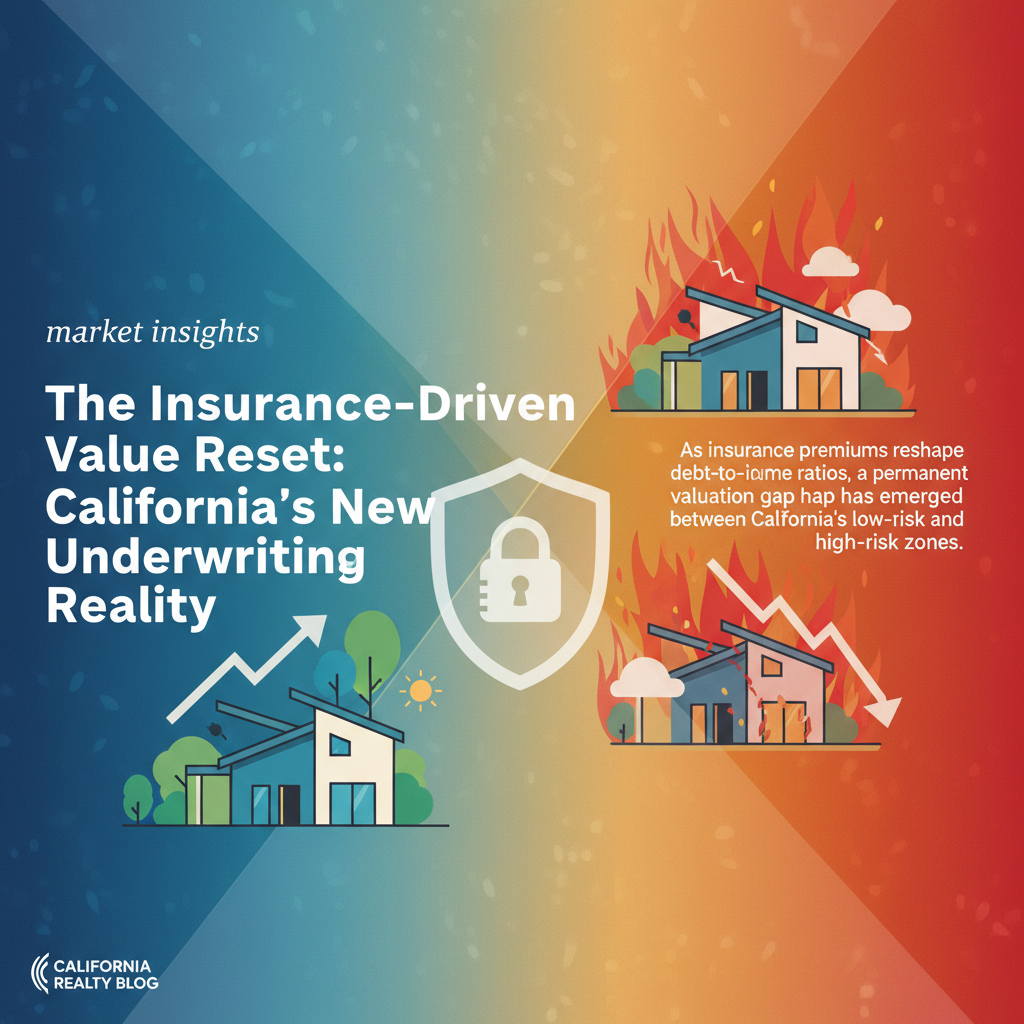
In May 2026, the California real estate market is grappling with a fundamental shift in how property value is calculated. While the supply-demand imbalance dominated headlines in previous years, the primary driver of market friction today is the 'Insurance Premium Gap.' As traditional carriers have restructured their footprints, the cost of insuring a home has transitioned from a negligible closing cost to a primary determinant of a buyer’s Debt-to-Income (DTI) ratio.
According to recent data from the California Department of Insurance (CDI), average homeowners insurance premiums in Wildland-Urban Interface (WUI) zones have increased by 38% since 2024. This surge has created a bifurcated market: 'Insurable Blue Zones' where traditional coverage remains available, and 'FAIR Plan Dependent Zones' where the high cost of the state-mandated last-resort coverage is actively depressing home price appreciation.
The Impact on Purchasing Power
The National Association of Realtors (NAR) reports that for every $1,000 increase in annual carrying costs—such as insurance or taxes—a buyer’s purchasing power is reduced by approximately $12,000 to $15,000, depending on the current mortgage rate. In regions like the Santa Cruz Mountains or the Sierra Foothills, where annual premiums have jumped from $2,500 to $9,000 over the last 24 months, buyers are seeing their effective budgets slashed by over $80,000, regardless of the home's list price.
Commercial real estate is feeling the pressure as well. CBRE insights indicate that insurance now accounts for nearly 15% of total operating expenses for multi-family assets in high-risk zones, up from 6% in 2022. This 'Insurance-Driven Cap Rate Expansion' is forcing a repricing of assets that were once considered blue-chip investments.
Strategic Shifts for 2026 Investors
The 2026 market is rewarding those who prioritize 'Resilience Underwriting.' Institutional investors are no longer just looking at zip codes; they are looking at specific parcel-level risk scores. Properties that have invested in 'Hardened Home' retrofits—such as non-combustible siding, ember-resistant vents, and automated perimeter sprinkler systems—are beginning to command a 5% to 7% 'Resilience Premium' over non-mitigated neighbors.
Practical Takeaways for Market Participants
- For Buyers: Make the Comprehensive Loss Underwriting Exchange (CLUE) report a non-negotiable part of your initial due diligence. Before removing an inspection contingency, secure a firm insurance quote rather than relying on an estimate, as premiums in 2026 can vary significantly even between adjacent blocks.
- For Sellers: In high-risk areas, a 'Resilience Package' is now more valuable than a kitchen remodel. Documented defensible space compliance and retrofitting upgrades can prevent a deal from falling through at the eleventh hour when a lender’s underwriting department reviews the insurance binder.
- For Investors: Focus on the 'Insurance Neutral' mid-cities. Areas with low wildfire and flood scores are seeing accelerated appreciation as 'Climate Refugees' from higher-risk coastal and mountain regions seek stable long-term carrying costs.
Conclusion: The Era of Transparency
As we move further into 2026, the California market is reaching a point of transparency. The hidden costs of climate risk are now fully baked into the financing process. While this has caused a cooling effect in some of the state's most scenic regions, it is fostering a more sustainable and realistic valuation model for the state’s housing stock. The winners in this cycle are those who recognize that a home’s value is no longer just about its location, but its long-term viability in the eyes of an underwriter.


