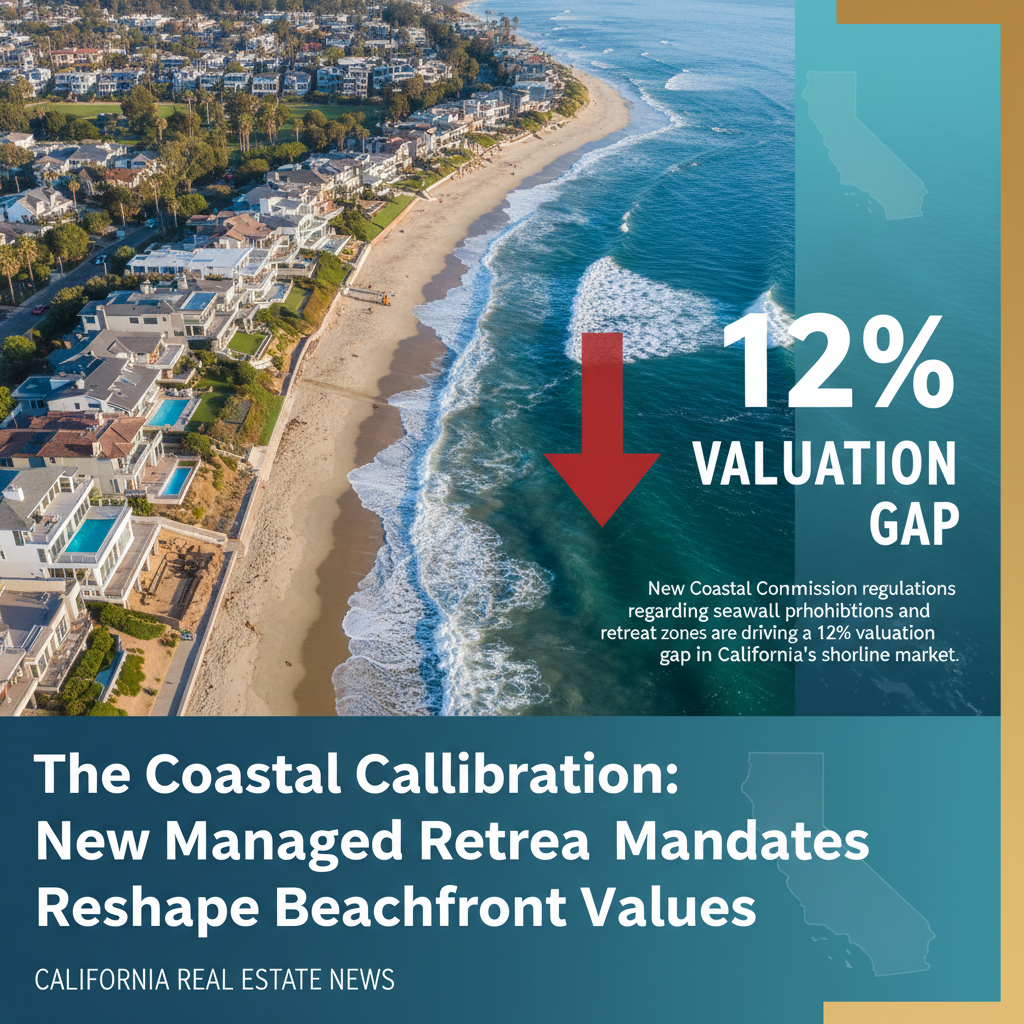
The Era of Managed Retreat Reaches the 2026 Market
As the California real estate market enters the peak spring season of 2026, a significant regulatory shift is fundamentally altering the valuation of the state's most coveted asset: beachfront property. The California Coastal Commission’s (CCC) 2025 'Resilient Shorelines Initiative' has now reached full implementation, and the market is responding with a stark price divergence between 'armored' properties and those within newly designated 'Managed Retreat' zones.
The Valuation Gap Widens
According to data from the California Association of Realtors (CAR) for April 2026, single-family homes located in retreat zones—areas where the state has restricted the construction of new seawalls or the repair of existing armoring—have seen a 12% decline in price per square foot compared to May 2025. Conversely, coastal properties situated on high bluffs or those with grandfathered, permanent protective structures are commanding a 'security premium' of 8% to 15% above the local market average.
This 'Coastal Calibration' is the result of the CCC's strict enforcement of Public Resources Code Section 30235, which now limits protective structures to only those properties that were legally existing before the latest 2025 amendments. For buyers, the prospect of purchasing a home that cannot be physically defended against rising tides is no longer a theoretical risk but a present-day appraisal factor.
Data Points: The Shift in Shoreline Liquidity
- Days on Market (DOM): Homes in identified erosion hazard zones are averaging 64 days on the market, compared to the state coastal average of 22 days.
- Insurance Premiums: Private excess flood insurance for unarmored coastal assets has risen 40% year-over-year, following the 2026 National Flood Insurance Program (NFIP) rate adjustments.
- Development Permits: Coastal development permit (CDP) applications for major renovations in retreat zones have dropped by 30% as owners weigh the risk of 'unbuildable' designations.
Impact on Local Tax Bases
In municipalities like Solana Beach, Malibu, and Santa Cruz, local governments are beginning to brace for the 'Blue Line' impact. As property values in the first and second rows from the mean high tide line soften, property tax assessments are expected to follow. This has led to a surge in 'Property Tax Hardship' filings under Proposition 8, as homeowners argue that new zoning restrictions have permanently impaired their market value.
Practical Takeaways for Investors and Buyers
For those navigating the 2026 California coastal market, the following strategies are now essential:
- Verify 'Mean High Tide' Projections: Before closing, buyers should commission an independent shoreline survey that projects the mean high tide line 30 years into the future based on the 2026 NOAA Sea Level Rise Technical Report.
- Audit Seawall Rights: Not all coastal armoring is created equal. Ensure that any existing seawall has a permanent permit rather than a temporary emergency authorization, which the CCC is increasingly refusing to renew.
- Look for 'Adaptive Design' Credits: Some coastal counties are offering density bonuses or tax credits for homes built on transportable foundations or piers, allowing the structure to be moved inland as the shoreline recedes.
The 2026 market is proving that while the allure of the California coast remains undiminished, the definition of 'prime' real estate is moving inland and upward. Investors are increasingly prioritizing geological stability and regulatory permanence over proximity to the sand.