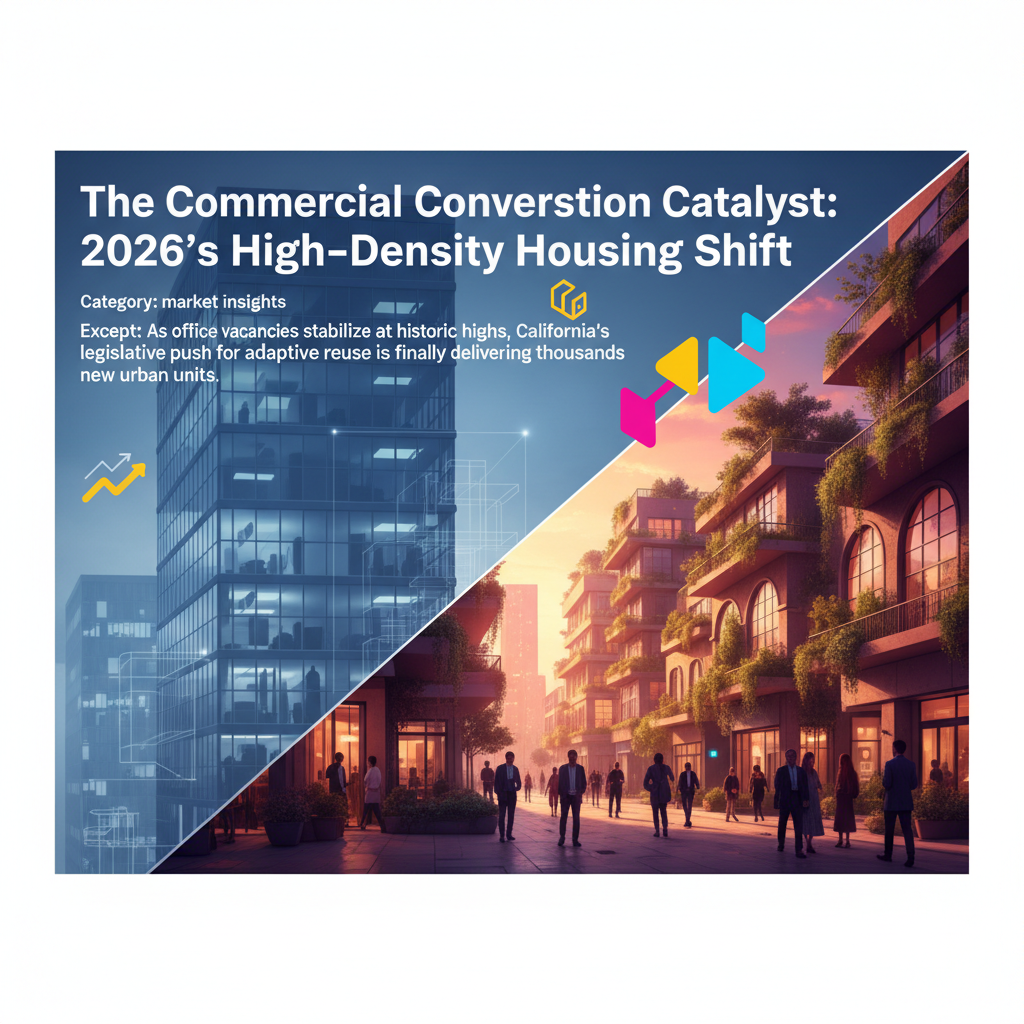
The Great Repurposing: From Cubicles to Condos
As of May 2026, the California real estate landscape is witnessing a structural transformation that few predicted would scale so rapidly. While the 'exit from the city' narrative dominated the early 2020s, the current market is defined by the Commercial Conversion Catalyst. Driven by the full implementation of Assembly Bill 2011 and Senate Bill 6, the state is finally seeing the fruits of streamlined zoning for adaptive reuse, turning underutilized Class B and C office spaces into high-density residential hubs.
The Data Behind the Transition
According to recent CBRE market reports and California Department of Finance data, office vacancy rates in San Francisco and Los Angeles have hovered between 22% and 26% for the past eighteen months. This 'new normal' in commercial real estate has triggered a valuation reset, allowing residential developers to acquire urban footprints at a cost basis that was previously unthinkable. In the first quarter of 2026 alone, conversion permits for over 8,500 units were issued across the state’s five largest metropolitan areas, representing a 40% year-over-year increase in adaptive reuse starts.
The Regulatory Tailwinds
The success of this movement is largely attributed to the erosion of local discretionary review. By 2026, the legislative 'teeth' of housing mandates have forced municipalities to green-light projects that meet specific affordability and density requirements. For investors, this means the 'entitlement risk'—historically the largest barrier to California development—has been significantly mitigated. Projects that once took four years to clear environmental and zoning hurdles are now moving from acquisition to construction in under 14 months.
Investment Perspectives: The Yield Shift
Institutional capital is shifting its focus. The traditional multi-family 'build-from-scratch' model is facing competition from these conversion projects, which often benefit from existing infrastructure and architectural character that appeals to Gen Z and Millennial renters. Market analysts note that these converted units are hitting the market at a price point roughly 12% lower than new-build luxury towers, filling a critical gap in the 'missing middle' of urban housing.
Economic Trends and Market Resilience
This inventory surge is providing a much-needed safety valve for California’s price appreciation. While suburban single-family home prices remain buoyed by low inventory, the influx of urban conversion units has stabilized rent growth in core markets. This stability is attracting a renewed workforce that seeks the amenities of the city without the 2022-era price volatility. The California Association of Realtors (CAR) indicates that these urban centers are seeing a 15% increase in first-time buyer activity as converted lofts become the new entry-level 'starter home' for the tech and service sectors.
Practical Takeaways for 2026 Stakeholders
- For Investors: Look for 'stranger' assets. Class B office buildings in transit-oriented districts currently offer the highest potential for adaptive reuse under SB 6 guidelines. Pay close attention to floor-plate depth, as buildings with narrower footprints are more cost-effective for residential conversion.
- For Buyers: The 'Urban Core' is no longer a monolith of high-priced luxury. The 2026 inventory of converted units offers unique layouts and high ceilings that traditional apartments lack. These units often come with lower HOA fees due to the lack of extensive 'resort-style' amenities found in ground-up builds.
- For Sellers: Increased supply in the condo market means your pricing strategy must be data-driven. Highlight walkability scores and proximity to the new 'mixed-use' hubs that these conversions are creating to remain competitive against modern adaptive reuse projects.
As we move further into 2026, the ability to reimagine existing structures will be the primary driver of California’s housing resilience. The state is no longer just building out; it is building within.